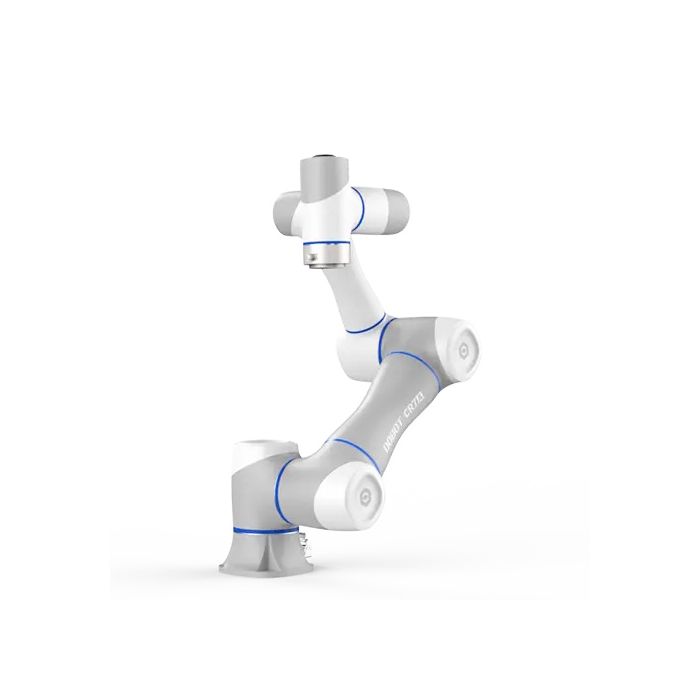
Dobot CRA Collaborative Robot (CR7A)
In stock
- BRAND:
- DOBOT
- PART #:
- 1200000188
- ORIGIN:
- China
- AVAILABILITY:
- SUBJECT TO AVAILABILITY
- SKU:
- Dobot-CR7A
Dobot CRA Collaborative Robot (CR7A)
The real test of a robot arm on a production floor is not the smooth cycle. It is the unplanned moment: a power cut mid-move, an operator stepping into the cell, a tool change that has to happen between shifts. The Dobot CRA Collaborative Robot (CR7A) is designed for those moments. When power fails, its electromagnetic brake engages within 18 ms and holds position within 1 mm. A stand-alone safety controller rated PLd Cat.3 watches over its movements. Its dual-channel end effector lets one arm work with more than one tool. Behind those details sits a working arm with a 7 kg maximum payload and an 800mm working radius, intended for picking, packing, palletising and welding.
Robots Middle East supplies the CR7A to manufacturers, system integrators, research groups and training centres across the Middle East. We prepare each quotation around your application. We then arrange delivery to your site and provide support once the robot is running. Robots Middle East is your point of contact for the specification questions that matter before purchase, from controller I/O to safety configuration.
Background
DOBOT and the CRA series
DOBOT is a robotics manufacturer whose range runs from educational and desktop arms to industrial collaborative robots and, more recently, humanoid and legged platforms. The CRA series is its line of collaborative arms for industrial work. It spans the CR3A, CR5A, CR7A, CR6AL, CR10A, CR12A, CR16A, CR16AL, CR20A and CR30A. Each model balances reach, payload and footprint differently, so a buyer can match the arm to the task rather than adapt the task to the arm. Within that line, the CR7A combines a compact working envelope with a payload suited to heavier picking and handling. You can explore the wider range in our Dobot collection.
Safety architecture and the dual-channel wrist
Collaborative robots are meant to work near people without the full guarding of a conventional industrial cell. That makes their safety design central to how they are deployed. The CRA series uses a stand-alone safety controller rated PLd Cat.3 with more than 20 safety functions. The series is certified to ISO 13849-1, ISO 10218-1 and ISO/TS 15066, the standards that integrators commonly reference when assessing collaborative applications. At the wrist, the CR7A uses what DOBOT describes as an industry-first dual-channel end effector design, which connects directly to multiple end tools. Each robot is calibrated with a laser calibration system, giving an absolute positioning accuracy of under 0.4 mm.
Technical Specifications
| Specification | Value |
|---|---|
| Maximum payload | 7 kg |
| Working radius | 800mm |
| Weight | 24.5 kg |
| Maximum linear speed | 2 m/s |
| Maximum joint speed J1 / J2 | 180° /s |
| Maximum joint speed J3 | 180° /s |
| Maximum joint speed J4 / J5 / J6 | 223° /s |
| Range of motion J1/J2/J4/J5/J6 | ±360° |
| Range of motion J3 | ±160° |
| Absolute positioning accuracy | Under 0.4 mm (laser calibrated) |
| Power consumption | 150W |
| IP rating | IP54 (robot body and control box) |
| Noise | ≤ 70 dB |
| Cable length to control box | 5m |
| Installation orientation | Any angle |
| Materials | Aluminium alloy, ABS plastic |
| End effector I/O | 2 x AI, 2 x DO, 2 x DI (multiplexed with RS485) |
| Controller digital I/O | 24 digital IO ports with PNP and NPN switching |
| Communication protocols | Modbus TCP/RTU, EtherNet/IP, PROFINET and others |
| Safety controller | Stand-alone, PLd Cat.3, 20+ safety functions |
| Certifications | ISO 13849-1, ISO 10218-1, ISO/TS 15066 |
| Power-loss brake | Electromagnetic brake engages within 18 ms; position held within 1 mm |
| Software | DobotStudio Pro; Blockly and LUA script programming |
Specifications are as published by the manufacturer and are confirmed against the datasheet at quotation.
The manufacturer has not published the dimensions of the arm base or the control box, the supply voltage, the service life or the contents of the box; we confirm these at quotation.
What happens if the CR7A loses power mid-task?
For anyone planning a cell, this question is practical. An arm that sags or drifts when power drops can damage the part it holds, the fixture beneath it or the tool at its wrist. The CR7A addresses this with an electromagnetic brake that engages within 18 ms of an unexpected outage and keeps the arm's position within 1 mm. In practice, a carton, a casting or a welding torch stays close to where it was when the supply failed. This makes recovery a matter of restarting the program, not clearing up after a collision.
The same reasoning applies to everyday operation alongside people. The stand-alone PLd Cat.3 safety controller runs separately from the motion program and provides more than 20 safety functions. The series certification to ISO 13849-1, ISO 10218-1 and ISO/TS 15066 gives integrators a recognised basis for their own risk assessment. Every installation still needs that assessment for its specific tooling and layout. The IP54 rating covers both the robot body and the control box, which matters in workshops where dust and splashes are part of the environment.
How does the CR7A fit into an existing production line?
A robot earns its place when it talks to the equipment already on the floor. The CR7A's controller offers 24 digital IO ports with support for both PNP and NPN switching. Sensors, valves and signals from existing machinery can therefore be wired in without converting logic standards. On the network side, Modbus TCP/RTU, EtherNet/IP and PROFINET come as standard, alongside other methods. This lets the arm exchange data with PLCs and line controllers from the major automation ecosystems.
At the wrist, the end effector provides two analogue inputs, two digital outputs and two digital inputs multiplexed with RS485. Together with the dual-channel design, this lets grippers, suction tools and other end tools connect directly at the tool flange rather than through cables routed down the arm. The arm installs at any angle, so floor, wall and inverted mounting are all available to the cell designer. The 5m cable to the control box gives flexibility in where the cabinet sits. Programming suits different skill levels. DobotStudio Pro offers Blockly for graphical programming, and LUA scripting lets experienced developers build more complex applications.
Who is the Dobot CRA Collaborative Robot (CR7A) for?
The CR7A suits production teams in the automotive, home appliance, logistics and metalworking industries, which DOBOT names as its target sectors. It is also a strong option for system integrators who want a single arm that covers handling, end-of-line packing and welding cells. Its broad protocol support and flexible mounting make it easier to standardise across projects. Smaller manufacturers taking their first step into automation may value the graphical Blockly environment. Technical colleges and research laboratories can use the same arm to teach both graphical and scripted programming.
The CR7A is not the only choice in the series. Where a task calls for more payload or a longer reach than the CR7A offers, the higher-payload models further up the CRA range, such as the CR10A, CR12A and CR16A, deserve consideration. For light, compact tasks, the smaller CR3A and CR5A are the natural comparison. Robots Middle East can advise on which model fits your application. Our Cobots category gathers the collaborative arms we supply.
What is the Dobot CRA Collaborative Robot (CR7A) used for?
- Heavy-duty picking: moving parts and products between conveyors, bins and fixtures within its 800mm working radius.
- Packing: placing items into cartons and trays at the end of a line, with grippers connected directly at the wrist.
- Palletising: stacking finished goods in repeatable patterns in logistics and distribution settings.
- Welding: guiding a welding tool in metalworking cells where a steady, repeatable path matters.
- Machine tending: loading and unloading equipment, with the controller's digital I/O handling signals to and from the machine.
- Training and research: teaching collaborative robotics through Blockly and LUA programming in DobotStudio Pro.
Pricing and Availability
Robots Middle East supplies the CR7A on quotation. This lets us reflect the configuration, tooling and integration support your project needs rather than a generic package. Delivery, customs and after-sales support are arranged as part of your quotation. To start the conversation, share your application, payload and cycle requirements with our team, and request your quotation using the enquiry options available on this page.
Frequently Asked Questions
What is the maximum payload of the CR7A?
The CR7A has a maximum payload of 7 kg. Any gripper or tool counts towards that figure, so it should be included when you size the application.
How far can the CR7A reach?
Its working radius is 800mm. The arm can be installed at any angle, which helps position that envelope where the work actually is.
Is the CR7A safe to work alongside people?
The CRA series uses a stand-alone PLd Cat.3 safety controller with more than 20 safety functions and is certified to ISO 13849-1, ISO 10218-1 and ISO/TS 15066. A risk assessment of each specific installation is still required.
What happens during a power outage?
The electromagnetic brake engages within 18 ms and holds the arm's position within 1 mm. This protects the equipment and the product being handled.
Which industrial protocols does the CR7A support?
It comes with Modbus TCP/RTU, EtherNet/IP and PROFINET as standard, along with other communication methods. The controller also offers 24 digital IO ports with PNP and NPN switching.
How is the CR7A programmed?
It runs DobotStudio Pro, which supports graphical Blockly programming and LUA scripting. Newcomers and experienced developers can therefore work on the same system.
Where can I buy the Dobot CRA Collaborative Robot (CR7A) and what does it cost?
You can buy the CR7A from Robots Middle East, which supplies it across the Middle East. Pricing depends on configuration and project scope, so please request a quotation and our team will respond with the details.
Summary
The value of a collaborative arm shows most clearly when something unplanned happens. The CR7A is designed for exactly that. It has a brake that holds position within 1 mm after a power loss, a certified stand-alone safety controller and an IP54 rating on both the body and the control box. On a normal day, it brings a 7 kg maximum payload, an 800mm working radius, a dual-channel wrist for multiple tools and the I/O and protocols to fit into an existing line. For picking, packing, palletising and welding projects, Robots Middle East will help you confirm the details and build a quotation, and this page is the starting point.