Dobot Dobot X-Trainer (Dobot X-Trainer)
In stock
- BRAND:
- DOBOT
- PART #:
- 8000000050
- ORIGIN:
- China
- AVAILABILITY:
- SUBJECT TO AVAILABILITY
- SKU:
- Dobot-Dobot-X-Trainer
Dobot Dobot X-Trainer (Dobot X-Trainer)
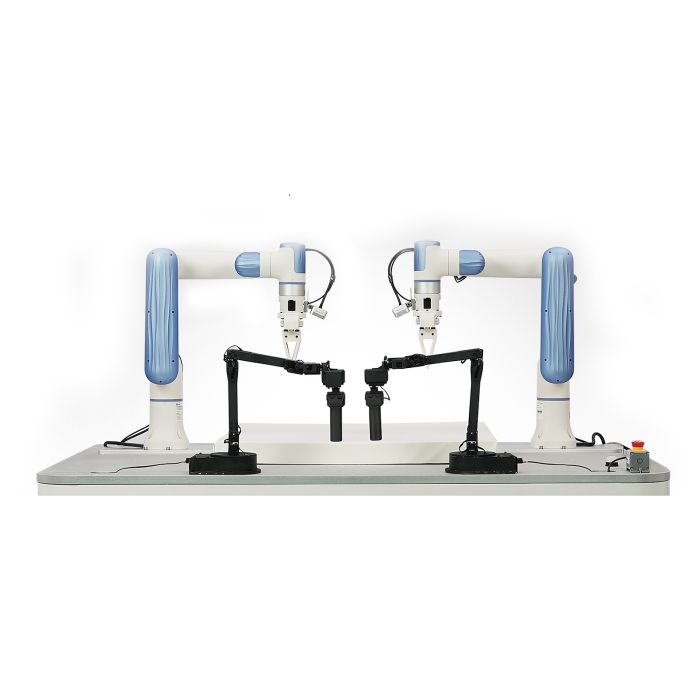
A sound engineer will tell you that a recording is only as good as the room in which it is made: the microphones, the mixing desk and the treatment on the walls decide what can be captured at all. Robot learning follows the same rule. Before any policy can be trained, a human movement has to be captured faithfully, synchronised with what the cameras saw and stored in a form a model can read, and the equipment that does the capturing sets the ceiling for everything that follows. The Dobot Dobot X-Trainer (Dobot X-Trainer) is, in that sense, a studio for motion: teleoperated master hands, Dobot Nova2 collaborative arms that follow them, cameras at the wrists and above the workspace, and software that carries a demonstration through to autonomous inference.
Robots Middle East supplies the X-Trainer to universities, research centres, national innovation programmes and corporate AI laboratories across the Middle East. Our team prepares your quotation, coordinates delivery and import formalities to your site, and remains your point of contact for technical support once the system is in use, so that it arrives as a working research instrument rather than a collection of parts to be assembled by trial and error.
Background
DOBOT and its move into embodied AI
DOBOT is a robotics manufacturer based in Shenzhen, China, which first became widely known for compact desktop robot arms used in classrooms and maker spaces, before extending into collaborative robots for commercial and industrial work. The Nova family is its lightweight cobot line, intended for close work alongside people. In April 2024, Dobot released the X-Trainer AI Data Collection and Training Robotics System to empower embodied AI agents, the branch of artificial intelligence that learns to act in the physical world rather than only to process text or images. The system now sits within a wider portfolio that also includes humanoid and legged platforms, all of which you can explore in our Dobot range.
Teleoperation as a data instrument
The X-Trainer is built on the master–follower principle. An operator moves a pair of handheld master devices; the corresponding Nova2 arms reproduce each movement in real time, while cameras record the scene and the joint positions are logged alongside the images. The result is a paired record of what the robot saw and what it did, which is precisely the material that imitation learning methods require. Dobot designed the output to suit Mobile ALOHA training, a well-known open approach to learning bimanual manipulation from demonstrations, so that captured sessions can feed established research pipelines without a conversion step. Around this core sits a complete SDK covering data collection, model training and autonomous inference, accompanied by detailed documentation that guides users systematically through the whole data processing pipeline.
Technical Specifications
| Specification | Value |
|---|---|
| Product type | AI data collection and training robotic system for AGI research and practical AI projects |
| Slave arms | Dobot Nova2 (×2), including end gripper (×2) and end camera (×2) |
| Master hands | Teleoperated Master Hand (×2) |
| Mounting platform | Removable mounting platform (×1) with global camera (×1) |
| Axes | 6-axis per arm |
| Reach | 625mm per arm; expandable to 1200mm in dual-arm mode |
| Repeat positioning accuracy | ±0.05mm |
| Payload | 2kg single-arm; 3kg dual-arm |
| Top speed | 1.6m/s |
| Motion interface | 25Hz end-to-end |
| Master hand load | Under 400g, with 3D printed monolithic joints |
| Master hand controls | Unlock button and record button |
| Collision detection (Nova2) | 5-level |
| Certification (Nova2) | ISO15066 |
| Safety functions | Auto de-sync of master-slave arms on power loss/alarms; master hand drop detection; low-speed master-slave sync |
| Workspace protection | Flexible EVA foam padding |
| Software | Complete SDK for data collection, model training and autonomous inference |
| Open APIs | Master/slave joint angles, gripper control, camera RGB/depth |
| Training data format | Suitable for Mobile ALOHA training |
| Release | April 2024 |
Specifications are as published by the manufacturer and are confirmed against the datasheet at quotation.
The manufacturer has not published the dimensions, weight, power supply, power consumption, camera resolution, gripper type and stroke, operating temperature or host computer requirements; we confirm these with you at quotation.
What makes the X-Trainer different from simply buying two cobots?
A laboratory could, in principle, acquire two collaborative arms, attach cameras and write its own teleoperation software. The difficulty lies in everything between those components. The X-Trainer arrives with the master hands, follower arms, wrist cameras, global camera and mounting platform designed as one system, and with the safety logic that a hand-built rig usually lacks. If power is lost or an alarm is raised, the master and slave arms de-synchronise automatically; if an operator drops a master hand, the system detects it; and when the arms first align, they synchronise at low speed to prevent collisions. The Nova2 arms themselves carry 5-level collision detection and ISO15066 certification for safe human-robot interaction, and the workspace is padded with flexible EVA foam to cushion an accidental drop of the end-effector and protect the gripper and arm.
The second difference is ergonomic. Demonstration quality falls as the operator tires, so Dobot kept the hand load under 400g and used 3D printed monolithic joints to reduce the number of parts. The unlock button lets the operator freeze the master hand pose and rest without disturbing the scene, while the record button places control of data capture directly under the operator's thumb, so that sessions start and stop exactly where the task does. Finally, open APIs expose master and slave joint angles, gripper control and camera RGB and depth streams, which allows a team to connect its own models instead of being confined to a closed workflow.
How quickly can the X-Trainer learn a new task?
Speed in this context has two meanings: how responsively the follower arms track the operator, and how long it takes to turn demonstrations into a working skill. On the first, the 25Hz end-to-end motion interface improves response speed by 150% compared with similar products and runs more stably, which matters because lag between hand and arm produces hesitant, unnatural demonstrations. With a top speed of 1.6m/s, the arms can also keep pace with brisk human movement. On the second, training time is shortened by 70%, with routine scenarios such as dish-washing or folding clothes completed in just 2H. Combined with ±0.05mm repeat positioning accuracy, a reach of 625mm per arm that extends to 1200mm in dual-arm mode, and payloads of 2kg single-arm and 3kg dual-arm, this gives researchers a platform that covers a broad range of tabletop manipulation without constant reconfiguration.
Who is the Dobot X-Trainer for?
The clearest fit is the university or institute laboratory working on imitation learning, bimanual manipulation or embodied AI, where the bottleneck is collecting consistent demonstration data rather than designing hardware. Corporate research and development teams exploring robotic automation of household, service or light assembly tasks will value the complete SDK and open APIs, which shorten the path from a proof of concept to a model that can be evaluated on real hardware. National AI programmes and innovation centres in the region can use the system as shared infrastructure, allowing several research groups to build datasets on a common platform. Engineering faculties and advanced training centres may also adopt it for teaching, because the documented pipeline takes students through data capture, training and inference in a single, coherent sequence.
The sources name two configurations: the DOBOT X-Trainer and the DOBOT X-Trainer (Lightweight Base). The figures above are not broken down by configuration, so the Robots Middle East team will help you choose the version that suits your laboratory space and research plan. Teams whose work extends to whole-body or mobile robotics may also wish to review the humanoid and legged platforms in the wider Dobot range.
What is the Dobot X-Trainer used for?
- Building imitation learning datasets: recording synchronised joint and camera data from human demonstrations for policy training.
- Household manipulation research: teaching routine scenarios such as dish-washing or folding clothes.
- Bimanual coordination studies: exploring how two arms share a task across the extended dual-arm workspace.
- Model evaluation and inference testing: running trained policies autonomously on the same hardware that captured the data.
- Custom AI integration: connecting in-house models through open APIs for joint angles, gripper control and RGB/depth imagery.
- Teaching embodied AI: guiding students through the full pipeline from demonstration to autonomous behaviour.
Pricing and Availability
The X-Trainer is supplied on a quotation basis, because the right configuration depends on the version you select, your laboratory space and your computing environment. Delivery, customs clearance and technical support are arranged together with your quotation. Our team will also help you plan installation so that the system is ready for research from the first session. To begin, please submit your enquiry using the quotation request available on this page.
Frequently Asked Questions
What is included with the Dobot X-Trainer?
The core components are two Teleoperated Master Hands, two Dobot Nova2 arms each with an end gripper and end camera, and a removable mounting platform with a global camera.
Which data format does the system produce?
It generates data formats suitable for Mobile ALOHA training, so captured demonstrations can feed established imitation learning pipelines.
How accurate are the follower arms?
The arms achieve ±0.05mm repeat positioning accuracy, which supports precise experimental operations and sensitive data collection tasks.
Is the system safe to operate near people?
The Nova2 arms have 5-level collision detection and ISO15066 certification, and the system adds automatic master-slave de-sync on power loss or alarms, master hand drop detection and low-speed synchronisation.
Can we use our own AI models?
Yes. Open APIs provide access to master and slave joint angles, gripper control and camera RGB and depth data for integration with custom models and research projects.
How long does it take to train a routine task?
Routine scenario training, such as dish-washing or folding clothes, can be completed in just 2H, a reduction of 70% in training time.
Where can I buy the Dobot X-Trainer and what does it cost?
You can buy it from Robots Middle East, which supplies, delivers and supports the system across the region. Pricing depends on configuration and is provided in a tailored quotation requested through this page.
Summary
Just as a recording studio shapes the music captured within it, the X-Trainer shapes the quality of the demonstrations from which a robot learns. Light master hands keep operators precise for longer, a responsive motion interface keeps the follower arms faithful, layered safety functions protect people and hardware, and a complete SDK carries each session from capture to autonomous inference in a Mobile ALOHA-ready format. For research groups across the Middle East that want to spend their time on models rather than on building rigs, Robots Middle East provides the system with delivery and support arranged in one quotation. For a laboratory ready to start capturing embodied AI data, this page is the starting point.