
Dobot LUMO L1 Humanoid Robot
In stock
- BRAND:
- DOBOT
- PART #:
- DBT-LUMO-L1
- ORIGIN:
- China
- Warranty:
- 12 MONTHS
- AVAILABILITY:
- SUBJECT TO AVAILABILITY
- SKU:
- Dobot-LUMO-L1
Dobot LUMO L1 Humanoid Robot
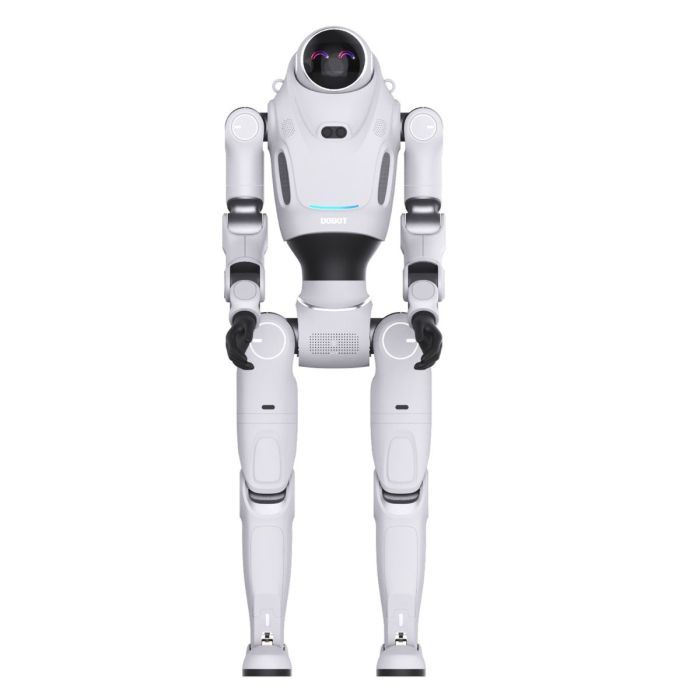
Two robots can share one skeleton and still think in entirely different ways. The Dobot LUMO L1 Humanoid Robot is offered in exactly that form: one bipedal body, 1240 mm tall with 30 degrees of freedom, carrying either a Rockchip RK3588 processor or an NVIDIA Jetson Thor T4000 module behind its expressive face. The choice between the two has little to do with how the robot looks or moves. It turns on how much reasoning the buyer expects the robot to carry out on board, whether it is there to greet guests and keep a family company, or to run the embodied AI experiments a university laboratory has in mind.
Robots Middle East supplies the LUMO L1 in both its Standard and Max configurations to households, schools, universities, research groups and businesses across the Middle East. Our team prepares each quotation, coordinates delivery and import formalities, and remains your point of contact for technical support once the robot has arrived. This helps ensure that the configuration you order matches the work you intend it to do.
Background
DOBOT and the move towards embodied intelligence
DOBOT built its reputation on robot arms for education, light industry and collaborative work. The LUMO L1 carries that experience into a complete humanoid form. Motion control, programmability and classroom use were long the company's core territory, and they remain central to this product. What changes is the scale of the challenge: a walking, gesturing humanoid has to balance, navigate and interact with people at the same time, rather than simply move a tool between two points. The LUMO L1 sits in DOBOT's humanoid range as a versatile, companion-sized platform alongside the company's larger full-size and wheeled models.
One foundation model, a face and a body
At the heart of the LUMO L1 is DobotWAM, DOBOT's self-developed Embodied AI Foundation Model. The intelligence is expressed through a bionic facial system with more than 15 expressions, which works together with head movements and body language so that the robot conveys emotion in a way people read intuitively. A 5-zone capacitive touch sensor on the head lets the robot respond to physical contact, and integrated high-precision navigation and obstacle avoidance support its human-like gait. This combination of expressive face, responsive touch and dynamic whole-body movement is what separates an embodied AI humanoid from a screen-based assistant: the robot communicates through presence as well as speech.
Technical Specifications
| Specification | DOBOT LUMO L1 Standard | DOBOT LUMO L1 Max |
|---|---|---|
| Product dimensions | 1240 mm(H) x 560 mm(W) x 244 mm(D) | 1240 mm(H) x 560 mm(W) x 244 mm(D) |
| Weight (with battery) | Approx. 40.5 kg | Approx. 41 kg |
| Total degrees of freedom | 30 | 30 |
| Operating time | Approx. 2 h (typical motion conditions) | Approx. 2 h (typical motion conditions) |
| Joint maximum torque | 130Nm | 130Nm |
| Single arm payload (without gripper) | 1.5kg | 1.5kg |
| AI computing | Rockchip RK3588, 6 TOPS | NVIDIA Jetson Thor T4000; 1,200 TFLOPS (FP4) |
| Communication | Wi-Fi 6 (Support STA/AP), BLE 5.2 | Wi-Fi 6 (Support STA/AP), BLE 5.2 |
| Head touch sensor | 5-zone capacitive touch sensor | 5-zone capacitive touch sensor |
| Facial expressions | Bionic facial system, 15+ expressions | Bionic facial system, 15+ expressions |
| Remote controller | 1 included | 1 included |
| Battery | 1, packed separately | 1, packed separately |
Specifications are as published by the manufacturer and are confirmed against the datasheet at quotation.
The manufacturer has not published the walking speed, battery capacity, charging time, ingress protection rating, operating temperature range or speaker and microphone specifications; Robots Middle East confirms these details at quotation.
What does the LUMO L1 Max add over the Standard?
The two versions share the same frame, the same 30 degrees of freedom, the same 130Nm joint maximum torque and the same 1.5kg single arm payload without gripper. They also have the same operating time under typical motion conditions. In terms of movement, therefore, a Standard and a Max perform alike: both walk naturally, both perform complex dance routines, kicks, flips and martial arts-inspired movements, and both express themselves through the same bionic face.
The difference lies in the computer. The Standard runs on a Rockchip RK3588 rated at 6 TOPS, an efficient processor well suited to running the robot's built-in behaviours, interaction and navigation. The Max carries an NVIDIA Jetson Thor T4000 rated at 1,200 TFLOPS (FP4), a module designed for demanding on-device AI workloads. As the table shows, the more powerful computer adds only a modest difference in weight. For buyers who will use the robot largely as DOBOT ships it, the Standard covers the brief. For those who intend to train, deploy and test their own models directly on the robot, the Max provides far greater headroom for that work.
Can the Dobot LUMO L1 be programmed for research and teaching?
Yes. The LUMO L1 supports secondary development, which opens the platform to hands-on work in robotics, motion control, embodied AI algorithms, SLAM navigation, visual perception and human-robot interaction. In a teaching context, this means a single robot can serve a whole syllabus: students can begin with motion and balance, progress to mapping and localisation, and finish with perception and interaction projects, all without changing hardware.
Wi-Fi 6, with support for both station and access-point modes, and BLE 5.2 give developers flexible ways to connect the robot to a laboratory network or to work with it directly. The included remote controller remains useful during development, when manual control of a bipedal robot is often the safest way to reposition it between tests. As with any dynamic humanoid, routines such as flips and kicks are best developed in a clear space under supervision.
Who is the Dobot LUMO L1 Humanoid Robot for?
Families looking for an interactive companion will find that the Standard's expressive face, touch response and movement repertoire suit everyday life at home. Browsing our Companion Robots range places it alongside other machines designed for the household. Schools and STEM centres that want a humanoid students can programme will also generally be well served by the Standard, because the curriculum topics supported by secondary development do not depend on the larger computing module.
Universities, research groups and corporate AI teams are a different matter. Where the aim is to run embodied AI algorithms, perception models or advanced navigation experiments on the robot itself, the Max, with its NVIDIA Jetson Thor T4000, is the better match. Businesses deploying the robot in receptions, showrooms or events can choose either version: the Standard where the robot will perform the behaviours it ships with, the Max where a bespoke interactive experience is to be developed. Buyers comparing several walking humanoids can view the wider Bipedal Humanoids category.
What is the Dobot LUMO L1 Humanoid Robot used for?
- Home companionship: conversation, play and emotional interaction with family members through facial expressions and body language.
- STEM education: a programmable humanoid that brings robotics and motion control lessons to life in the classroom.
- Embodied AI research: a platform for developing and testing embodied AI algorithms, particularly in the Max configuration.
- Navigation and perception studies: hands-on work with SLAM navigation and visual perception on a walking robot.
- Commercial service: welcoming and engaging visitors in receptions, showrooms and customer-facing spaces.
- Exhibitions and performances: dance routines and dynamic movements that draw attention at events and trade shows.
Pricing and Availability
Robots Middle East supplies the Dobot LUMO L1 on a quotation basis, so that each offer reflects the version you need, either Standard or Max, and the way you plan to use it. Delivery, customs and support are arranged with your quotation. Tell us whether the robot is intended for a home, a classroom, a laboratory or a commercial venue, and we will tailor the offer to that setting. A quotation for the Dobot LUMO L1 Humanoid Robot can be requested at any time and is available on this page.
Frequently Asked Questions
How many degrees of freedom does the Dobot LUMO L1 have?
The LUMO L1 has 30 degrees of freedom across its entire body, in both the Standard and Max versions. This allows natural walking, dance routines, kicks, flips and martial arts-inspired movements.
How long does the robot operate on one battery?
The operating time is approx. 2 h under typical motion conditions, for both the Standard and the Max.
What is the difference between the Standard and the Max?
Both share the same body, motion capabilities and arm payload. The Standard uses a Rockchip RK3588 rated at 6 TOPS, while the Max uses an NVIDIA Jetson Thor T4000 rated at 1,200 TFLOPS (FP4) for demanding on-device AI.
Can I develop my own software for the LUMO L1?
Yes. The robot supports secondary development for robotics, motion control, embodied AI algorithms, SLAM navigation, visual perception and human-robot interaction.
What is included with the robot?
The packing list includes one remote controller and one battery, which is packed separately.
How does the Dobot LUMO L1 connect to other devices?
Both versions communicate over Wi-Fi 6, with support for station and access-point modes, and over BLE 5.2. This lets the robot join a local network or connect directly to a device during development.
Where can I buy the Dobot LUMO L1 Humanoid Robot and what does it cost?
You can buy it from Robots Middle East, which supplies, delivers and supports the robot across the Middle East. The cost depends on the version and requirements, and it is set out in a personal quotation that you can request on this page.
Summary
The Dobot LUMO L1 Humanoid Robot offers one expressive, agile body with a choice of two very different processors. Its 30 degrees of freedom, bionic face, touch-sensitive head and DobotWAM foundation model are common to both versions, so the decision comes down to how much computing the work requires. The Standard suits companionship, teaching and service roles that rely on the robot's built-in abilities. The Max suits research teams that intend to push their own embodied AI onto the robot itself. Robots Middle East will help you weigh that choice and arrange delivery and support across the region; for anyone considering this humanoid, this page is the starting point.