
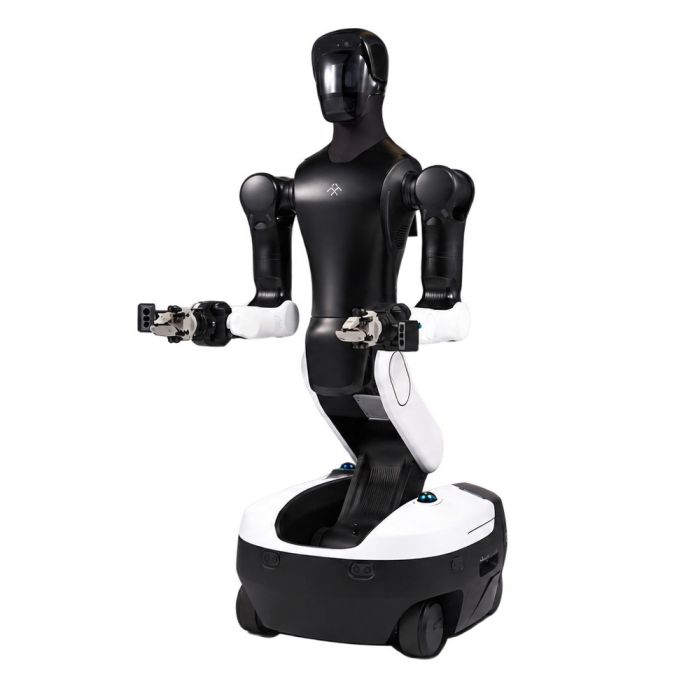
FF Faber U Industrial EAI Mobile Manipulator
In stock
- BRAND:
- FARADAY FUTURE
- ORIGIN:
- United States
- Warranty:
- 12 MONTHS
- AVAILABILITY:
- ALLOW 2-4 WEEKS FOR DELIVERY
- SKU:
- FF-Faber-U
FF Faber U Industrial EAI Mobile Manipulator
Two arms are only as useful as the picture of the world that guides them. A mobile manipulator that cannot tell a tote from its shadow, or a shelf edge from a person stepping into the aisle, will move cautiously, slowly or not at all. On a busy loading floor, hesitation costs nearly as much as error. The FF Faber U Industrial EAI Mobile Manipulator tackles that problem from the sensing side first. It is the most advanced configuration in Faraday Future's Faber series. It pairs the Thor high-performance AI compute platform with dual LiDAR and a multi-camera sensing system, and it carries the series' mobile, dual-arm body into industrial loading, unloading and logistics transfer.
Robots Middle East supplies the FF Faber U to industrial, logistics and research organisations across the Middle East. Our team prepares each quotation and coordinates delivery to your site. We also provide support once the machine is in service. We will work with you on the configuration that suits your operation, including the exclusive customisation that the Faber series supports.
Background
Faraday Future and its Physical AI ambitions
Faraday Future (FF) was founded in 2014. It describes itself as a U.S.-based Physical AI ecosystem company, dedicated to reshaping the future of robotics and mobility solutions through AI innovation and technologies. The Faber series is the company's industrial expression of that aim. FF presents it as the first industrial-grade embodied AI (EAI) mobile manipulator series in the U.S. ready for commercial sales and delivery. The name was chosen with care: Faber comes from Latin and means "skilled craftsman". That is a fitting label for a machine meant to carry out practical, hands-on work rather than simply move goods from one point to another.
Where the Faber U sits in the series
The Faber series comprises three sub-models. The Faber U is the most advanced, distinguished by Thor AI compute and multi-sensor fusion. The FF Faber T Industrial EAI Mobile Manipulator is positioned for deployment at scale in power inspection and data centres. The FF Faber S Industrial EAI Mobile Manipulator Wheeled Humanoid Robot offers the largest arm span in the family, together with a full embodied-AI data collection toolchain. All three share a common idea. Faraday Future states that Faber breaks the boundary of traditional fixed robotic arms and AMRs by combining three things: the high precision of fixed robotic arms, the autonomous mobility of AMRs, and the coordinated, flexible operating capabilities of humanoid robots. Within that family, the Faber U is the model in which perception and onboard intelligence receive the greatest emphasis.
Technical Specifications
| Specification | Value | Published for |
|---|---|---|
| Configuration level | Most advanced configuration in the Faber series | Faber U |
| AI compute | Thor high-performance AI compute platform | Faber U |
| Sensing | Dual LiDAR and a multi-camera sensing system | Faber U |
| Arms | Dual 7-axis arms | Faber series |
| Degrees of freedom | 26–35 DOF | Faber series |
| Software platform | Open Ubuntu/ROS platform | Faber series |
| Single-arm lift | Up to 11 pounds | Faber series |
| Operating range | Ground level to about 6.6 feet high | Faber series |
| Force-control precision | Better than 0.5 newtons | Faber series |
| Mobility | Autonomous navigation and omnidirectional mobility | Faber series |
| Customisation | Fully supports exclusive customisation | Faber series |
Specifications are as published by the manufacturer and are confirmed against the datasheet at quotation.
The manufacturer has not yet published the weight, dimensions, battery capacity, runtime, Faber U payload, top speed, ingress protection rating, connectivity, charging method or box contents; each of these is confirmed at quotation.
What does the Faber U add to the Faber series?
Every Faber shares the same working body: dual 7-axis arms, autonomous navigation, omnidirectional mobility and an open Ubuntu/ROS software base. What separates the sub-models is where each one places its emphasis. The Faber T is positioned for repeatable deployment at scale in power inspection and data centres. The Faber S stretches physical reach with the largest arm span and adds a full data collection toolchain for embodied AI. The Faber U concentrates on the machine's understanding of its surroundings.
That understanding rests on three published elements: the Thor high-performance AI compute platform, dual LiDAR and a multi-camera sensing system. Faraday Future describes the combination as multi-sensor fusion. In practical terms, LiDAR and cameras complement one another in this class of robot. LiDAR is generally used for spatial mapping and obstacle detection, while cameras support object recognition and fine positioning. Merging both on a capable onboard processor is how a mobile manipulator decides where to drive, where to stop and how to approach an object with its arms. For an operator, that emphasis matters most where the environment is untidy and changeable: mixed loads, shared aisles, varied containers and workstations that are rearranged from week to week.
How does a mobile manipulator differ from a fixed arm or an AMR?
A fixed industrial arm is precise, but the work must be brought to it. An autonomous mobile robot (AMR) can travel across a facility, yet it usually relies on people or separate equipment to load and unload it. A mobile manipulator places arms on a mobile base, so a single machine can travel to a task and then carry it out. Faraday Future frames the Faber series in exactly these terms, adding the coordinated, flexible handling usually associated with humanoid robots.
The published figures show how the series approaches that handling. Each arm can lift up to 11 pounds on its own. Both arms can also work together on transport, assembly and delicate operations that would be difficult for one arm alone. The working envelope runs from ground level to about 6.6 feet high, which spans floor-level containers through to upper shelving. Force-control precision is better than 0.5 newtons, which is relevant wherever parts must be seated, inserted or handled without damage. The Faber U brings these series capabilities together with its own compute and sensing package.
Who is the FF Faber U for?
The first audience is industrial and logistics operators. Loading, unloading and logistics transfer are the series' stated primary focus, and the Faber U's sensing suite suits sites where the robot must work among changing loads and people. Manufacturers running light industrial production are a second group: the series' coordinated dual-arm handling and fine force control support intelligent production tasks on the shop floor.
System integrators and in-house automation teams form a third segment. The open Ubuntu/ROS platform allows them to build on familiar tooling, and the series' support for exclusive customisation lets a deployment be shaped around a specific process. Universities and research laboratories will find a capable platform for work on perception, manipulation and embodied AI. Further options are collected in our Research Robots category.
Some buyers will be better served by a sibling. Organisations planning large fleets for power inspection or data centres should look closely at the FF Faber T, which Faraday Future positions for that kind of deployment at scale. Teams whose priority is maximum reach, or the collection of training data for embodied AI, should consider the FF Faber S. Buyers who want a full humanoid form rather than a mobile manipulator can browse our Humanoids range.
What is the FF Faber U used for?
- Industrial loading and unloading: moving goods on and off racks, carts and workstations without a dedicated fixed cell.
- Logistics transfer: carrying items between points in a facility and handling them at both ends of the journey.
- Sorting: picking and placing items by destination, using its multi-camera sensing to identify them.
- Indoor inspection: patrolling plant rooms and facilities, guided by dual LiDAR and autonomous navigation.
- Retail, reception and guided services: supporting supermarket operations and greeting or guiding visitors in public-facing spaces.
- Research, education and light industrial production: serving as an open Ubuntu/ROS platform for laboratories, and as a coordinated dual-arm worker in light industrial settings.
Pricing and Availability
Robots Middle East supplies the FF Faber U on a quotation basis. This allows each offer to reflect your configuration, any customisation and the needs of your site. Delivery, customs clearance and after-sales support are all arranged together with the quotation. To begin, please share your intended application and environment with our team. A quotation request for the FF Faber U is available on this page.
Frequently Asked Questions
What AI compute does the FF Faber U use?
The Faber U is equipped with the Thor high-performance AI compute platform. It works alongside dual LiDAR and a multi-camera sensing system.
How many arms and degrees of freedom does the Faber series have?
The Faber series uses dual 7-axis arms and spans 26–35 DOF across the series. The figure for your configuration is confirmed when Robots Middle East prepares the quotation.
Can we develop our own software for the Faber U?
Yes. The Faber series is built on an open Ubuntu/ROS platform, which allows integrators and research teams to work with established robotics tooling.
How high can the Faber series reach?
The series' operating range extends from ground level to about 6.6 feet high. This covers both floor-level and upper-shelf work.
Can the Faber U be customised for our process?
Faraday Future states that the Faber series fully supports exclusive customisation. Robots Middle East can discuss your requirements as part of the quotation.
Should we choose the Faber U or the Faber T for inspection work?
The Faber U supports indoor inspection and offers the series' most advanced sensing. For large-scale power inspection or data centre deployments, the Faber T is the model Faraday Future positions for that role.
Where can I buy the FF Faber U and what does it cost?
Robots Middle East supplies the FF Faber U across the Middle East. The cost is provided by quotation, once your configuration, delivery and support requirements have been reviewed.
Summary
A pair of arms on a mobile base is only half the story; the other half is how well the machine sees and reasons about the space it works in. The FF Faber U is the Faber configuration built around that second half. It combines Thor high-performance AI compute, dual LiDAR and a multi-camera sensing system with the series' dual 7-axis arms, omnidirectional mobility and open Ubuntu/ROS platform. It is aimed first at loading, unloading and logistics transfer, and it extends to sorting, inspection, retail, research and light industrial production. Robots Middle East quotes, delivers and supports it across the region. For organisations that need a robot able to perceive the task as well as reach it, this page is the starting point.