
FF Master Ultra Humanoid Robot
In stock
- BRAND:
- FARADAY FUTURE
- ORIGIN:
- United States
- Warranty:
- 12 MONTHS
- AVAILABILITY:
- SUBJECT TO AVAILABILITY
- SKU:
- FF-Master-Ultra
FF Master Ultra Humanoid Robot
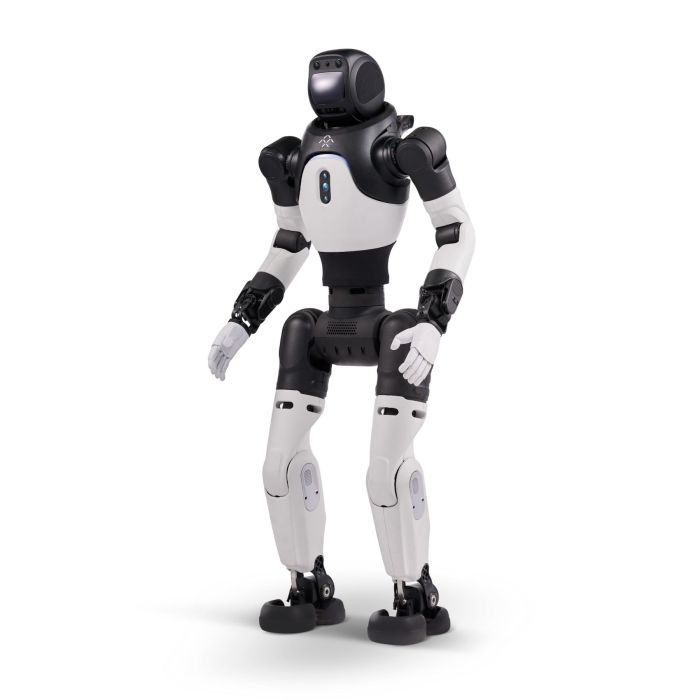
Every humanoid robot must settle one question before it takes a single step: where does its thinking actually happen? Some machines send each decision to a server down the corridor; others carry a modest processor and depend on the task staying simple. The FF Master Ultra Humanoid Robot takes a third route. It places an NVIDIA Orin NX 16GB module rated at 157 TOPS inside a body 1.31 m tall, and it keeps a 4G/5G link open for the moments when a human operator needs to step in. The result is a compact humanoid that can interpret its surroundings with its own resources, yet can still be guided by a person wearing a VR headset when a task calls for human judgement rather than an algorithm.
Robots Middle East supplies the FF Master Ultra Humanoid Robot to universities, research institutes, innovation centres and corporate laboratories across the Middle East. Our team prepares each quotation, coordinates delivery to your site and remains your point of contact for support once the robot is in service, so that your organisation deals with a single, regionally based partner from the first enquiry onwards.
Background
Faraday Future and its move into robotics
Faraday Future is best known to many readers as an electric vehicle company, and its entry into robotics follows a path that several automotive firms have taken: the disciplines behind a modern vehicle, namely sensor fusion, embedded computing, power electronics and connected software, transfer naturally to machines that must move safely among people. The company now presents a family of robots that ranges from compact humanoids such as the Master series to the larger FF Futurist and the Faber line of industrial mobile manipulators. Within that family, the Master series addresses buyers who want a humanoid form factor at a scale suited to classrooms, laboratories and public spaces.
Where the Ultra sits in the Master line
The sources name three versions of the platform: the FF Master, the Master Edu and the Master Ultra. This article concerns the Ultra alone, and every figure quoted here belongs to that version. Its defining characteristics are a dedicated AI computing module, a layered set of cameras combined with 3D LiDAR, cellular connectivity and support for VR remote manipulation. Taken together, these place the Ultra as the version intended for work in which perception, on-board processing and remote human involvement all matter at once.
Technical Specifications
| Specification | Value |
|---|---|
| Height | 1.31 m |
| Weight | 39 kg |
| Degrees of freedom | 30 DOF |
| Peak torque | 120 N·m |
| Maximum speed | 1.8 m/s |
| AI compute | NVIDIA Orin NX 16GB (157 TOPS) |
| Connectivity | 4G/5G |
| Remote operation | VR remote manipulation supported |
| Cameras and LiDAR | 3D LiDAR, interactive RGB camera, dual front RGB cameras, rear RGB camera, RGB-D camera |
Specifications are given as published by the manufacturer and are confirmed against the datasheet at quotation.
Faraday Future has not published the payload, battery capacity, runtime, IP rating, overall dimensions beyond height, operating temperature, charging time, Wi-Fi and Bluetooth provision or box contents for the Ultra, and each of these is confirmed at quotation.
What does on-board Orin NX computing mean for the FF Master Ultra?
A humanoid robot generates a constant stream of data: images from several cameras, depth information, a LiDAR point cloud and the positions of thirty joints. Handling that stream locally, rather than shipping it elsewhere for processing, shortens the delay between seeing and acting, and it allows the robot to keep functioning when a network connection is weak or unavailable. The NVIDIA Orin NX 16GB module in the Ultra, rated at 157 TOPS, belongs to a class of embedded processors widely used in robotics for exactly this purpose: running neural networks for detection, segmentation and tracking on the machine itself.
For research teams, this matters in a practical way. Models trained in the laboratory can be deployed to the robot and tested in real conditions without rebuilding the computing architecture around a tethered workstation. The Orin family is also familiar to many robotics developers, which tends to shorten the learning curve for students and engineers who already work in that ecosystem. At the same time, the 4G/5G connection means the robot need not operate in isolation: it can exchange data with remote systems, report its state and accept instructions from a distant operator. The Ultra therefore combines local intelligence with remote reach, rather than forcing a choice between the two.
How does the FF Master Ultra perceive and act in its surroundings?
Perception on the Ultra is built in layers. The 3D LiDAR provides a geometric picture of the space around the robot, the kind of data typically used for mapping, localisation and obstacle awareness. The dual front RGB cameras look ahead, the rear RGB camera covers what lies behind, and the RGB-D camera adds depth to colour imagery, which is valuable when the robot must judge the distance to an object or a person. A separate interactive RGB camera is dedicated to engagement with the people in front of it. This combination gives developers several independent views of the same scene, an arrangement that supports sensor-fusion research and makes perception more robust than reliance on any single sensor.
On the motion side, the Ultra offers 30 DOF, a peak torque of 120 N·m and a maximum speed of 1.8 m/s. Thirty degrees of freedom give a humanoid enough articulation for expressive gestures, balance control and whole-body motion studies, while the published peak torque and speed describe the dynamic envelope within which control algorithms can be tested. When autonomous behaviour is not yet mature enough for a task, VR remote manipulation allows an operator to guide the robot directly, an approach widely used both to perform delicate work and to collect demonstration data for training learning-based controllers.
Who is the FF Master Ultra for?
The first group is university research laboratories working in embodied AI, humanoid locomotion, human–robot interaction and teleoperation. For them, the combination of on-board computing, multiple sensing modalities and VR remote manipulation offers a single platform on which perception, control and learning can all be studied. A compact humanoid also fits more readily into ordinary laboratory spaces than a full-size machine.
The second group comprises corporate innovation centres and technology demonstrators that wish to show connected robotics in action. The cellular link and remote operation support make it possible to present scenarios in which a robot in one city is guided from another, a compelling demonstration of what networked robotics can achieve.
The third group includes institutions that run robotics competitions, training programmes and advanced teaching. Where the emphasis is chiefly on teaching rather than on the full perception and computing package described here, buyers may wish to compare the Ultra with the FF Master Edu Humanoid Robot, a sibling version in the same family whose specification is quoted separately. Those still surveying the field can browse our wider range of humanoids before narrowing their choice.
What is the FF Master Ultra used for?
- Embodied AI research — developing and testing perception and decision models on a humanoid body with its own processing.
- Teleoperation studies — exploring how operators guide a humanoid through VR remote manipulation over a cellular link.
- Demonstration data collection — recording operator-guided motion to train learning-based controllers.
- Sensor-fusion development — combining LiDAR, RGB and RGB-D data into a coherent model of the scene.
- Human–robot interaction — studying how people respond to a compact humanoid in shared spaces.
- Advanced teaching and competitions — giving students a realistic humanoid platform for projects and contests.
Pricing and Availability
The FF Master Ultra Humanoid Robot is supplied on quotation, which allows Robots Middle East to match the offer to your project, your site and the configuration you require. Delivery, customs clearance and after-sales support are arranged together with the quotation. Any specification that Faraday Future has not yet published is confirmed at that stage, so that your decision rests on verified information. To begin, please submit your requirements through the quotation request available on this page.
Frequently Asked Questions
How tall is the FF Master Ultra and how much does it weigh?
The FF Master Ultra stands 1.31 m tall and weighs 39 kg. This compact scale suits laboratories, classrooms and public spaces designed around people.
Which processor does the FF Master Ultra use?
It is powered by an NVIDIA Orin NX 16GB module rated at 157 TOPS. This allows perception and AI workloads to run on the robot itself.
Can the FF Master Ultra be operated remotely?
Yes. The Ultra supports VR remote manipulation and offers 4G/5G connectivity, so an operator can guide the robot from a distance.
Which sensors does the FF Master Ultra carry?
It is equipped with a 3D LiDAR, an interactive RGB camera, dual front RGB cameras, a rear RGB camera and an RGB-D camera. Together these provide geometric, colour and depth information about its surroundings.
How many degrees of freedom does it have?
The Ultra has 30 DOF, and its published peak torque is 120 N·m. This articulation supports whole-body motion, balance and gesture research.
How fast can the FF Master Ultra move?
Its maximum speed is 1.8 m/s. Robots Middle East can discuss with you how this relates to your intended environment and application.
Where can I buy the FF Master Ultra and what does it cost?
The FF Master Ultra Humanoid Robot is available from Robots Middle East, which supplies it across the Middle East. Pricing is provided by quotation, prepared to reflect your configuration, delivery and support requirements.
Summary
The question of where a robot's thinking happens shapes everything it can do, and the FF Master Ultra answers it with unusual balance. Its NVIDIA Orin NX 16GB module handles perception on board, its LiDAR and camera array give it several independent views of the world, and its 4G/5G link with VR remote manipulation keeps a human within reach whenever autonomy is not enough. At 1.31 m and 39 kg, with 30 DOF, it brings these capabilities to a scale that fits real laboratories and public spaces. For research groups, innovation centres and advanced teaching programmes in the region that need local intelligence and remote control in one humanoid, a quotation from Robots Middle East on this page is the starting point.