
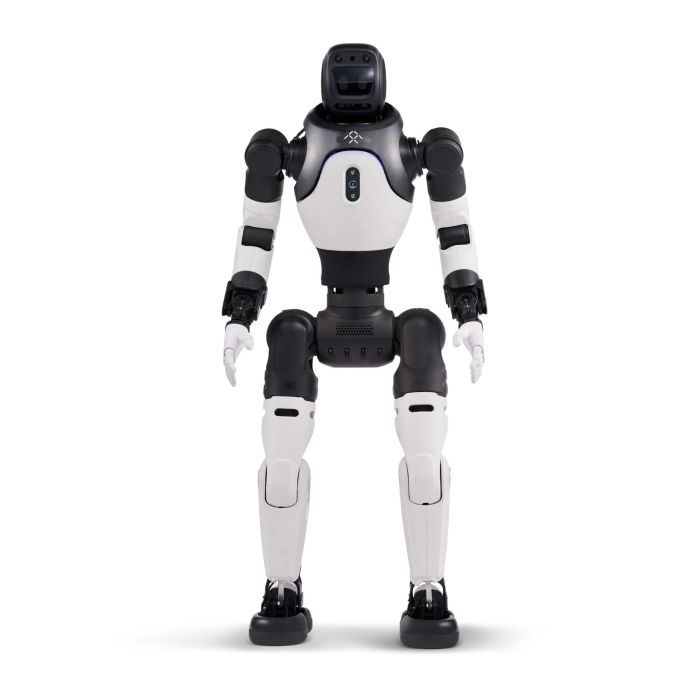
FF Master Edu Humanoid Robot
In stock
- BRAND:
- FARADAY FUTURE
- ORIGIN:
- United States
- Warranty:
- 12 MONTHS
- AVAILABILITY:
- USUALLY SHIPS IN 3-5 BUSINESS DAYS
- SKU:
- FF-Master-Edu
FF Master Edu Humanoid Robot
In education, the robot that proves its worth is rarely the one with the most impressive demonstration. It is the one still working when the third group of students arrives after lunch. A humanoid that spends half the day on a charger teaches very little, however capable it may be. The FF Master Edu Humanoid Robot from Faraday Future is built for that practical reality. It is a compact humanoid robot designed for education, research and interactive development, and it runs on a swappable battery, so a session can continue while a spent pack recharges. It is a machine meant to be used across a full timetable, not admired on a plinth.
Robots Middle East supplies the FF Master Edu to universities, schools, research centres and innovation laboratories across the Middle East. Our team prepares your quotation, arranges delivery to your site and provides support once the robot is in use. Your department therefore deals with a single regional partner from the first enquiry to the robot's first lesson, and well beyond it.
Background
Faraday Future and its move into embodied AI
Faraday Future is best known as an electric vehicle company, and its robotics work carries the same ambition into embodied artificial intelligence, the field in which software intelligence is given a physical body that moves, senses and acts in the real world. Its current range runs from compact humanoids to full-size humanoid platforms and wheeled industrial mobile manipulators. The FF Master family occupies the compact end of the humanoid line, and the sources name two versions: the Master and the Master Edu. You can see the wider family in our Humanoids category.
Two software platforms on one body
What sets the Master Edu apart as a teaching and research tool is the way its capabilities are organised. The robot supports the II Platform for intelligent and interactive capabilities, and the LM Platform for locomotion and manipulation. In practice, this separates two of the main questions in humanoid robotics: how a robot understands and responds to people, and how it moves its body and handles objects. A course or a research group can concentrate on one side, or combine both. Over-the-air (OTA) updates add new features over time, so the robot a department receives is not fixed at the capabilities it has on the day of delivery.
Technical Specifications
| Specification | Value (Master Edu) |
|---|---|
| Product type | Compact humanoid robot for education, research and interactive development |
| Height | 1.31 m |
| Weight | 35 kg |
| Degrees of freedom | 25 |
| Peak torque | Up to 120 Nm |
| Maximum speed | 1.8 m/s |
| Battery | Swappable, 500 Wh |
| Continuous operation | Up to 2 hours |
| Charging time | Under 1.5 hours to full charge |
| Software platforms | II Platform (intelligent and interactive); LM Platform (locomotion and manipulation) |
| Software updates | OTA updates adding new features over time |
Specifications are as published by the manufacturer and are confirmed against the datasheet at quotation.
The manufacturer has not published the IP rating, the onboard compute, the operating system or the colour of the Master Edu; we confirm these with you at quotation.
How does the FF Master Edu keep a teaching day running?
A school timetable or a laboratory schedule is unforgiving. Lessons start on time, practical slots are booked in advance, and a robot that runs out of power halfway through a session wastes the effort of everyone in the room. The Master Edu addresses this with a swappable 500 Wh battery that provides up to 2 hours of continuous operation. Because the battery can be exchanged, a department can keep a charged pack ready and change it between sessions rather than parking the robot.
Recharging is equally relevant. A depleted battery is fully charged in under 1.5 hours, which means a pack taken out at the end of one session can be ready again before the robot needs it once more. With two batteries in rotation, the robot can support a sequence of classes or a long experimental day with far less downtime. For a teaching team, this turns the humanoid from an occasional showpiece into equipment that can be written into the curriculum.
The physical scale matters as well. At 1.31 m tall and 35 kg, the Master Edu is compact by humanoid standards: large enough to behave like a genuine walking robot, small enough to work in an ordinary laboratory or classroom without dedicated infrastructure.
What can students and researchers build on the II and LM Platforms?
The two platforms map neatly onto the topics that robotics programmes tend to teach. The LM Platform covers locomotion and manipulation, and the hardware gives it real material to work with: 25 degrees of freedom for versatile movement and precise control, peak torque of up to 120 Nm and a maximum speed of 1.8 m/s. Those characteristics make the robot a capable platform for exploring gait, balance, whole-body motion and handling tasks, which are the core of most humanoid research.
The II Platform addresses the other half of the picture: intelligent and interactive capabilities. This is where students explore how a robot engages with the people around it, a subject that has become central to human-robot interaction, social robotics and applied AI courses. Projects can move from simple interactive behaviours towards more ambitious work as learners progress.
Because OTA updates add features over time, the platform can grow alongside a programme. A course designed in its first year can be extended in later years as new capabilities arrive, without replacing the hardware the department has already invested in.
Who is the FF Master Edu for?
The clearest fit is the university engineering or computer science department that wants students to work on a real humanoid rather than a simulation alone. The combination of locomotion, manipulation and interaction on one body supports undergraduate practicals, final-year projects and postgraduate study on the same machine.
Research laboratories form the second group. Teams studying legged locomotion, control or embodied AI need a platform they can run repeatedly over a working day, and the swappable battery and short charging time suit that pattern of use.
Secondary schools, colleges and STEM centres are the third. A compact humanoid gives younger learners a tangible focus for programming and engineering, and the interactive side of the robot makes it effective for engaging audiences who are new to robotics.
Innovation centres, technology showrooms and corporate training teams can also use the Master Edu for interactive development and demonstrations, where reliable operation through a long day is essential.
If your work calls for a different scale, the FF Futurist Full-Size Humanoid Robot and the FF Master Mini Humanoid Robot are worth comparing. The Robots Middle East team will gladly advise which model best suits your programme.
What is the FF Master Edu used for?
- Robotics teaching: hands-on practicals in which students programme a real humanoid robot.
- Locomotion research: studying walking, balance and whole-body movement through the LM Platform.
- Manipulation studies: developing and testing how a humanoid reaches for and handles objects.
- Human-robot interaction: building interactive behaviours on the II Platform for social and service scenarios.
- Embodied AI development: connecting AI models to a physical body that moves and responds in the real world.
- Outreach and demonstration: engaging visitors, prospective students and partners at events and in innovation spaces.
Pricing and Availability
Robots Middle East supplies the FF Master Edu on a quotation basis, so that each offer reflects your configuration, your site and the way your institution intends to use the robot. Delivery, customs clearance and after-sales support are arranged together with your quotation. Our team is also happy to discuss spare batteries, training and integration into your existing teaching or research programme. To begin, please use the quotation request available on this page.
Frequently Asked Questions
What kind of robot is the FF Master Edu?
It is a compact humanoid robot from Faraday Future, designed for education, research and interactive development.
How large is the FF Master Edu?
The robot stands 1.31 m tall and weighs 35 kg, a compact size that suits classrooms and laboratories.
How long does the battery last?
The swappable 500 Wh battery provides up to 2 hours of continuous operation. Because it can be exchanged, a charged spare keeps the robot working between sessions.
How quickly does the battery recharge?
A depleted battery is fully charged in under 1.5 hours, which helps reduce downtime during development and teaching.
What software platforms does the robot support?
The Master Edu supports the II Platform for intelligent and interactive capabilities and the LM Platform for locomotion and manipulation. OTA updates add new features over time.
Has the manufacturer published an IP rating or details of the onboard computer?
Not at present. The IP rating, onboard compute, operating system and colour are confirmed at quotation.
Where can I buy the FF Master Edu Humanoid Robot and what does it cost?
You can obtain it from Robots Middle East, which supplies institutions across the Middle East. The cost depends on your configuration and delivery requirements, so please request a quotation and our team will prepare an offer for you.
Summary
A humanoid robot earns its place in education by being available when the lesson begins, not merely by being impressive when it is switched on. The FF Master Edu combines a compact 1.31 m body, 25 degrees of freedom and two distinct software platforms for interaction, locomotion and manipulation with a power system designed around the working day: a swappable battery, up to 2 hours of operation per pack and charging in under 1.5 hours. OTA updates allow it to grow with a programme over the years. Supplied, delivered and supported by Robots Middle East, it is a practical way to bring real humanoid robotics into a timetable. For a quotation tailored to your institution, this page is the starting point.