
Fourier ArmMotus EMU 3D Upper Limb Rehabilitation Robot
In stock
- BRAND:
- FOURIER
- PART #:
- ArmMotus EMU
- ORIGIN:
- China
- Warranty:
- 12 MONTHS
- AVAILABILITY:
- SUBJECT TO AVAILABILITY
- SKU:
- Fourier-ArmMotus-EMU
Fourier ArmMotus EMU 3D Upper Limb Rehabilitation Robot
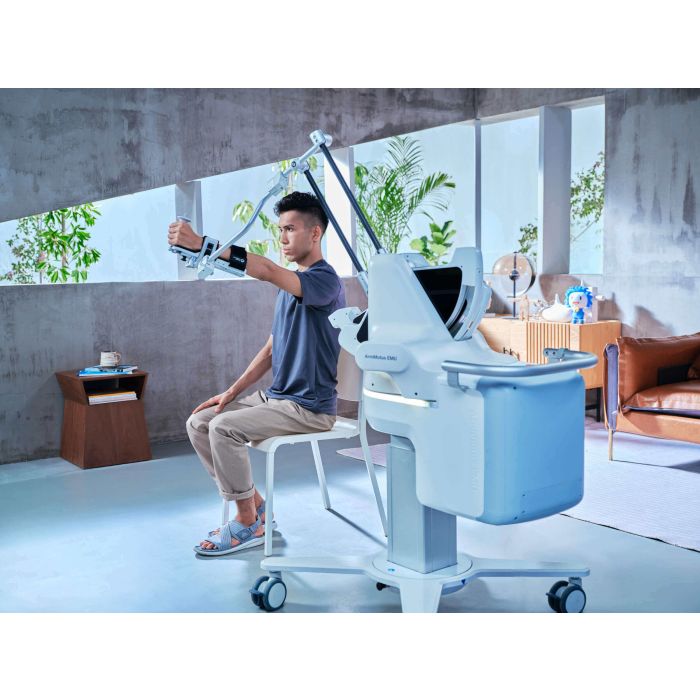
Reaching for a glass of water looks effortless until it has to be learnt again. The arm travels forward, lifts, rotates at the wrist and slows as the fingers close: a path through open space rather than along a fixed rail. The Fourier ArmMotus EMU 3D Upper Limb Rehabilitation Robot is designed around that kind of movement. It is a back-drivable device that follows the patient's arm in three dimensions, adds assistance or resistance where the therapist decides, and records what the arm actually did. Its purpose is not to stand in for the clinician but to carry the clinician's judgement into every repetition of a session.
Robots Middle East supplies the ArmMotus EMU to hospitals, rehabilitation centres, university clinics and specialist therapy practices across the Middle East. Our team prepares the quotation, coordinates delivery to your facility and remains your point of contact for support once the system is in use, so that procurement, clinical and technical staff work with a single partner from the first enquiry to the first patient session.
Background
Shanghai Fourier Intelligence and its rehabilitation range
The ArmMotus EMU is manufactured by Shanghai Fourier Intelligence Co., Ltd., based in Shanghai, China. Fourier's rehabilitation portfolio addresses the body from the shoulder down to the ankle: alongside the EMU, the range includes the Fourier ArmMotus M2 Pro Upper Limb Rehabilitation Robot, ankle joint equipment, active and passive cycle trainers and the Fourier ExoMotus M4 Lower-Limb Exoskeleton Rehabilitation Robot. For a clinical department, this means the EMU can form part of a wider robotic pathway from one manufacturer rather than standing alone as an isolated machine.
Cable drive, carbon fibre and back-drivability
The engineering choice that defines the EMU is its drive. Instead of heavy motors and gearboxes placed at the joints of a rigid arm, it uses a cable-driven mechanism combined with a parallel structure of lightweight carbon fibre rods. The manufacturer designed this arrangement to reduce the friction and inertia of the device, which is what makes it back-drivable: the patient can move the robot, not only be moved by it. The patient is connected at a single point along the forearm, so training can take place sitting or standing, with a free hand or with a handle. In practical terms, the machine is built to keep out of the way of natural movement until the therapist asks it to intervene.
Technical Specifications
| Specification | Value |
|---|---|
| Product type | 3D back-drivable upper limb rehabilitation robot |
| Mechanism | Cable-driven mechanism with a parallel structure of lightweight carbon fibre rods |
| Dimensions | 131 cm (L) x 77 cm (W) x 126 cm (H) (± 5 cm) |
| Weight | 135 kg |
| Patient connection | Single point along the forearm; sitting or standing, free hand or handle |
| Force feedback | Simulates the therapist's hands; adjustable assistance or resistance |
| Feedback during training | Real-time visual, audio and haptic feedback |
| Training environments | Virtual (game) environment or real objects |
| Training trajectory | Therapist selects and customises movements to the user's needs |
| Training modes | Upper limb cooperation and mirror training |
| Measurement | Movement trajectory, strength, cognitive ability, ROM, motor control ability; report generated after training |
| Indication | Upper limb disability caused by neurological disorder or musculoskeletal disorder |
| Manufacturer | Shanghai Fourier Intelligence Co., Ltd., Shanghai, China |
Specifications are as published by the manufacturer and are confirmed against the datasheet at quotation.
The manufacturer has not published the power requirements, workspace size, maximum output force, connectivity, display or software platform, the contents of the box, certifications or the maximum user load; these details are confirmed at quotation.
How does a back-drivable, cable-driven arm robot change a therapy session?
Many therapy devices are good at one thing: moving a limb along a prescribed path. That is useful in the early stages of recovery, yet it leaves little room for the patient to contribute. A back-drivable design reverses the relationship. Because the EMU's cable drive and carbon fibre structure are built for low friction and low inertia, the patient's attempt to move is transmitted to the device rather than absorbed by it, and the therapist can see and feel whether the effort is genuine.
On top of that freedom sits force feedback. The EMU uses it to simulate the therapist's hands, and the level of assistance or resistance is adjustable. A patient who cannot yet complete a reach can be helped through the part of the movement that fails; a patient who is progressing can be challenged with resistance. The same machine therefore follows a patient from dependence towards strength, with the therapist deciding at each stage how much the robot gives and how much it asks.
The single forearm connection matters as much as the drive. Training sitting or standing, with a free hand or a handle, lets the therapist choose a posture close to the task being relearned. Combined with the option of training in a game environment or with real objects, this allows a session to move from abstract exercise to functional practice, such as picking up and placing an everyday item, without changing equipment.
What does the ArmMotus EMU measure, and how is it reported?
Recovery is easier to manage when it can be seen. The EMU measures every movement trajectory, along with strength, cognitive ability, range of motion (ROM) and motor control ability, and it generates a report after training. For the therapist, this turns a session into a record that can be compared with the previous one; for the patient, it offers visible evidence that effort is producing change.
Measurement also supports planning. The EMU provides a comprehensive upper limb training trajectory in which the therapist selects and customises movements according to the user's needs, so the report and the next prescription are directly linked. During the exercise itself, real-time visual, audio and haptic feedback gives the user intuitive guidance and helps keep training varied, which is important when a programme runs over many weeks.
Who is the Fourier ArmMotus EMU 3D Upper Limb Rehabilitation Robot for?
The first group is neurological rehabilitation teams. The EMU is indicated for upper limb disability caused by neurological disorder, and its support for upper limb cooperation and mirror training addresses key parts of stroke rehabilitation. Hospital stroke units and neurorehabilitation centres that want measurable, repeatable arm therapy are its natural home.
The second group is musculoskeletal and orthopaedic rehabilitation services. The indication explicitly includes upper limb disability caused by musculoskeletal disorder, and adjustable assistance or resistance allows the same device to serve patients at very different stages of recovery.
The third group is clinical research departments and university hospitals. Objective measurement of trajectory, strength, ROM and motor control, with a report after each session, gives researchers structured data to work with. Finally, private rehabilitation centres in the region that want to offer robot-assisted upper limb therapy alongside conventional treatment will find a device that adapts to sitting and standing patients alike.
Departments that also treat the lower limb can consider the EMU together with other systems in the Medical Robots category, or browse the full Fourier range to build a complete rehabilitation pathway.
What is the Fourier ArmMotus EMU 3D Upper Limb Rehabilitation Robot used for?
- Stroke rehabilitation: structured arm therapy for upper limb disability of neurological origin, including mirror training.
- Musculoskeletal recovery: graded assistance or resistance for upper limb disability caused by musculoskeletal disorder.
- Bilateral coordination: upper limb cooperation training that engages both arms in a shared task.
- Functional task practice: training with real objects, sitting or standing, with a free hand or a handle.
- Motivating repetition: game-based exercises with real-time visual, audio and haptic feedback to sustain engagement.
- Assessment and progress tracking: measuring trajectory, strength, cognitive ability, ROM and motor control, with a report after training.
Pricing and Availability
The ArmMotus EMU is supplied on quotation, prepared by Robots Middle East for your facility and clinical requirements. Delivery, customs clearance and after-sales support are arranged together with the quotation. The quotation also confirms the published specifications and the details the manufacturer has not yet released, so that your clinical and procurement teams can decide with complete information. To begin, a quotation request for the Fourier ArmMotus EMU 3D Upper Limb Rehabilitation Robot is available on this page.
Frequently Asked Questions
What conditions is the ArmMotus EMU indicated for?
It is indicated for upper limb disability caused by neurological disorder or musculoskeletal disorder. Its cooperation and mirror training support stroke and other physical rehabilitation therapies.
What does back-drivable mean for the patient?
It means the patient can move the device rather than only being moved by it. The cable-driven mechanism and lightweight carbon fibre structure are designed to reduce friction and inertia so that the patient's own movement comes through.
Can patients train sitting and standing?
Yes. The patient is connected at a single point along the forearm and can train sitting or standing, with a free hand or with a handle.
Does the robot assist or resist movement?
Both. Its force feedback simulates the therapist's hands, and the level of assistance or resistance is adjustable.
What information does a session produce?
The EMU measures movement trajectory, strength, cognitive ability, ROM and motor control ability, and it generates a report after training.
How large and heavy is the ArmMotus EMU?
It measures 131 cm (L) x 77 cm (W) x 126 cm (H) (± 5 cm) and weighs 135 kg. Power requirements and workspace size are confirmed at quotation.
Where can I buy the Fourier ArmMotus EMU 3D Upper Limb Rehabilitation Robot and what does it cost?
You can buy it from Robots Middle East, which supplies it across the Middle East. The cost depends on your configuration and requirements and is set out in a quotation that you can request on this page.
Summary
Relearning a reach is a matter of moving freely through space and being guided only where help is truly needed. The Fourier ArmMotus EMU 3D Upper Limb Rehabilitation Robot is built for exactly that balance: a cable-driven, back-drivable structure that gives way to the patient, force feedback that steps in like a therapist's hands, training with games or real objects, and measurement that turns each session into a report. For neurological and musculoskeletal rehabilitation teams across the region, Robots Middle East quotes, delivers and supports the system, and for anyone planning robot-assisted upper limb therapy, this page is the starting point.