
Fourier GR-3 Care-Bot Humanoid Robot
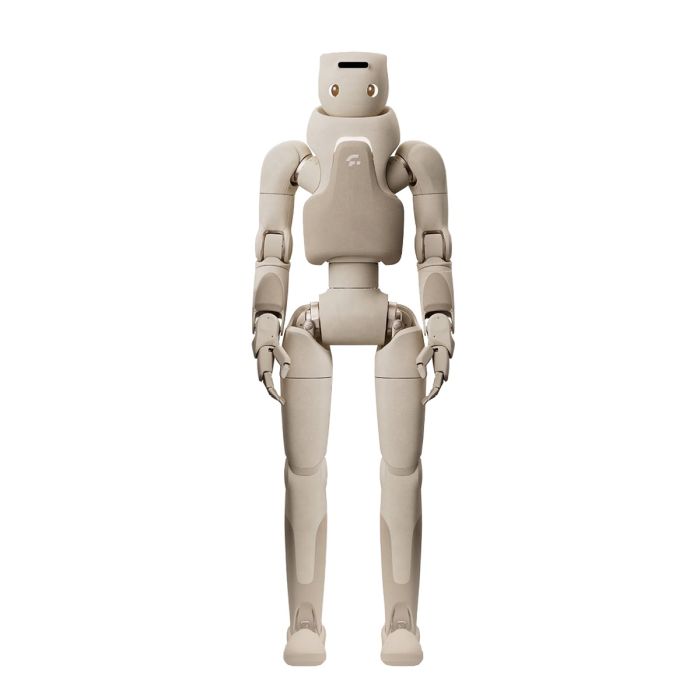
In stock
- BRAND:
- FOURIER
- PART #:
- GR-3
- ORIGIN:
- China
- AVAILABILITY:
- SUBJECT TO AVAILABILITY
- SKU:
- Fourier-GR-3
Fourier GR-3 Care-Bot Humanoid Robot
Most machines are designed on the assumption that nobody will touch them. The Fourier GR-3 Care-Bot Humanoid Robot starts from the opposite premise. Its head and torso carry tactile sensors, its body is finished in soft covering materials over an aluminium and engineering-plastic structure, and its microphones listen in every direction at once. A hand on the shoulder or a question asked from behind is information, not interference. It is a humanoid designed for being near people, and its specification reads accordingly.
Robots Middle East sells and supplies the Fourier GR-3 Care-Bot Humanoid Robot to organisations across the Middle East, including care providers, hospitality groups, universities and research laboratories. Robots Middle East prepares each quotation, arranges delivery and import to the customer's site, and remains the point of contact for support once the robot is in service.
Background
Fourier and the GRx series
The GR-3 belongs to Fourier's GRx family of full-size humanoid robots. The series began with the Fourier GR1 Humanoid Robot (GR-1), launched in 2023 and now discontinued. It continued with the Fourier GR2 Humanoid Robot and reached its third generation when the GR-3 was released in August 2025. Each generation has kept the same basic form, a bipedal robot of human proportions, while shifting where the engineering effort goes. With the GR-3, that effort moves decisively towards interaction. The wider range is gathered in the Fourier category.
The care-bot idea
The GR-3 is Fourier's first "Care-bot": a humanoid designed specifically for interactive companionship, with affinity, safety and emotional interaction at its core. In practice, the machine is judged first by how comfortably people accept it and only then by what it can carry. The soft covering, the touch sensing on head and torso and the omnidirectional sound pickup all follow from that priority. The GR-3 still walks, gestures and handles light objects. The difference is that those abilities serve the encounter with a person rather than a production line.
Technical Specifications
| Specification | Value |
|---|---|
| Height | 165 cm |
| Weight | 71 kg |
| Dimensions | 1642 mm × 552 mm × 292 mm |
| Arm span | 1395 mm |
| Materials | Aluminium alloy + engineering plastic + soft covering materials |
| Total actuator count | Up to 55 (with optional 12-DOF dexterous hand) |
| Maximum joint peak torque | 440 N·m |
| Walking speed | 6.1 km/h |
| Single arm payload | ≈3 kg |
| Battery capacity | 702 Wh + 234 Wh |
| Runtime | ≈3 h |
| Hot-swappable battery | Supports hot-swappable battery replacement |
| Wireless connection | Wi-Fi 6 |
| I/O | Type-C, USB3.0, RJ45 |
| Microphone | 360° omnidirectional sound pickup |
| Tactile sensors | Distributed on head and torso, supports tactile perception |
| Teleoperation | Immersive remote control (VR headset / exoskeleton teleoperation) |
| Operating temperature | 0 to 45°C |
Specifications are as published by the manufacturer and are confirmed against the datasheet at quotation.
The manufacturer has not published the ingress protection rating, the maximum obstacle clearance height, the camera resolution or the contents of the box; each of these is confirmed at quotation.
What makes the GR-3 different from an industrial humanoid?
A humanoid built for factory work is usually specified around its payload, its repeatability and its tolerance of a hard environment. The GR-3 gives a single arm payload of about 3 kg. That is enough for handing over a cup, a leaflet or a small parcel, and it is clearly not intended for heavy handling. Where the GR-3 invests instead is in the channels through which a person meets it. Tactile sensors across the head and torso let it perceive contact. The 360° omnidirectional microphone lets it pick up a voice from any side. The soft covering materials change what it feels like to stand beside a robot of 165 cm and 71 kg.
The mechanical side has not been neglected. A maximum joint peak torque of 440 N·m and a walking speed of 6.1 km/h give it the movement needed to accompany a visitor along a corridor or cross a lobby. The actuator count, up to 55 with the optional 12-DOF dexterous hand, supports expressive body language as much as manipulation. The aim is more human-like gesture and expression. For a companion, a posture that reads as attentive does as much work as a grip.
Operating practicalities matter too. The battery system, rated at 702 Wh + 234 Wh, gives a runtime of about 3 h, and it supports hot-swappable replacement. In a care home or a hotel, that means the robot can stay on duty through a battery change instead of disappearing to a charger at the busiest moment. Wi-Fi 6 handles wireless connection, while Type-C, USB3.0 and RJ45 ports allow integration with the systems a site already runs.
Which hand configuration should I choose?
The GR-3 comes in two versions. One is fitted with the 12-DOF dexterous hand, and it is with this hand that the total actuator count reaches up to 55. The other uses a single hand base with 6 DOF. The choice depends on what the robot is expected to do with its hands. The dexterous version suits laboratories studying manipulation and projects where fine gesture or object handling is part of the brief. The base hand suits deployments where the hands mainly contribute to gesture and simple interaction, and where the conversation and touch sensing matter more than finger articulation. Robots Middle East will advise on the configuration that fits each project.
Who is the Fourier GR-3 Care-Bot Humanoid Robot for?
The first group is organisations exploring companionship and social care: residential care providers, eldercare programmes and clinical teams who want to test how a humanoid can support residents and staff through conversation and presence. The robot's emphasis on safety and affinity is written for exactly this setting.
The second is guest-facing businesses. Hotels, shopping centres, museums and exhibition venues across the region increasingly look for attractions that also inform, and a humanoid able to greet, listen and gesture fills that role. The operating temperature range of 0 to 45°C should be considered against the conditions of the intended space, and outdoor use calls for discussion before purchase.
The third is research and education. Universities and laboratories working on human–robot interaction, teleoperation or embodied AI will find the VR headset and exoskeleton teleoperation support valuable for collecting demonstrations and running studies. These teams will often prefer the 12-DOF dexterous hand version. Buyers comparing the GR-3 with other full-size humanoids can browse the Bipedal Humanoids category.
What is the Fourier GR-3 Care-Bot Humanoid Robot used for?
- Companionship in care settings — conversing with residents, responding to touch and providing a steady, friendly presence.
- Reception and concierge duties — welcoming visitors in lobbies and directing them with speech and gesture.
- Exhibitions and brand experiences — drawing and engaging audiences at events, showrooms and museums.
- Human–robot interaction research — studying how people respond to touch, voice and body language from a humanoid.
- Teleoperation and data collection — driving the robot through a VR headset or exoskeleton to record demonstrations.
- Education and demonstration — giving students hands-on experience with a current-generation humanoid platform.
Pricing and Availability
The Fourier GR-3 Care-Bot Humanoid Robot is supplied on quotation, prepared for each project according to the hand configuration, the intended application and the site. Delivery, customs and support are arranged together with the quotation, so that a single document covers what reaches your premises and how it is looked after. Robots Middle East handles the process from first enquiry to commissioning. A quotation for the Fourier GR-3 Care-Bot Humanoid Robot can be requested through the enquiry form available on this page.
Frequently Asked Questions
How tall is the GR-3 and how much does it weigh?
The GR-3 stands 165 cm tall and weighs 71 kg. Its dimensions are 1642 mm × 552 mm × 292 mm, with an arm span of 1395 mm.
How long does the GR-3 run on one charge?
The runtime is about 3 h from a battery capacity of 702 Wh + 234 Wh. The battery supports hot-swappable replacement, so the robot can continue working during a change.
Can the GR-3 sense touch?
Yes. Tactile sensors are distributed on the head and torso and support tactile perception, so the robot can respond when someone touches it.
Can the GR-3 be operated remotely?
It supports immersive remote control by VR headset or exoskeleton teleoperation. This suits research teams collecting demonstration data and operators who need direct control.
What is the difference between the two hand versions?
One version carries the 12-DOF dexterous hand, which brings the total actuator count up to 55. The other uses a single hand base with 6 DOF and suits interaction-led deployments.
In what temperatures can the GR-3 operate?
The GR-3 operates from 0 to 45°C. This range should be compared with the conditions of the space where the robot will work.
Where can I buy the Fourier GR-3 Care-Bot Humanoid Robot and what does it cost?
The Fourier GR-3 Care-Bot Humanoid Robot is available from Robots Middle East, which supplies it across the Middle East. The cost is set in a project quotation covering configuration, delivery and support, which you can request on this page.
Summary
The GR-3 is built for a moment that most robots are never designed for: the moment a person reaches out to it. Fourier's third-generation GRx humanoid answers with tactile sensing on head and torso, omnidirectional hearing and a soft-covered body. Behind these sit up to 55 actuators with the dexterous hand, a hot-swappable battery system and teleoperation by VR headset or exoskeleton. It is a companion first and a handler of light objects second, and it makes sense in care, hospitality, exhibition and research settings where people are the point. For organisations ready to place a humanoid among people rather than behind a safety fence, this page is the starting point.