
DISCONTINUED - Fourier GR1 Humanoid Robot (GR-1)
Out of stock
- BRAND:
- FOURIER
- MODEL:
- GR1
- ORIGIN:
- China
- AVAILABILITY:
- SUBJECT TO AVAILABILITY
- SKU:
- Fourier-GR1
DISCONTINUED - Fourier GR1 Humanoid Robot (GR-1)
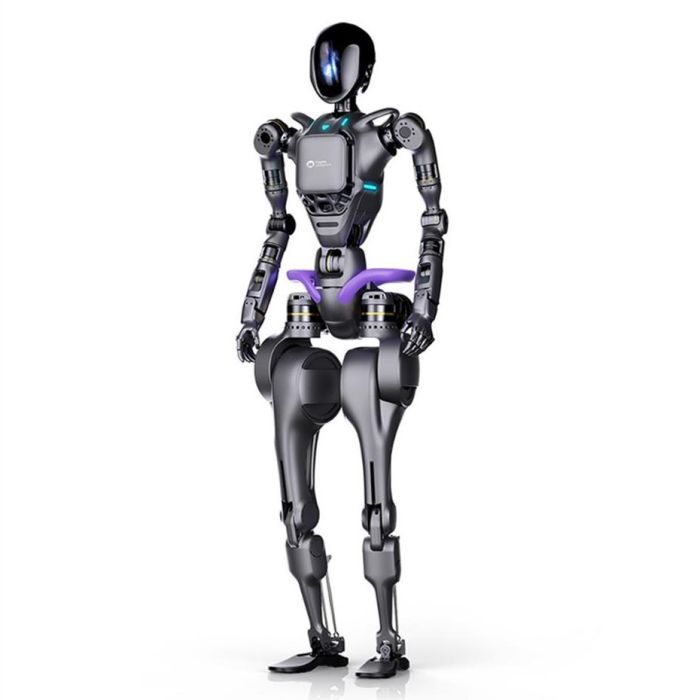
Leonardo da Vinci drew the ideal human figure with outstretched arms matching its height, and the DISCONTINUED - Fourier GR1 Humanoid Robot (GR-1) comes strikingly close to that old proportion. It stands 1650 mm tall and has an arm span of 1680 mm. That closeness is not decoration. A machine built to human measurements works at the heights and reaches that rooms, benches and corridors were designed for, which is why humanoids of this class serve as test beds for walking, manipulation and embodied intelligence. Production of the GR-1 has ended, yet the robot remains a well-defined reference point in Fourier's humanoid line and a capable platform for organisations that understand what they are acquiring.
Robots Middle East sells the Fourier GR-1 and supplies it to universities, research centres and corporate innovation teams across the Middle East. Because the model is discontinued, Robots Middle East checks with each enquiry whether a unit can still be supplied and, where that is not possible, sets out the current Fourier alternatives. Robots Middle East prepares the quotation, arranges delivery to the customer's site and remains the point of contact for support after installation.
Background
Fourier: from rehabilitation to humanoids
Fourier built its reputation in rehabilitation robotics, developing equipment that helps patients regain movement in their limbs. That work demands a precise understanding of human joints, of how force passes through a limb and of how a machine can move safely alongside a person. The step from rehabilitation devices to a full humanoid was therefore less abrupt than it might appear: the same knowledge of human biomechanics and of compact, controllable actuators underpins both. The GR-1 was the robot with which Fourier entered the general-purpose humanoid field, and it opened what the company calls the GR series.
The GR-1 and its actuator design
The defining feature of the GR-1 is its actuation. The robot carries 44 joint actuators in total, of which 32 are Fourier's own FSA actuators, and the strongest joint delivers a maximum torque of 230 N.m. A high actuator count matters for a humanoid because each joint is a degree of control: the more joints a robot can drive independently, the more closely its posture and movement can follow a human model. The structure combines aluminium alloy with engineering plastics, keeping the net weight to around 55 kg for a robot of adult height. On the software side, the robot runs Ubuntu20.04+ROS 2, the combination widely used in robotics research, so laboratories can work with familiar tools rather than a closed environment.
Technical Specifications
| Specification | Value |
|---|---|
| Standing size | 1650 x 515 x 320 mm |
| Arm span | 1680 mm |
| Net weight | ≈ 55 kg |
| Materials | Aluminum alloy, engineering plastics |
| Walk speed | 5 km/h |
| Single hand payload | ≈ 3 kg |
| Total joint actuators | 44 |
| FSA actuators | 32 |
| Max. joint torque | 230 N.m |
| Battery capacity | 483 Wh |
| Battery type | Lithium battery |
| Cruise duration | ≈ 60 min |
| Walk cruise duration | ≈ 45 min |
| Full charge time | 315 min |
| Depth camera | Realsense |
| Operating system | Ubuntu20.04+ROS 2 |
| Wireless connection | Wi-Fi,EEE 80211a/b/g/n/ac, bluetooth 4.2 |
| External interfaces | HDMIx1,Type-C x 3(fast charge,USB,peripheral extension ports) |
Specifications are as published by the manufacturer and are confirmed against the datasheet at quotation.
The manufacturer has not published the IP rating, the operating temperature range, the maximum incline, the degrees of freedom of the hands, the package contents or the maximum running speed; these points are confirmed at quotation.
What do the GR-1's battery and charging figures mean for a working day?
A research humanoid is only as useful as the time it can spend moving. The GR-1 carries a 483 Wh lithium battery, which gives a cruise duration of around 60 minutes and a walking cruise duration of around 45 minutes. A full charge takes 315 min. In practice this shapes how a laboratory schedules its work: an experimental session is planned in blocks of activity followed by long periods of charging, and a team running walking trials will see less operating time than one focused on upper-body tasks. Groups that need longer continuous testing usually plan sessions around the charging cycle, for example by preparing code, simulation runs and data analysis while the robot charges.
The interface layout supports that rhythm. Three Type-C ports cover fast charging, USB and peripheral extension, and an HDMI port allows a display to be connected directly, which is convenient during development and debugging. Wi-Fi and Bluetooth 4.2 provide wireless links for monitoring and control from a workstation.
Why consider the GR-1 now that it is discontinued?
Buying a discontinued robot is a deliberate choice, and it suits some organisations better than others. The GR-1's appeal lies in its specification being fixed and known: a team knows in advance the actuator count, the torque ceiling, the walking speed of 5 km/h and the payload of around 3 kg per hand. For a research group that wants to reproduce or extend work already carried out on this platform, or to add a unit to an existing GR-1 installation, that continuity is valuable. The open software stack based on ROS 2 also means that work done on the GR-1 can be carried over to other robots that use the same framework.
The other side of the decision is long-term support. Organisations planning a multi-year programme should weigh the availability of spare parts and updates for a model that is no longer produced. Robots Middle East discusses these points openly with each buyer and, where a current model is the better fit, recommends one of Fourier's newer robots instead.
Who is the Fourier GR-1 for?
The GR-1 fits university laboratories working on bipedal locomotion, whole-body control and robot learning, where a human-sized platform with a mainstream operating system lowers the barrier to experimentation. Corporate research and innovation teams exploring how humanoids might operate in facilities designed for people form a second group, as do teaching institutions that want students to work on a real humanoid rather than in simulation alone. Research groups that already operate a GR-1 are a natural buyer as well, since an additional unit keeps experiments comparable.
Buyers who need a model in current production should look first at the Fourier GR2 Humanoid Robot, the next robot in the GR series. Teams that prefer an open-source humanoid can consider the Fourier N1 Open-Source Humanoid Robot, while projects centred on care environments may find the Fourier GR-3 Care-Bot Humanoid Robot more suitable. Applications that do not require legs can be served by the Fourier GRW Wheeled Bi-Arm Robot. The wider range is gathered in the Bipedal Humanoids category.
What is the Fourier GR-1 used for?
- Locomotion research: testing walking controllers and balance strategies on a full-size bipedal platform.
- Robot learning: training and validating learned behaviours developed in simulation on real hardware.
- Manipulation studies: exploring grasping and handling of light objects with either hand.
- Perception development: building vision pipelines around the Realsense depth camera.
- Education: giving engineering students hands-on experience with a humanoid running ROS 2.
- Human–robot interaction: studying how people respond to a robot built to human proportions.
Pricing and Availability
Robots Middle East prices the Fourier GR-1 by individual quotation, reflecting the configuration, the destination and the support required. As the model is discontinued, the offer also states whether a unit can be supplied or whether a current Fourier model is proposed in its place. Delivery, customs clearance and after-sales support are arranged together with the quotation. To begin, please send your requirements through the quotation request available on this page.
Frequently Asked Questions
Is the Fourier GR-1 still in production?
No, the GR-1 is discontinued. Robots Middle East checks whether a unit can be supplied when you enquire and can propose a current model from the GR series.
How many actuators does the GR-1 have?
The robot has 44 joint actuators in total, 32 of which are FSA actuators. The maximum joint torque is 230 N.m.
What software does the GR-1 run?
It runs Ubuntu20.04+ROS 2, a combination widely used in robotics research and teaching.
How long does the GR-1 operate on one charge?
The cruise duration is around 60 minutes, and around 45 minutes when walking. A full charge takes 315 min.
How much can each hand carry?
The single-hand payload is around 3 kg, which suits the handling of light objects in research and teaching tasks.
Which sensors and connections does it offer?
The GR-1 uses a Realsense depth camera and offers Wi-Fi, Bluetooth 4.2, one HDMI port and three Type-C ports for fast charging, USB and peripheral extension.
Where can I buy the Fourier GR-1 and what does it cost?
Robots Middle East supplies the GR-1 across the Middle East and prices it by individual quotation. Please submit a quotation request on this page to receive an offer.
Summary
The Fourier GR-1 brings the proportions of the human body into a research machine: an arm span close to its height, 44 joint actuators and a software stack built on ROS 2. Its production has ended, which makes it a considered purchase for teams that value a fixed, known specification or wish to extend existing GR-1 work, while others will be better served by Fourier's current robots. Robots Middle East advises on both routes and handles quotation, delivery and support. For any organisation weighing a human-sized platform for its laboratory, this page is the starting point.