
Fourier GR2 Humanoid Robot
In stock
- BRAND:
- FOURIER
- MODEL:
- GR2
- ORIGIN:
- China
- AVAILABILITY:
- SUBJECT TO AVAILABILITY
- SKU:
- Fourier-GR2
Fourier GR2 Humanoid Robot
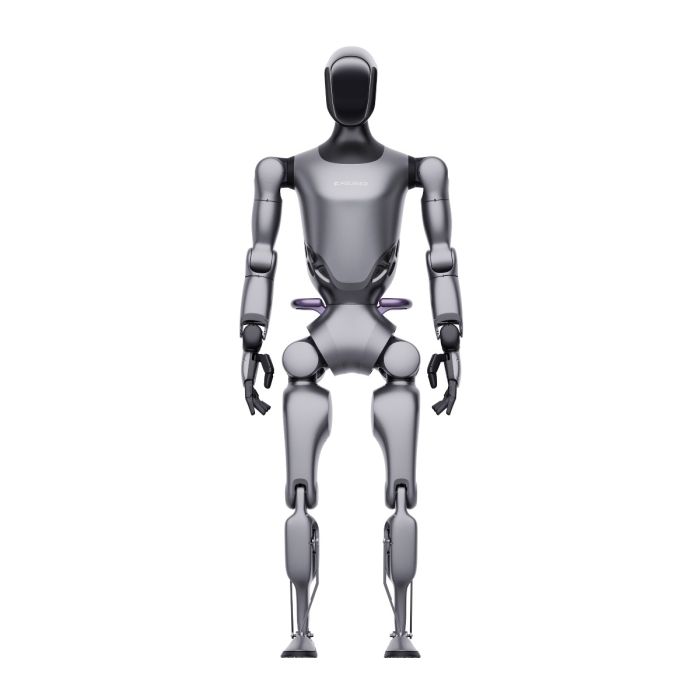
Most humanoid robots are first judged by how they walk. The Fourier GR2 Humanoid Robot invites a different test: what happens when its hands close around an object, and how much of that moment it can record. At 175 cm and 63 kg, it occupies roughly the space a person would at a workbench, a laboratory counter or a reception desk. Its strongest argument, however, sits in the upper body: in the actuators that drive its arms, in the teaching modes that let an operator show it a task, and in an optional hand that senses force and texture as it grips.
Robots Middle East supplies the GR2 to universities, research institutes, innovation centres and system integrators across the Middle East. Robots Middle East prepares the quotation, coordinates delivery to your site and remains your point of contact for support once the robot is in service. A project can therefore move from evaluation to deployment with a single regional partner.
Background
Fourier and the road from the GR-1
Fourier built its reputation in rehabilitation robotics before turning to general-purpose humanoids, and that clinical heritage shows in its attention to controlled, precise movement. The GR2, styled GR-2 by the manufacturer, builds on its predecessor, the Fourier GR1 Humanoid Robot (GR-1): the world's first mass-produced humanoid robot. Rather than a minor refresh, the second generation revisits the body itself. Fourier redesigned the joint configuration, reworked the cabling and changed the power system, so the GR2 is best understood as a re-engineered platform rather than a GR-1 with new software.
FSA 2.0 actuation and a redesigned body
At the centre of the GR2 is Fourier's FSA 2.0 actuator series. It comprises seven different types of actuator, each tailored to the torque demands of the particular joint it drives, with peak torques exceeding 380 N.m. A dual-encoder system doubles control accuracy, which matters most where a task depends on repeatable, fine positioning. The joints have moved from a parallel to a serial structure, and power and communication are routed through integrated cabling, so the wires are concealed and the packaging is more compact. Together, these choices give the robot a cleaner, more serviceable body that is better suited to sustained work alongside people.
Technical Specifications
| Specification | Value |
|---|---|
| Height | 175 cm |
| Weight | 63 kg |
| Degrees of freedom | 53 |
| Single-arm load capacity | 3 kg |
| Actuators | FSA 2.0 series, seven types, each tailored to the torque demands of its joint |
| Actuator peak torque | Exceeding 380 N.m |
| Encoders | Dual-encoder system, doubling control accuracy |
| Joint structure | Serial (redesigned from a parallel structure) |
| Cabling | Integrated power and communication cabling, concealed wires |
| Battery | Detachable; capacity doubled, extending runtime by an hour |
| Upper-limb teaching modes | VR remote control, lead-through programming, direct command |
| Hand versions | GR-2 with Basic Dexterous Hand; GR-2 with Enhanced Dexterous Hand (12-DoF, optional) |
| Tactile sensing (Enhanced Dexterous Hand) | Six array-type tactile sensors; senses force, identifies object shapes and materials, adjusts grip in real time |
Specifications are as published by the manufacturer and are confirmed against the datasheet at quotation.
The manufacturer has not published the charge time, the IP rating, the Wi-Fi and Bluetooth details, the operating temperature range, the camera resolution, the operating system or the contents of the box; all of these are confirmed at quotation.
What does the Enhanced Dexterous Hand add to the GR2?
The GR2 is offered with two hand configurations, and the choice between them shapes what the robot can learn. The Basic Dexterous Hand serves projects in which the hand is one part of a broader study of locomotion, posture or whole-body control. The optional Enhanced Dexterous Hand, with 12 degrees of freedom, is the configuration for teams whose work centres on manipulation itself.
Its distinguishing feature is touch. Six array-type tactile sensors allow the GR2 to sense force, identify the shapes and materials of the objects it holds, and adjust its grip in real time. For a research group, that means each grasp produces data about contact as well as position. A robot that knows only where its fingers are can repeat a motion; a robot that also feels what its fingers meet can begin to adapt, for example by easing pressure on a soft item or tightening on a smooth one. When the brief involves handling varied objects, the enhanced hand is the version to specify.
How does the GR2 improve on the GR-1?
The differences fall into three groups. The first is strength and precision: the FSA 2.0 actuators, with peak torques exceeding 380 N.m and a dual-encoder system that doubles control accuracy, give each joint power matched to its role. The second is endurance and practicality: the battery is now detachable, its capacity has doubled and runtime is extended by an hour, so a charged pack can be swapped in rather than the robot being taken out of service. The third is architecture: the serial joint structure and integrated, concealed cabling produce a more compact body with fewer exposed wires to snag or wear.
Above all, the GR2 is built to be taught. It supports VR remote control, lead-through programming and direct command for the upper limbs, and it records a comprehensive set of operational data, from motion paths to tactile responses. That turns every demonstration into a dataset, which is precisely what teams training embodied AI models need.
Who is the Fourier GR2 Humanoid Robot for?
The GR2 suits university laboratories and research institutes working on embodied AI, manipulation and human–robot interaction, particularly those that need to gather demonstration data at human scale. Corporate innovation teams evaluating humanoids for service or industrial pilots will find its teaching modes useful for building proof-of-concept tasks quickly. System integrators preparing demonstrators for clients can use its full-size form to show what a humanoid looks like in a real workspace.
Within that audience, the hand configuration is the main decision: manipulation and tactile research points to the Enhanced Dexterous Hand, while broader whole-body work may be well served by the Basic Dexterous Hand. If your brief points elsewhere in the Fourier range, Robots Middle East can also quote the Fourier N1 Open-Source Humanoid Robot or the Fourier GR-3 Care-Bot Humanoid Robot, and the wider selection is gathered under Bipedal Humanoids and Humanoids.
What is the Fourier GR2 Humanoid Robot used for?
- Embodied AI research — training and testing models that link perception, decision-making and physical action in a human-sized body.
- Manipulation data collection — recording motion paths and tactile responses during demonstrations to build learning datasets.
- Teleoperation studies — using VR remote control to investigate how operators guide a humanoid through complex tasks.
- Teaching and training — giving engineering and computer-science students hands-on experience with a modern full-size humanoid.
- Applied pilots — trialling humanoid assistance in service, logistics or customer-facing settings before wider rollout.
- Actuation and control research — studying high-torque actuators and precise joint control on a complete robotic platform.
Pricing and Availability
The GR2 is supplied on quotation, so that the hand configuration and any project requirements can be agreed before an order is placed. Delivery, customs clearance and after-sales support are arranged by Robots Middle East together with the quotation. To begin, please share your intended application, preferred hand version and delivery location with our team; a quotation request for the Fourier GR2 Humanoid Robot is available on this page.
Frequently Asked Questions
How tall is the Fourier GR2 Humanoid Robot and how much does it weigh?
The GR2 stands 175 cm tall and weighs 63 kg, placing it firmly at human scale.
How many degrees of freedom does the GR2 have?
The GR2 offers 53 degrees of freedom. The optional Enhanced Dexterous Hand itself has 12 degrees of freedom.
What can each arm carry?
The GR2 has a single-arm load capacity of 3 kg.
Which hand should I choose?
The Enhanced Dexterous Hand, with six array-type tactile sensors, is the choice for manipulation and touch-based research. The Basic Dexterous Hand suits projects in which grasping is a smaller part of the work.
How is the GR2 taught new tasks?
Its upper limbs support VR remote control, lead-through programming and direct command. During teaching, it records operational data ranging from motion paths to tactile responses.
What has changed in the battery?
The battery is now detachable, and its capacity has doubled, extending runtime by an hour. Because the pack can be removed, a charged battery can be fitted while another is recharged.
Where can I buy the Fourier GR2 Humanoid Robot and what does it cost?
Robots Middle East supplies the GR2 across the Middle East and provides a quotation tailored to your configuration and delivery location. Please submit your request through this page to receive it.
Summary
Judged only by its stride, the GR2 would be one humanoid among many. Judged by its hands and by what it learns through them, it stands apart: FSA 2.0 actuators with peak torques exceeding 380 N.m, a dual-encoder system for finer control, a serial joint structure with concealed cabling, a detachable battery, and an optional 12-DoF hand that senses force, shape and material. Combined with teaching modes that capture every demonstration as data, it offers research and innovation teams a full-size platform for turning human skill into robot behaviour. For organisations across the Middle East ready to take that step with Robots Middle East, this page is the starting point.