
Galaxea R1 Wheeled Humanoid Robot
In stock
- BRAND:
- GALAXEA
- PART #:
- R1
- ORIGIN:
- China
- AVAILABILITY:
- SUBJECT TO AVAILABILITY
- SKU:
- Galaxea-R1
Galaxea R1 Wheeled Humanoid Robot
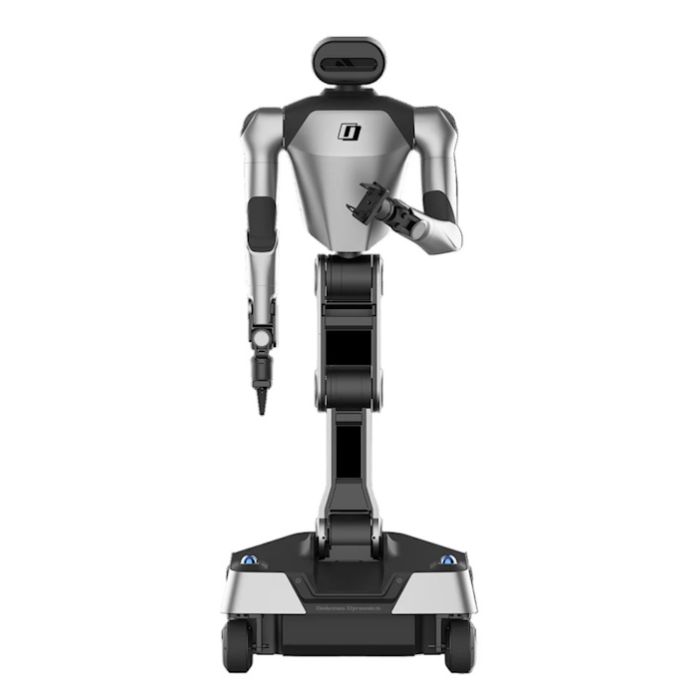
Picture the space a person covers at a workbench without moving their feet: from the floor to just above head height, and roughly an arm's length in every direction. The Galaxea R1 Wheeled Humanoid Robot is designed to occupy that same space and then take it somewhere else. Its working envelope runs from 0 to 200 cm in height. Each arm reaches 70 cm, or 86 cm with its gripper fitted, and a three-wheel steering vector chassis carries the whole envelope across the room. For laboratories that study how robots cope with ordinary surroundings, this turns a fixed manipulation cell into one that travels with the task.
Robots Middle East supplies the Galaxea R1 Wheeled Humanoid Robot to universities, research institutes, corporate innovation teams and system integrators across the Middle East. Robots Middle East prepares each quotation, coordinates delivery to the customer's site and provides support once the robot is in service. A project team therefore deals with one regional partner from the first enquiry to the robot's first task.
Background
Galaxea AI and its team
The R1 is built by Galaxea AI, a company based in Suzhou, China, and founded in September 2023 by a team drawn from Tsinghua and Stanford. The company is young, and its products reflect the priorities of embodied-AI research: robots that collect data, learn tasks and operate among the furniture, shelving and objects people already use. Galaxea also offers its manipulators separately; the arm fitted to the R1 is available on its own as the Galaxea A1 Robotic Arm. This allows a team to prototype grasping work on a bench before moving to the full mobile platform.
A humanoid built around reach
Galaxea describes the R1 as a full-size dual-arm humanoid robot. It combines two 6-DoF Galaxea A1 robot arms, two Galaxea G1 grippers, a 4-DoF torso and a three-wheel steering vector chassis. The design keeps the parts of the human form that matter for handling objects: a torso that changes posture, two arms that can work together, and grippers at a human working height. It replaces legs with a wheeled base. The result belongs to the class of wheeled humanoids, a branch of the wider humanoid field that values a stable, continuously mobile body over walking.
Technical Specifications
| Specification | Value |
|---|---|
| Product type | Full-size Dual-Arm Humanoid Robot |
| Arms | Two 6-DoF Galaxea A1 robot arms |
| Grippers | Two Galaxea G1 grippers |
| Torso | 4-DoF |
| Chassis | Three-wheel steering vector chassis |
| Operating range (height) | 0 ~ 200 cm |
| Operating radius | 70 cm per arm; 86 cm per arm with gripper |
| Max. payload | 5 [email protected] m |
| Degrees of freedom | 24 DOF in total: 6 DOF for chassis, 4 DOF for torso, 14 DOF for dual arms with grippers |
| Cameras | Head: 1, Wrist: 2, Chassis: 5 |
| LiDAR | 1 * 360° (2 for Optional) |
| Height | 1700 mm when standing |
| Width | 675 mm |
| Weight | 96 kg with battery |
| Gripper stroke | 0 ~ 100 mm |
| Communication interface | Ethernet, USB |
Specifications are as published by the manufacturer and are confirmed against the datasheet at quotation.
The manufacturer has not published the battery runtime, charging time, IP rating, operating temperature range, maximum travel speed, gripper payload or software and operating-system version; these are confirmed at quotation.
How far can the Galaxea R1 reach, and why does the torso matter?
Reach on a mobile manipulator depends on more than arm length. The R1's arms reach 70 cm each, extending to 86 cm with the gripper. Those figures describe only a horizontal slice of the workspace. The vertical dimension comes from the 4-DoF torso, which positions the shoulders so that the grippers can work across a height range of 0 to 200 cm. In practice, the same robot can pick an item from the floor, work at a table and place something on a high shelf without being moved to a different station.
The torso also helps with load. The R1 handles a maximum payload of 5 kg at 0.5 m, and a body that can lean and change posture lets the arms meet an object at a better angle rather than at full stretch. With 24 degrees of freedom shared between chassis, torso and arms, a planner has many ways to reach the same point. This redundancy is valuable in cluttered spaces and a rich subject for motion-planning research.
What does the sensor suite give the Galaxea R1?
Perception is spread around the body rather than concentrated in the head. The R1 carries one head camera, two wrist cameras and five chassis cameras, together with a 360° LiDAR; a second LiDAR is available as an option. The head camera gives an overview of the scene, the wrist cameras view the object at the moment of grasping, and the chassis cameras and LiDAR watch the floor and surroundings while the base moves.
For teams training learning-based policies, this arrangement matters because each viewpoint records a different part of the task: where to go, what to approach and how the fingers close. Ethernet and USB interfaces connect the robot to the lab's own computing and logging equipment. The gripper stroke of 0 ~ 100 mm suits a wide range of everyday objects, from slim tools to packaged goods.
Who is the Galaxea R1 Wheeled Humanoid Robot for?
The R1 is aimed first at research groups working on mobile manipulation and embodied AI. These include university laboratories, national research centres and corporate innovation units that need a platform able to move, perceive and handle objects within one integrated body. Its multi-camera layout and full working height make it a candidate for teams collecting demonstration data for household, retail or service tasks.
System integrators exploring indoor automation will find a platform for trials in settings designed around people, where shelves, counters and trolleys sit at human heights. Teaching programmes in robotics and AI can use it to give students practice in navigation, perception and dual-arm control on a single machine.
Galaxea offers the same family in other versions. Buyers comparing options can review the Galaxea R1 Pro Wheeled Humanoid Robot and the Galaxea R1 Lite Wheeled Humanoid Robot. The figures on this page apply to the R1 only, and Robots Middle East can set out the differences between versions against a specific project brief.
What is the Galaxea R1 Wheeled Humanoid Robot used for?
- Mobile manipulation research: studying how a robot combines driving, reaching and grasping in one continuous task.
- Demonstration data collection: recording multi-camera views of tasks to train and evaluate learning-based control policies.
- Household task studies: working with objects from floor level to high cupboards in mock-up homes and service settings.
- Retail and shelf handling trials: testing picking and restocking along aisles built to human proportions.
- Laboratory logistics: moving samples, tools and consumables between benches and storage within a facility.
- Education and training: giving students a single platform for navigation, perception and bimanual manipulation projects.
Pricing and Availability
The Galaxea R1 Wheeled Humanoid Robot is supplied on quotation. Robots Middle East agrees the configuration with you, including whether the optional second LiDAR is fitted. Delivery, customs clearance and after-sales support are arranged with the quotation, so the commercial offer reflects the full scope of the project. To begin, send your requirements and intended application through the quotation request available on this page.
Frequently Asked Questions
How tall is the Galaxea R1?
The R1 stands 1700 mm tall and measures 675 mm in width. Its working range in height extends from 0 to 200 cm.
How much does the Galaxea R1 weigh?
The robot weighs 96 kg with its battery fitted.
How many degrees of freedom does the R1 have?
It has 24 degrees of freedom in total: 6 for the chassis, 4 for the torso and 14 for the dual arms with grippers.
What payload can the R1 handle?
The maximum payload is 5 kg at 0.5 m.
What sensors does the R1 carry?
It carries eight cameras, one in the head, two at the wrists and five on the chassis, together with one 360° LiDAR. A second LiDAR is available as an option.
How does the R1 connect to other equipment?
The R1 offers Ethernet and USB communication interfaces, which link it to a laboratory's computers, data-logging systems and development tools.
Where can I buy the Galaxea R1 Wheeled Humanoid Robot and what does it cost?
Robots Middle East supplies the R1 across the Middle East. The cost depends on configuration, delivery and support, so it is set out in a tailored quotation that you can request on this page.
Summary
The Galaxea R1 Wheeled Humanoid Robot takes the working space of a person at a bench, from the floor to above head height and an arm's length around, and puts it on wheels. A 4-DoF torso, two 6-DoF Galaxea A1 arms with G1 grippers, a three-wheel steering vector chassis and a distributed set of cameras and LiDAR make that space mobile, observable and ready for research into how robots handle real surroundings. Robots Middle East quotes, delivers and supports the R1 throughout the region. For teams ready to move manipulation research off the fixed bench, this page is the starting point.