
Galaxea R1 Pro Wheeled Humanoid Robot
In stock
- BRAND:
- GALAXEA
- PART #:
- R1 Pro
- ORIGIN:
- China
- AVAILABILITY:
- SUBJECT TO AVAILABILITY
- SKU:
- Galaxea-R1-Pro
Galaxea R1 Pro Wheeled Humanoid Robot
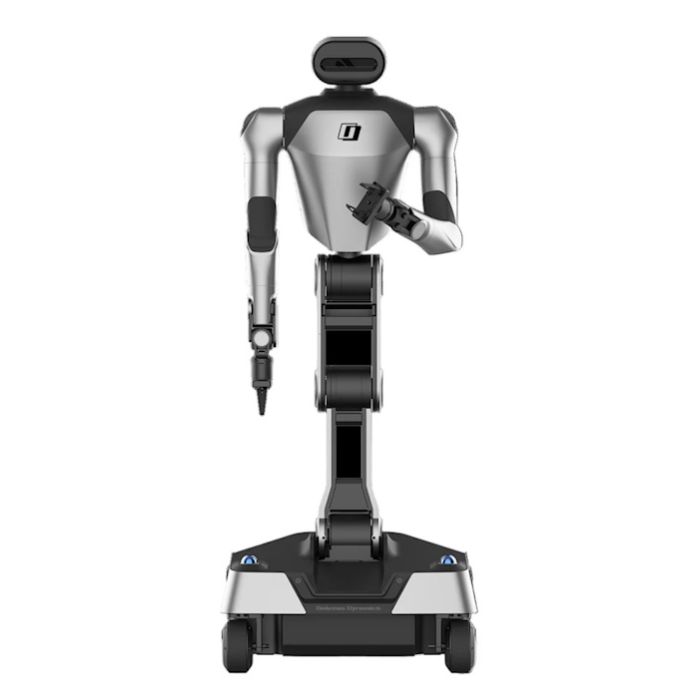
Embodied AI is usually discussed as a software problem, yet every policy a team trains is limited by the body that carries it out: how far an arm reaches, how firmly a gripper closes, how precisely a movement repeats and how quickly the platform can move to the next task. A model trained on a limited body learns limited behaviour. The Galaxea R1 Pro Wheeled Humanoid Robot is Galaxea's answer to that problem. It is a full-height robot with two articulated arms on an omnidirectional wheeled chassis, and it carries its own NVIDIA Jetson AGX Orin computer, so the hardware does not hold back the research programme.
Robots Middle East supplies the R1 Pro to universities, research institutes, corporate innovation teams and system integrators across the Middle East. Robots Middle East prepares each quotation for the configuration the project requires and coordinates delivery to the customer's site. It remains the point of contact for technical support once the robot is in service.
Background
Galaxea and a self-developed platform
Galaxea describes the R1 Pro as a high-performance embodied AI robot platform fully self-developed by the company. For a research buyer this matters a great deal. When the arms, torso, chassis and system integration come from one developer, the robot behaves as a single, coherent system rather than an assembly of components from different suppliers. The R1 Pro belongs to a family that also includes the Galaxea R1 Wheeled Humanoid Robot and the Galaxea R1 Lite. Galaxea's range extends to standalone manipulators such as the Galaxea A1 Robotic Arm (A1) and the Galaxea A1 XY Robotic Arm (A1 XY). Teams can therefore stay with one manufacturer from a bench-top arm to a complete mobile humanoid.
A body built for coverage
The central idea of the R1 Pro is coverage. Each arm has seven degrees of freedom, the torso adds four, and the chassis contributes six with 360° omnidirectional movement. The robot as a whole offers 26 degrees of freedom. Together these give a vertical workspace from floor level to 2000 mm, so the same machine can deal with an object on the ground and one above head height. The force-controlled parallel gripper and onboard computing power of 200 TOPS complete the picture. On the R1 Pro, perception, planning and manipulation can be developed together on one body rather than in separate test rigs.
Technical Specifications
| Specification | Value |
|---|---|
| Product type | High-performance embodied AI robot platform, fully self-developed by Galaxea |
| Dimensions (H × W × D) | 1700 * 675 * 126 mm (66.9 × 26.6 × 5.0 in) |
| Weight (including battery) | 126 kg (277.8 lb) |
| Total degrees of freedom (DOF) | 26 |
| Single-arm degrees of freedom (DOF) | 7 |
| Gripper-equipped arm radius | 860 mm (33.9 in) |
| Single-arm payload | Rated: 3.5 kg (7.7 lb); Maximum: 5 kg (11.0 lb) |
| Repeatability | ±0.5 mm (±0.02 in) |
| Maximum end-effector linear velocity | 7.5 m/s (16.8 mph) |
| Maximum end-effector acceleration | 10 m/s² (32.8 ft/s²) |
| End-effector | Force-Controlled Parallel Gripper |
| Gripping range | 0–100 mm (0–3.94 in) |
| Gripping force | Rated: 150 N (33.7 lbf); Peak: 350 N (78.7 lbf) |
| Torso degrees of freedom (DOF) | 4 |
| Vertical workspace | 0–2000 mm (0–78.7 in) |
| Chassis degrees of freedom (DOF) | 6, 360° Omnidirectional |
| Chassis speed | 1.5 m/s (3.4 mph) |
| Computing unit | NVIDIA Jetson AGX Orin, 32GB |
| Computing power | 200 TOPS |
Specifications are as published by the manufacturer and are confirmed against the datasheet at quotation.
The manufacturer has not published the battery capacity, battery runtime, charging time, IP rating, connectivity interfaces, operating temperature or the operating system and software stack; these are confirmed at quotation.
What does the R1 Pro offer for bimanual manipulation research?
Bimanual work means one hand holds while the other acts, or both arms share a load. It is far harder to develop than single-arm picking, because the controller must coordinate two kinematic chains around the same object. The R1 Pro gives each arm seven degrees of freedom, one more than the minimum needed to position and orient a tool. That redundancy lets the arm approach an object from several postures, so it can avoid obstacles or the other arm while keeping the gripper where the task requires it.
The gripper is force-controlled, with a rated gripping force of 150 N, a peak of 350 N and an opening range of 0–100 mm. This combination suits research into contact-rich tasks: grasping deformable items, regulating how hard a component is held, or detecting when an object begins to slip. A rated single-arm payload of 3.5 kg, with a maximum of 5 kg, covers the tools, containers and parts typical of laboratory and light assembly work. A repeatability of ±0.5 mm means that a demonstrated motion can be replayed consistently.
Speed matters as well. With a maximum end-effector linear velocity of 7.5 m/s and acceleration of 10 m/s², the arms are not confined to slow, cautious motion. Researchers can study dynamic behaviour, provided the safety measures appropriate to their facility are in place.
What is included with the R1 Pro, and what must be added?
Planning a purchase depends as much on what ships separately as on what ships with the robot. The dexterous hand, the VR teleoperation device and the wrist camera and accessories are not included. Projects that depend on teleoperated data collection, on a multi-fingered hand instead of the parallel gripper, or on a close-up view from the wrist should state this when requesting a quotation. Robots Middle East can then specify the complete set of equipment the work requires. It is also worth listing site-specific requirements, such as expected shift length and the software environment the team works in, at this stage so that the offer reflects them.
Who is the Galaxea R1 Pro for?
The R1 Pro is aimed at organisations for which embodied AI is a core activity rather than an experiment on the side. University laboratories in robotics and machine learning will find a platform broad enough to support several research lines at once, from whole-body motion planning to learning from demonstration. Companies building foundation models for robots need hardware that can produce varied, realistic manipulation data. The combination of a mobile base, a height-adjustable torso and redundant arms addresses exactly that need.
System integrators and industrial innovation teams form a second group. Before committing to a dedicated automation cell, they may wish to test whether a general-purpose humanoid can handle a task in an existing workspace. The omnidirectional chassis, with a speed of 1.5 m/s, allows the robot to move between stations in a pilot area rather than being fixed to one point.
Buyers whose projects are narrower in scope may prefer to compare the other members of the family, the Galaxea R1 Wheeled Humanoid Robot and the Galaxea R1 Lite Wheeled Humanoid Robot (R1 Lite). Robots Middle East can set their specifications alongside the R1 Pro in a quotation. The wider selection of platforms is presented in the Wheeled Humanoids category.
What is the Galaxea R1 Pro used for?
- Embodied AI research: developing and testing policies that link perception, reasoning and physical action on one integrated body.
- Demonstration data collection: recording manipulation sequences to train imitation-learning and foundation models for robots.
- Bimanual manipulation studies: investigating coordinated two-arm tasks such as holding, passing, folding and assembling.
- Mobile manipulation in mixed-height spaces: reaching from floor level to shelf height within a single workspace.
- Industrial prototyping: assessing whether a general-purpose humanoid can take on a task before investment in dedicated automation.
- Teaching and training: giving students and engineers practical experience with a full-scale humanoid system.
Pricing and Availability
The R1 Pro is supplied on quotation, so that the offer reflects the configuration, accessories and support each project requires. Delivery, customs clearance and after-sales support are arranged together with the quotation by Robots Middle East. To begin, please describe the intended application, the working environment and any additional equipment, such as a teleoperation device or wrist camera. The request form for a tailored quotation for the Galaxea R1 Pro is available on this page.
Frequently Asked Questions
How many degrees of freedom does the R1 Pro have?
The robot has 26 degrees of freedom in total. Each arm has seven, the torso has four and the omnidirectional chassis has six.
What computing hardware is built into the R1 Pro?
The R1 Pro uses an NVIDIA Jetson AGX Orin with 32GB, providing computing power of 200 TOPS on board.
How much can each arm lift?
Each arm has a rated payload of 3.5 kg and a maximum payload of 5 kg. Robots Middle East can help assess whether a specific task stays within these limits.
What kind of gripper does the R1 Pro use?
It is fitted with a force-controlled parallel gripper with a gripping range of 0–100 mm, a rated gripping force of 150 N and a peak of 350 N.
Is a VR teleoperation device included?
No. The VR teleoperation device, the dexterous hand and the wrist camera and accessories are not included. They should be specified separately when requesting a quotation.
How fast does the R1 Pro move around a workspace?
The 360° omnidirectional chassis reaches a speed of 1.5 m/s. It can reposition the robot in any direction between workstations in laboratories and pilot areas.
Where can I buy the Galaxea R1 Pro and what does it cost?
The R1 Pro is available from Robots Middle East, which supplies customers across the Middle East. Its cost depends on configuration and accessories, so it is given in a tailored quotation that can be requested on this page.
Summary
A learning system can only become as capable as the body that carries out its decisions, and the Galaxea R1 Pro is designed so that its body is not the limiting factor. Redundant seven-degree-of-freedom arms, a four-degree-of-freedom torso, a vertical workspace up to 2000 mm, a force-controlled gripper and 200 TOPS of onboard computing give research and development teams room to grow their ambitions. Robots Middle East supplies the platform with delivery, customs and support arranged in a single quotation. For any organisation ready to give its embodied AI work a capable physical form, this page is the starting point.