
Husarion Lynx UGV
In stock
- BRAND:
- HUSARION
- MODEL:
- PANTHER
- PART #:
- PTH12
- ORIGIN:
- Poland
- AVAILABILITY:
- SUBJECT TO AVAILABILITY
- SKU:
- Husarion-Lynx-UGV
Husarion Lynx UGV
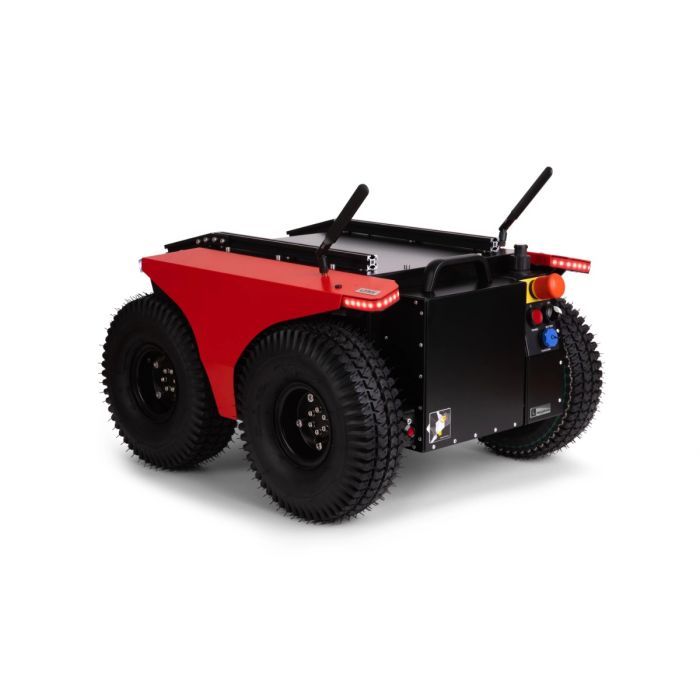
A desert test site at midday, a dusty loading yard in the afternoon and a quiet laboratory corridor in the evening: a mobile robot working in the Middle East may have to handle all three in a single week. The Husarion Lynx UGV is a compact and robust unmanned ground vehicle designed to operate in both indoor and outdoor environments. Its rated operating range runs from -20°C to 50°C, and its chassis measures 0.65 x 0.55 x 0.38 m. It is best understood less as a finished robot and more as a dependable foundation, where a team's own sensors, computers and tools meet the ground and start moving.
Robots Middle East supplies the Husarion Lynx UGV to universities, research institutes, system integrators and industrial engineering teams across the Middle East. We prepare a written quotation for the configuration you require and arrange delivery to your site. Once the platform is in your hands, Robots Middle East remains your point of contact for technical support, from first power-up to the integration of your payload.
Background
Husarion and its mobile robot range
Husarion is a robotics manufacturer known for mobile platforms built around the Robot Operating System. Its range spans small educational and research robots as well as heavier field vehicles, and the common thread is openness. The company publishes drivers and software examples so that customers can build their own applications rather than work around a closed controller. The Lynx sits within this family as a compact all-terrain base, and you can explore the wider Husarion range alongside it.
An open base built for integration
The thinking behind the Lynx is that the mobile base should never be the bottleneck in a project. Husarion designed it to make payloads easy to add: a T-slot mounting rail accepts LIDARs, 3D cameras, manipulators and other components. Accessible user power ports supply up to 780 W in total at 5 V, 12 V, 19 V and 32–42 V, and the platform offers extensive communication interfaces for connecting that equipment. On the software side, an open-source ROS 2 driver and a comprehensive suite of software examples, including an open-source autonomy stack, give developers a working starting point rather than a blank page.
Technical Specifications
| Specification | Value |
|---|---|
| Product type | Compact and robust Unmanned Ground Vehicle (UGV) platform for indoor and outdoor environments |
| Dimensions (L x W x H) | 0.65 x 0.55 x 0.38 m |
| Weight (overview) | 40 kg (including battery) |
| Weight (with WH05 wheels, per manual) | 38.8 kg |
| Ground clearance | 85 mm |
| Protection index | IP54 / IP66 |
| Operating temperature | -20°C to 50°C |
| Max speed | 1.5 m/s |
| Max carrying capacity | 65 kg |
| Hill climb grade (with 36 / 65 kg cargo) | 90% (42°) / 56% (29°) |
| Traction force (nominal / max) | 362 N / 755 N |
| Motors | 2 x BLDC, 473 W each |
| Battery capacity / voltage | 720 Wh / 36V (nominal) |
| Battery chemistry | Lithium-Ion |
| Runtime | 4.5 h - 9 h |
| Output power (total / peak) | 1.0 kW / 1.8 kW |
| Charging temperature | 0°C to 45°C |
| Built-in computer | Quad-core 64-bit SoC @ 1.5GHz and 4GB RAM |
| IMU | PhidgetSpatial 3/3/3 Precision (3-axis compass, 3-axis gyroscope, 3-axis accelerometer) |
| Wheels (WH05) | All-terrain pneumatic wheels, tyre size 4.00-4 |
| User power ports | Up to 780 W total; 5 V, 12 V, 19 V and 32–42 V |
| Payload integration | T-slot mounting rail, accessible power ports, communication interfaces |
| Software | Open-source ROS 2 driver and software examples |
| User computer options | ASUS® NUC (Intel® Core i7-1360P, 16GB RAM, 500GB SSD), Lenovo ThinkStation P360 Tiny (Intel® Core i7-12700T, 16GB RAM, 512GB SSD, NVIDIA® T1000) or NVIDIA® Jetson Orin NX (16GB RAM, 512GB SSD) |
| Default package content | Lynx mobile base, charger, gamepad |
Specifications are as published by the manufacturer and are confirmed against the datasheet at quotation.
The manufacturer has not published the exact weight of the Lite version, an ingress-rating test certificate, a list of the communication interfaces or a service-life figure, so these points are confirmed at quotation.
How much can the Husarion Lynx UGV carry, and how far can it work?
For most buyers, the practical question is not how fast a base can travel but how much useful equipment it can take into the field and for how long. The Lynx has a maximum carrying capacity of 65 kg, which is more than its own weight of 40 kg including battery. That leaves room for a substantial sensor mast, a manipulator or a high-performance computer. Two BLDC motors of 473 W each deliver a nominal traction force of 362 N and a maximum of 755 N. The total output power is 1.0 kW, with a peak of 1.8 kW.
Slopes are where load and terrain meet. With 36 kg of cargo, the Lynx climbs a grade of 90% (42°). At its full 65 kg load, it climbs 56% (29°). Together with 85 mm of ground clearance and all-terrain pneumatic wheels, this gives a clear picture of the ground the vehicle is built to cover. Energy comes from a 720 Wh Lithium-Ion battery at 36V nominal, with a runtime of 4.5 h - 9 h, and from that same supply the user power ports feed up to 780 W to the payload. When planning in a hot climate, please note that the charging temperature range is 0°C to 45°C, which is narrower than the operating range.
How does the Lynx fit into a ROS 2 development workflow?
The Lynx is supplied with an open-source ROS 2 driver, so it appears to your software as a standard ROS 2 robot from the outset. Husarion's software examples, including the open-source autonomy stack, give teams a reference for navigation and integration that they can adapt rather than write from scratch. The built-in quad-core 64-bit SoC with 4GB RAM handles the base itself. For heavier perception and autonomy workloads, the user computer options cover x86 machines such as the ASUS® NUC and the Lenovo ThinkStation P360 Tiny, as well as the NVIDIA® Jetson Orin NX for GPU-accelerated edge processing. The PhidgetSpatial 3/3/3 Precision IMU supplies orientation data for localisation work. In short, a team can move from unpacking the base, its charger and gamepad to driving it under ROS 2 control without first building its own low-level layer.
Who is the Husarion Lynx UGV for?
The Lynx suits university laboratories and research institutes that need one platform for both indoor experiments and outdoor trials. It also serves engineering companies prototyping inspection, logistics or agricultural robots, which need a base that carries real equipment while their own product takes shape. System integrators will value the T-slot rail and the multi-voltage power ports, which shorten the work of mounting customer-specified sensors and arms. Organisations testing autonomy software in demanding outdoor conditions, including heat, dust and uneven ground, form another natural audience.
The sources name a Husarion Lynx UGV Lite (LNX02L) and a Husarion Lynx UGV Standard (LNX02S), as well as IP54 and IP66 protection options. Robots Middle East will confirm which combination matches your environment when preparing the quotation. Teams whose requirements fall outside the Lynx may wish to compare the Husarion Panther Industrial Grade Indoor / Outdoor UGV (PTH12) or the Husarion ROSbot XL UGV. The full selection is listed in our UGVs category, and we are glad to advise on the choice.
What is the Husarion Lynx UGV used for?
- Autonomous navigation research: developing and testing mapping, localisation and path planning on the open ROS 2 driver.
- Outdoor inspection prototypes: carrying cameras and LIDARs around facilities, yards and perimeters.
- Mobile manipulation: mounting a robotic arm on the T-slot rail to study picking and handling on the move.
- Agricultural field trials: moving sensors along rows and across uneven ground on all-terrain pneumatic wheels.
- Logistics experiments: transporting loads between indoor and outdoor areas within the platform's carrying capacity.
- Teaching and training: giving students hands-on experience with a real field robot rather than a simulation alone.
Pricing and Availability
Robots Middle East supplies the Husarion Lynx UGV on quotation, so that the version, protection option, user computer and any accessories match your project exactly. Delivery, customs and after-sales support are arranged as part of the quotation. To begin, please tell us about your application and environment using the quotation request available on this page.
Frequently Asked Questions
Can the Husarion Lynx UGV operate outdoors?
Yes. The Lynx is designed for both indoor and outdoor environments, with a protection index of IP54 / IP66 and an operating temperature range of -20°C to 50°C.
What payload can the Lynx carry?
Its maximum carrying capacity is 65 kg. With that full load, it climbs a grade of 56% (29°).
How long does the battery last?
The 720 Wh Lithium-Ion battery gives a runtime of 4.5 h - 9 h. The actual figure depends on how the vehicle and its payload are used.
Which software does the Lynx support?
It is supported by an open-source ROS 2 driver and a suite of software examples, including an open-source autonomy stack.
Can I add my own computer?
Yes. User computer options include the ASUS® NUC, the Lenovo ThinkStation P360 Tiny and the NVIDIA® Jetson Orin NX, in addition to the built-in quad-core SoC.
What is included in the box?
The default package contains the Lynx mobile base, a charger and a gamepad.
Where can I buy the Husarion Lynx UGV and what does it cost?
You can buy the Husarion Lynx UGV from Robots Middle East, which supplies it across the Middle East. The cost depends on the configuration you choose, so please request a quotation and we will prepare one for your project.
Summary
A robot that moves between desert heat, dusty yards and clean laboratory floors needs more than toughness; it needs to stay open to the people building on it. The Husarion Lynx UGV brings both qualities to a compact chassis. It carries up to 65 kg, climbs steep grades and runs from a 720 Wh battery, while a T-slot rail, multi-voltage power ports and an open-source ROS 2 driver keep it ready for your own equipment and code. Robots Middle East quotes, delivers and supports it throughout the region. For teams ready to turn a payload concept into a working field vehicle, this page is the starting point.