
Husarion ROSbot 3 UGV
In stock
- BRAND:
- HUSARION
- MODEL:
- ROSbot 3
- ORIGIN:
- Poland
- Warranty:
- 12 MONTHS
- AVAILABILITY:
- SUBJECT TO AVAILABILITY
- SKU:
- Husarion-ROSbot-3
Husarion ROSbot 3 UGV
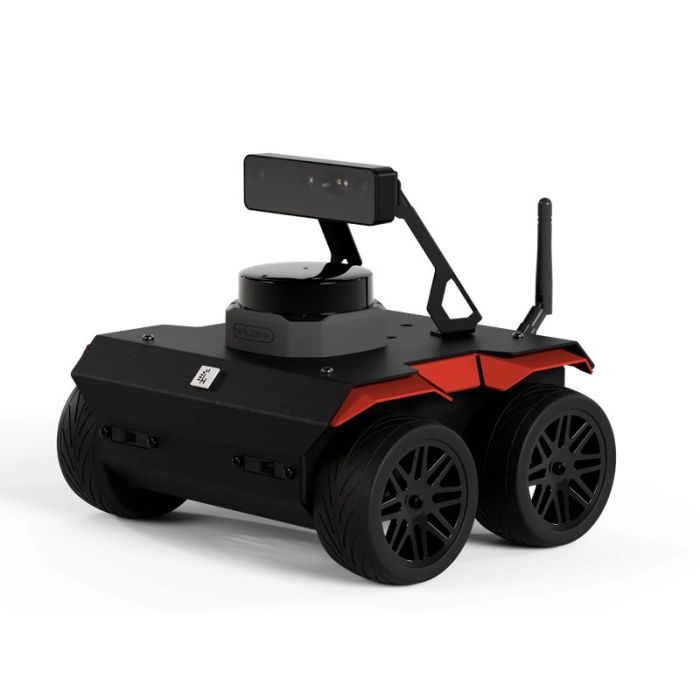
Picture a corridor after hours: a small robot moves past the doorways while, on a laptop across the room, a map takes shape line by line. For many students, this is the moment robotics stops being theory. The Husarion ROSbot 3 UGV is designed to make that moment routine rather than rare. It is an indoor mobile robot platform, purpose-built for research and education, that brings a Raspberry Pi 5 computer, a 360 degree LiDAR, a depth camera and a preinstalled ROS 2 environment together in a chassis that sits comfortably on a desk. Its value lies less in novelty than in repeatability: a platform dependable enough for a class to run the same experiment many times, and capable enough for a research group to keep using once the course is over.
Robots Middle East sells the Husarion ROSbot 3 UGV and supplies it to universities, schools, research centres and engineering teams across the Middle East. Our team prepares each quotation, coordinates delivery to your institution and remains your point of contact for technical support once the robot has arrived, so that your laboratory deals with a single partner from the first enquiry to the first mapped room.
Background
Husarion and the ROSbot line
Husarion builds mobile robots around ROS, the open-source Robot Operating System that has become the shared working language of academic and applied robotics. The ROSbot line occupies the compact end of the range: robots intended for desks, teaching laboratories and office floors rather than warehouses or open ground. The ROSbot 3 generation is offered in two versions, ROSbot 3 and ROSbot 3 PRO. Both share the same chassis, computer, drive figures and core electronics, and differ in the camera and LiDAR fitted. This page covers the ROSbot 3, the version equipped with the Luxonis OAK-D Lite camera and the RPLIDAR C1.
For institutions, this shared architecture matters. Code written for one version runs on hardware that is otherwise identical, so a department can equip a teaching laboratory and a research group with the same family and keep a single body of course material, launch files and maintenance knowledge.
A complete stack on a Raspberry Pi 5
At the heart of the robot is a Raspberry Pi 5 with 8GB RAM and a VideoCore VII GPU, running from a 64GB microSD card. Ubuntu 24.04 with ROS 2 Jazzy comes preinstalled, so the platform starts on a current long-term software base rather than on an older distribution that a laboratory would first have to migrate. Alongside the single-board computer sits a built-in STM32F407 microcontroller, and dual-band 2.4 GHz and 5 GHz 802.11b/g/n/ac wireless LAN connects the robot to a workstation or campus network.
Perception is layered. A 360 degree RPLIDAR C1 scans the surroundings, the OAK-D Lite provides 3D vision, a BNO055 9-axis absolute orientation sensor reports attitude, four VL53L0X time-of-flight sensors measure nearby distances and four magnetic encoders track wheel motion. Together they provide the raw material for mapping, localisation and sensor fusion without any hardware having to be added first.
Technical Specifications
| Specification | ROSbot 3 | ROSbot 3 PRO |
|---|---|---|
| Product type | Indoor mobile robot platform for research and education | Indoor mobile robot platform for research and education |
| Dimensions with camera and LiDAR (L x W x H) | 200 x 233 x 197 mm / 7.9 x 9.2 x 7.7 in | 200 x 233 x 197 mm / 7.9 x 9.2 x 7.7 in |
| Dimensions without camera and LiDAR (L x W x H) | 200 x 233 x 103 mm / 7.9 x 9.2 x 4.0 in | 200 x 233 x 103 mm / 7.9 x 9.2 x 4.0 in |
| Weight | 2,84 kg / 100 oz (with camera and LiDAR), 2,45 kg / 86 oz (without camera and LiDAR) | 2,84 kg / 100 oz (with camera and LiDAR), 2,45 kg / 86 oz (without camera and LiDAR) |
| Standard wheel diameter / Clearance / Wheelbase | 84 mm / 23 mm / 106 mm | 84 mm / 23 mm / 106 mm |
| Chassis material | Powder-coated aluminium plate, 1.5 mm thick | Powder-coated aluminium plate, 1.5 mm thick |
| Maximum translational velocity | 1.0 m/s | 1.0 m/s |
| Maximum rotational velocity | 420 deg/s (7.33 rad/s) | 420 deg/s (7.33 rad/s) |
| Maximum load capacity | Up to 5 kg / 176 oz (not in continuous work) | Up to 5 kg / 176 oz (not in continuous work) |
| Battery life | 1.5h - 5h | 1.5h - 5h |
| Computer | Raspberry Pi 5 (8GB RAM, VideoCore VII GPU) | Raspberry Pi 5 (8GB RAM, VideoCore VII GPU) |
| Storage | 64GB microSD card | 64GB microSD card |
| Networking | 2.4 GHz and 5 GHz 802.11b/g/n/ac wireless LAN | 2.4 GHz and 5 GHz 802.11b/g/n/ac wireless LAN |
| 3D camera | Luxonis OAK-D Lite | Luxonis OAK-D Pro |
| LiDAR | RPLIDAR C1, 360 degree | RPLIDAR S2, 360 degree |
| IMU sensor | BNO055 9-axis absolute orientation sensor | BNO055 9-axis absolute orientation sensor |
| Infrared distance sensors | 4 x VL53L0X Time-of-Flight, up to 200 cm range | 4 x VL53L0X Time-of-Flight, up to 200 cm range |
| Encoders | 4 x magnetic, 48cpr, 12 poles | 4 x magnetic, 48cpr, 12 poles |
| Batteries | 3 x Li-Ion 18650 protected, rechargeable, 3500mAh, 3.7V nominal (similar batteries may be supplied) | 3 x Li-Ion 18650 protected, rechargeable, 3500mAh, 3.7V nominal (similar batteries may be supplied) |
| Built-in microcontroller | STM32F407 | STM32F407 |
| USB (rear panel) | 2 x USB 2.0 host ports from SBC | 2 x USB 2.0 host ports from SBC |
| Servo outputs | 6, with PWM | 6, with PWM |
| Operating system | Ubuntu 24.04 with ROS 2 Jazzy preinstalled | Ubuntu 24.04 with ROS 2 Jazzy preinstalled |
Specifications are as published by the manufacturer and are confirmed against the datasheet at quotation. Husarion has not published an IP rating, an operating temperature range, the camera resolution, a motor power figure for the robot as a whole or its climbing ability; these points are confirmed at quotation.
What is the difference between ROSbot 3 and ROSbot 3 PRO?
The two versions are deliberately close. Dimensions, weight, wheel geometry, chassis, top speeds, load capacity, battery life, computer, storage, networking, inertial sensing, time-of-flight sensors, encoders, microcontroller and expansion ports are listed identically for both. The difference lies entirely in the perception hardware: the ROSbot 3 carries the Luxonis OAK-D Lite camera and the RPLIDAR C1, whereas the ROSbot 3 PRO carries the OAK-D Pro camera and the RPLIDAR S2.
In practice, the choice is driven by the sensing your work depends on. Where the aim is to teach the ROS 2 workflow, run SLAM and navigation exercises and build perception pipelines, the ROSbot 3 provides a complete sensor suite on the same mechanical and software base. Where a project is defined by the particular camera or LiDAR model, for example to match equipment already used elsewhere in a laboratory, the PRO configuration is the one to compare. Because the rest of the robot is shared, software developed on one version carries over to the other with the sensor drivers as the main point of attention.
What can the ROSbot 3 do straight out of the box?
The robot arrives with Ubuntu 24.04 and ROS 2 Jazzy preinstalled, so the first session can be spent driving, visualising sensor data and recording maps rather than installing operating systems. It can also be controlled without writing any code using a Logitech F710 gamepad; please note that the gamepad is not included in the standard set and can be added to your quotation if required.
Beyond the first day, the expansion features determine how far the platform can grow. Two USB 2.0 host ports on the rear panel accept additional peripherals, and six PWM servo outputs allow small actuators, such as a pan mechanism or a simple gripper, to be driven directly. With a maximum load capacity of up to 5 kg, not in continuous work, the chassis has room for modest experimental payloads. Battery life of 1.5h - 5h, depending on use, sets the rhythm of a laboratory session, and the three rechargeable Li-Ion 18650 cells are a familiar format.
Who is the Husarion ROSbot 3 UGV for?
The first audience is university teaching. Lecturers running courses in mobile robotics, autonomous systems or ROS 2 need hardware that behaves the same on every bench, week after week; a compact indoor robot with its sensors already integrated allows a course to focus on algorithms rather than assembly. Technical colleges and advanced secondary programmes with robotics tracks fall into the same group, particularly where the robot must be usable in an ordinary classroom.
The second audience is research. Groups working on localisation, mapping, path planning, multi-robot coordination or sensor fusion use small platforms like this to test ideas on real hardware before moving to larger vehicles. Engineering teams in companies developing indoor service or inspection concepts can use it in the same way for early prototyping.
Where a project is specified around the OAK-D Pro camera or the RPLIDAR S2, the Husarion ROSbot 3 PRO UGV is the better match, as it shares everything else with this version. Buyers comparing platforms for different environments or payloads can browse our full range of UGVs.
What is the Husarion ROSbot 3 UGV used for?
- SLAM teaching: students build maps of corridors and laboratories from the 360 degree LiDAR in real time.
- Autonomous navigation research: path planning and obstacle avoidance algorithms are tested on physical hardware rather than in simulation alone.
- Sensor fusion: LiDAR, depth camera, IMU, time-of-flight sensors and wheel encoders provide data for localisation experiments.
- Computer vision: the OAK-D Lite depth camera supports object detection and 3D perception projects on a moving platform.
- Multi-robot experiments: dual-band wireless networking allows several robots to share a network for coordination studies.
- Indoor application prototyping: servo outputs and USB ports let teams add small actuators and peripherals for proof-of-concept work.
Pricing and Availability
Robots Middle East supplies the Husarion ROSbot 3 UGV on a quotation basis, so that each offer reflects the configuration, quantity and accessories your institution actually needs, whether a single robot for a research group or a set for a teaching laboratory. Delivery, customs and support are arranged with the quotation. To receive a tailored offer for your project, please use the quotation request available on this page.
Frequently Asked Questions
Which software does the ROSbot 3 run?
The robot operates on Ubuntu 24.04 with ROS 2 Jazzy preinstalled. It is ready for ROS 2 development as soon as it is switched on.
Which camera and LiDAR does this version carry?
The ROSbot 3 is fitted with a Luxonis OAK-D Lite 3D camera and a 360 degree RPLIDAR C1. The ROSbot 3 PRO carries the OAK-D Pro and the RPLIDAR S2 instead.
Can the robot be driven without programming?
Yes, it can be controlled with a Logitech F710 gamepad. The gamepad is not included in the standard set and can be added to your quotation.
How long does the battery last?
Husarion states a battery life of 1.5h - 5h, which depends on how the robot is used. Power is supplied by three rechargeable Li-Ion 18650 cells.
How much can it carry?
The maximum load capacity is up to 5 kg / 176 oz, not in continuous work. For sustained payloads, please discuss your requirements with us when requesting a quotation.
Is the ROSbot 3 suitable for outdoor use?
It is designed as an indoor mobile robot platform, and no IP rating or operating temperature range has been published. Robots Middle East can advise on platforms better suited to outdoor work.
Where can I buy the Husarion ROSbot 3 UGV and what does it cost?
You can buy it from Robots Middle East, which supplies it across the Middle East. Pricing is provided by individual quotation according to your configuration and quantity, and you can request yours on this page.
Summary
The corridor at night, the map appearing on a screen, the robot correcting its course at a doorway: the Husarion ROSbot 3 UGV is built so that these experiences can be repeated by every student and every research group that needs them. It combines a Raspberry Pi 5, a 360 degree LiDAR, a depth camera, inertial and distance sensing and a preinstalled ROS 2 Jazzy environment in a compact aluminium chassis, with servo outputs and USB ports for growth. Its sibling, the ROSbot 3 PRO, shares the same base with different perception hardware, so departments can choose without fragmenting their software. With Robots Middle East handling quotation, delivery and support, bringing reliable indoor robotics into your laboratory begins with a single enquiry, and this page is the starting point.