
Kepler Humanoid Robot
In stock
- BRAND:
- KEPLER
- PART #:
- Humanoid Robot
- ORIGIN:
- China
- AVAILABILITY:
- SUBJECT TO AVAILABILITY
- SKU:
- Kepler-Humanoid-Robot
Kepler Humanoid Robot
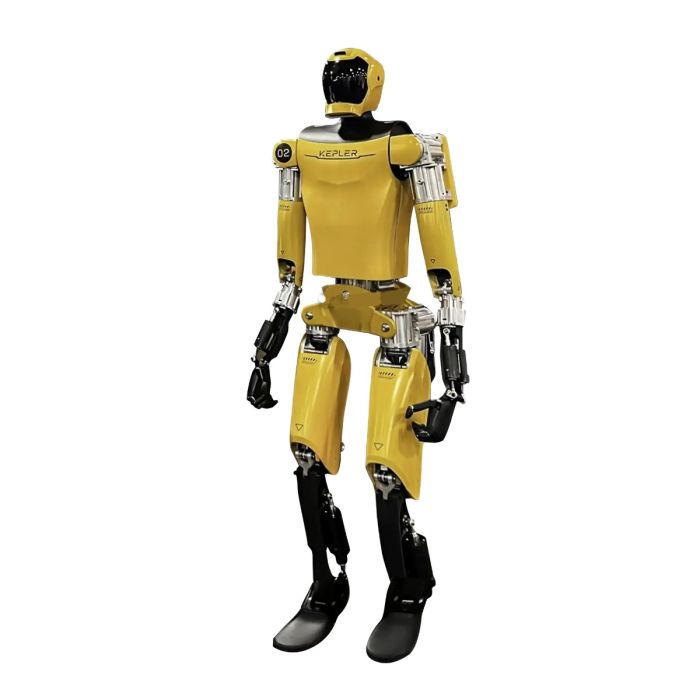
Place the Kepler humanoid beside a member of staff on a production line and the comparison is close to one for one. At 175 cm tall and 75 kg, it is built at human scale for workplaces that were designed around people, not machines. That likeness is the central argument for the Kepler Humanoid Robot . Rather than rebuilding a site around a new piece of automation, an operator can bring in a machine shaped for the site it already has. It has 52 degrees of freedom, sensorised hands and enough onboard compute to carry out task sequences autonomously in structured operational environments.
Robots Middle East supplies the Kepler Humanoid Robot to manufacturers, logistics operators, universities and research institutions across the Middle East. Our team prepares each quotation, coordinates delivery to your premises and remains your point of contact for support once the robot is in service. We can also advise on which of the three Kepler configurations best suits your project.
Background
A Shanghai developer with an industrial agenda
Kepler is a Shanghai, China-based robotics company. It has set out a clear commercial focus for its humanoid work. Its primary markets are intelligent manufacturing, warehousing and logistics, niche industries, academic research and education. That list says a good deal about the design priorities behind the robot. Industrial buyers measure a humanoid by how reliably it handles loads and repeats tasks. Researchers and educators need a capable, well-sensorised platform on which to build and test their own work. The figures on this page are those of the K2 Bumblebee, a model purpose-built for industrial settings.
Vertical integration and planetary roller screw actuation
Kepler develops and manufactures over 80% of the robot's core hardware in-house. This vertical integration is intended to reduce costs and strengthen supply chain resilience, which matters to any organisation planning a fleet rather than a single unit. At the heart of the mechanical design are Kepler's proprietary planetary roller screw actuators, engineered for smooth motion control and reduced energy draw. They work alongside a series-parallel architecture and an integrated rotary mechanism. Supported by AI algorithms, the rotary mechanism gives the robot 0.01-degree positioning accuracy and millimetre-level precision. The result is a platform that is designed to be strong enough to carry meaningful loads and precise enough for fine motor tasks.
Technical Specifications
| Specification | Value |
|---|---|
| Configurations | Bipedal Basic, Bipedal Developer, Wheeled Developer |
| Height | 175 cm (68.9 in.) |
| Weight | 75 kg (165.3 lb.) |
| Degrees of freedom | 52 |
| Integrated sensors | More than 80 |
| Onboard compute | 100 TOPS |
| Actuators | Proprietary planetary roller screw actuators |
| Payload | 15 kg (33.1 lb.) per arm; up to 30 kg (66.1 lb.) with both arms |
| Runtime | Up to eight hours of operational time on a single one-hour charge |
| Positioning accuracy | 0.01-degree |
| Precision | Millimetre-level (0.04 in) for fine motor tasks |
| Dexterous Hands | 11 degrees of freedom per hand; 25 force-sensing contact points per finger; six-axis force/torque sensor at the wrist |
| In-house hardware | Over 80% of core hardware developed and manufactured in-house |
Specifications are as published by the manufacturer and are confirmed against the datasheet at quotation.
The manufacturer has not published the walking speed, battery capacity, IP rating, operating temperature range, connectivity, operating system, package contents or a formal charging-time specification; each of these is confirmed at quotation.
How much can the Kepler Humanoid Robot carry, and for how long?
Payload and endurance are the two figures that decide whether a humanoid can do real work. On both, the Kepler Humanoid Robot is pitched at a full working shift. Each arm supports 15 kg (33.1 lb.), and the robot handles up to 30 kg (66.1 lb.) when both arms share the load. That covers a wide range of totes, cartons, component trays and tooling found in factories and distribution centres. This load capacity comes from the combination of the series-parallel architecture and the actuation system.
Endurance follows the same logic. The robot delivers up to eight hours of operational time on a single one-hour charge. In practice, this means it is planned around a shift pattern rather than around short demonstration cycles. The planetary roller screw actuators are engineered for reduced energy draw, which supports that endurance. Buyers planning around-the-clock operation are welcome to discuss charging logistics and shift rotation with us when requesting a quotation.
What makes the Kepler Dexterous Hands suited to fine work?
Carrying capacity alone does not make a humanoid useful. Many of the tasks people do on a line involve grip, feel and placement rather than force. Kepler's proprietary Dexterous Hands address this directly. Each hand has 11 degrees of freedom, and each finger carries 25 force-sensing contact points. A six-axis force/torque sensor sits at each wrist. Together, these give the robot detailed feedback on how firmly it is holding an object and how that object is reacting.
Combined with millimetre-level (0.04 in) precision and 0.01-degree positioning accuracy, the hands allow the robot to take on fine motor tasks as well as heavier handling. The more than 80 integrated sensors across the body, and 100 TOPS of onboard compute, support the autonomous execution of task sequences in structured environments. For integrators, this pairing of a strong frame with sensitive hands is what widens the range of jobs a single platform can cover.
Who is the Kepler Humanoid Robot for?
The first group is manufacturers pursuing intelligent manufacturing. These are plants where repetitive handling, line-side replenishment and fine assembly steps are candidates for automation, but where the layout is built for people. A human-scale robot can be introduced into such a setting with fewer changes to the surrounding infrastructure than fixed automation typically requires.
The second group is warehousing and logistics operators. They need a platform that lifts, carries and places goods consistently through a shift. The dual-arm payload and eight-hour runtime are the figures most relevant to them. Operators in niche industries, where tasks are specialised and volumes may not justify bespoke machinery, form a third segment.
Academic research groups and educational institutions complete the picture. For them, a heavily sensorised body and dexterous hands make the robot a platform for work in embodied AI, manipulation and human–robot interaction. Kepler offers the robot in three configurations: Bipedal Basic, Bipedal Developer and Wheeled Developer. Robots Middle East helps research teams and integrators choose the right starting point among them.
Buyers who want the K2 Bumblebee specifically can also consult the Kepler K2 Bumblebee Humanoid Robot (K2 BumbleBee) page. Those comparing walking platforms more broadly can browse our Bipedal Humanoids range or the wider Humanoids category.
What is the Kepler Humanoid Robot used for?
- Line-side material handling: moving parts, trays and components between stations on a production line.
- Warehouse handling: lifting and carrying totes and cartons within distribution and fulfilment operations.
- Fine assembly steps: using the sensorised Dexterous Hands for tasks that call for controlled grip and accurate placement.
- Niche industrial tasks: covering specialised, lower-volume work where dedicated machinery is hard to justify.
- Academic research: serving as a platform for studies in manipulation, locomotion and embodied AI.
- Education and training: giving students and engineers hands-on experience with a full-size humanoid robot.
Pricing and Availability
Robots Middle East supplies the Kepler Humanoid Robot on a quotation basis. This allows us to match the configuration, the scope of supply and the support arrangements to your project. Please tell us about your intended application, your site and the configuration you are considering, and we will prepare a tailored proposal. Delivery, customs clearance and after-sales support are arranged together with the quotation. To begin, please use the quotation request available on this page.
Frequently Asked Questions
Which configurations of the Kepler Humanoid Robot are offered?
Kepler offers three configurations: Bipedal Basic, Bipedal Developer and Wheeled Developer. Robots Middle East can advise which one suits your project.
How much weight can the robot lift?
The robot supports 15 kg (33.1 lb.) per arm and up to 30 kg (66.1 lb.) when using both arms.
How long does the robot operate between charges?
It delivers up to eight hours of operational time on a single one-hour charge.
What sensing does the robot have?
The robot has more than 80 integrated sensors. Each finger of its Dexterous Hands carries 25 force-sensing contact points, and each wrist has a six-axis force/torque sensor.
Can the robot work autonomously?
With 100 TOPS of onboard compute, the robot can autonomously execute task sequences in structured operational environments.
How large is the robot?
The robot stands 175 cm (68.9 in.) tall and weighs 75 kg (165.3 lb.), a human scale that suits workplaces designed around people.
Where can I buy the Kepler Humanoid Robot and what does it cost?
You can buy the Kepler Humanoid Robot from Robots Middle East, which supplies it across the Middle East. Cost depends on the configuration and the scope of supply, so please request a quotation through this page.
Summary
The Kepler Humanoid Robot makes its case by matching the people it works alongside. It has a human-scale body of 175 cm and 75 kg, and hands with the feedback needed for careful work. Beneath that familiar shape sit 52 degrees of freedom, proprietary planetary roller screw actuators and 100 TOPS of onboard compute. It can carry up to 30 kg (66.1 lb.) with both arms and runs for up to eight hours on a one-hour charge. It is a platform designed to fit into existing workplaces rather than to replace them, whether in a factory, a warehouse, a laboratory or a classroom. To agree the configuration and the terms of supply with Robots Middle East, this page is the starting point.
Specifications
General
What's included
Related Products
Out of stock