
Kepler K2 Hornet Humanoid Robot
In stock
- BRAND:
- KEPLER
- PART #:
- K2 Hornet
- ORIGIN:
- China
- AVAILABILITY:
- SUBJECT TO AVAILABILITY
- SKU:
- Kepler-K2-Hornet
Kepler K2 Hornet Humanoid Robot
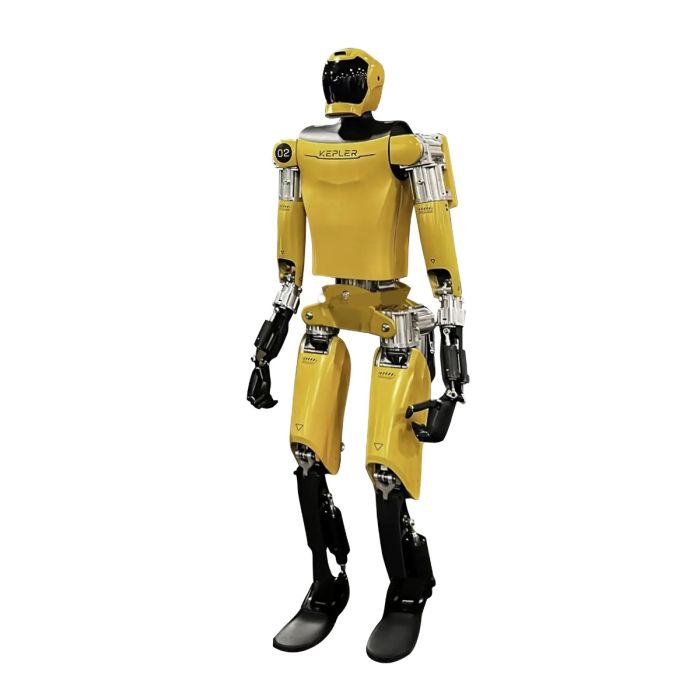
Almost every workplace in the region was designed around the human body: shelf heights, door handles, tool grips, control panels and the width of an aisle between racks. Redesigning a facility around a conventional machine is expensive. A robot built to the proportions of a person can, in principle, work within the existing layout. That is the case for the Kepler K2 Hornet Humanoid Robot, a bipedal humanoid from KEPLER that stands at adult height, walks on two legs and works with dexterous five-finger hands. Its onboard AI computer and sensor suite let it perceive and act in spaces that were never planned for automation.
Robots Middle East supplies the Kepler K2 Hornet Humanoid Robot to universities, research laboratories, system integrators and industrial operators across the Middle East. Robots Middle East prepares each quotation, arranges delivery to the customer's site and provides support after installation. Our team can also advise on how the robot fits into an existing programme of automation or research.
Background
KEPLER and its rapid path to production
KEPLER was founded in 2023. In less than three years it went from a start-up to small-batch mass production of humanoid robots, a short timeline for a sector where many projects remain at the prototype stage. The company follows a strategy of vertical integration: more than 80% of the core hardware in its robots is developed and manufactured in-house. Kepler links this approach to lower costs and a more resilient supply chain, both of which matter to buyers who plan to deploy several units or to maintain a fleet over years. KEPLER's range also includes the Kepler Robotics K1 Humanoid Robot, and the K2 "Hornet" has been shown in live demonstrations in the company's showroom.
Positioning: a general-purpose humanoid with its own AI model
The K2 is a general-purpose bipedal humanoid rather than a single-task machine. It runs KeplerBrain, Kepler's proprietary AI model built for industrial use, which supports collaboration between several robots. On the hardware side, an NVIDIA Jetson Orin NX module provides 100 TOPS of AI computing power on the robot itself. A sensor set combining 3D LiDAR, infrared binocular depth cameras and an RGB-D head camera supplies the spatial awareness needed to move and handle objects. Connectivity through Wi-Fi 6 and 5G, together with ROS2 support, places the K2 within the software ecosystem that many research and integration teams already use.
Technical Specifications
| Specification | Value |
|---|---|
| Height (standing) | 1720 mm |
| Weight | 75 kg |
| Degrees of freedom (excl. end effector / total) | 30 / 52 |
| Maximum joint torque | Over 220 N·m |
| Payload | 30 kg total (dual-arm) |
| Max movement speed | 1 m/s |
| Battery capacity | 30 Ah |
| Battery energy | 2.33 kWh, rechargeable |
| Battery life | 8 h |
| AI computing power | 100 TOPS |
| AI computing module (SoC / RAM / storage) | NVIDIA Jetson Orin NX / 16G / 128G |
| Head camera | RGB-D camera x1 (Orbbec Gemini 335) |
| Further sensors | 3D LiDAR, infrared binocular depth cameras |
| Wireless connectivity | WiFi 6, Bluetooth 5.2, 5G |
| ROS | ROS2 |
| End effector | Five-finger dexterous hand |
| Hand degrees of freedom | 6 active, 11 total |
| AI model | KeplerBrain, with multi-robot collaboration |
Specifications are as published by the manufacturer and are confirmed against the datasheet at quotation.
The manufacturer has not published the IP rating, the operating temperature range, the shipping dimensions, the package contents or a runtime figure on its own product page; these are confirmed at quotation.
What makes the Kepler K2 Hornet suited to spaces built for people?
The argument for a humanoid rests on three things: size, hands and judgement. At 1720 mm standing height, the K2 reaches the shelves, benches and controls that human workers use, and its bipedal gait lets it move through areas where floors, steps and thresholds were laid out for people on foot. The arms carry a total payload of 30 kg, enough for a wide range of handling tasks in workshops, stores and laboratories.
The hands make the difference between pushing objects around and actually manipulating them. Each five-finger dexterous hand has 11 degrees of freedom, 6 of them active, which allows grasps adapted to the shape of a part, a container or a tool. Across the whole body, 52 degrees of freedom and joint torque of over 220 N·m give the robot the range of motion and strength to bend, reach and lift in coordinated movements.
Judgement comes from the computing and sensing layers. The Jetson Orin NX module processes perception and control on board, so the robot does not depend on a constant link to a remote server for every decision. The 3D LiDAR maps the surroundings, the infrared binocular depth cameras and the Orbbec Gemini 335 RGB-D head camera resolve objects at working distance, and KeplerBrain coordinates tasks, including tasks shared between several robots. The result is a platform that can be introduced into an existing workplace with fewer changes to the layout than a fixed automation cell would usually require.
Should I choose the bipedal K2 or the wheeled K2-W?
KEPLER offers the K2 in two versions. The K2 described on this page walks on two legs; the K2-W mounts the same upper body on a wheeled chassis. The choice depends mainly on the ground the robot will cover. Legs make sense where the route includes steps, uneven surfaces or confined spaces in which a person would walk, and where the research interest lies in bipedal locomotion itself. A wheeled base generally suits long runs across level floors, such as the main aisles of a warehouse or a production hall, where stability and continuous travel matter more than stepping over obstacles.
Buyers whose sites are entirely flat may wish to compare the Kepler K2 Hornet Wheeled Humanoid Robot before deciding. Robots Middle East can set out the differences for a specific site as part of the quotation.
Who is the Kepler K2 Hornet for?
Universities and research institutes form a natural first group. The combination of ROS2, an NVIDIA Jetson computer and a full-body humanoid with dexterous hands gives research teams a platform for work on locomotion, manipulation, perception and embodied AI, without having to build the hardware themselves.
Industrial operators and logistics companies are the second group. Organisations exploring humanoid automation in manufacturing, warehousing or maintenance can use the K2 to test which tasks a humanoid can take over in their own facilities, and the multi-robot collaboration supported by KeplerBrain points towards deployments of more than one unit.
System integrators are a third group: companies that build automation solutions for clients and need a humanoid base on which to develop applications. Innovation centres, technology showrooms and organisations preparing public demonstrations also find the K2 relevant, as it shows visitors what current humanoid robotics can do.
Those comparing several platforms can browse the wider Bipedal Humanoids range or the full Humanoids category, while sites with level floors throughout should look at the wheeled K2-W described above.
What is the Kepler K2 Hornet used for?
- Materials handling: picking, carrying and placing items in workshops and stores within its total payload of 30 kg.
- Logistics support: moving goods between shelves, workstations and staging areas laid out for human workers.
- Manufacturing assistance: repetitive handling and assembly support at workstations designed for people.
- Inspection and patrol: walking set routes while its LiDAR and depth cameras observe the surroundings.
- Research and teaching: a ROS2-compatible platform for work on locomotion, dexterous manipulation and embodied AI.
- Demonstration and innovation programmes: showing customers, partners and students how humanoid automation works in practice.
Pricing and Availability
The Kepler K2 Hornet Humanoid Robot is supplied on quotation, as configuration, software requirements and the intended application all influence the final offer. Robots Middle East prepares each quotation individually and confirms the specifications against the current manufacturer datasheet. Delivery, customs clearance and after-sales support are arranged together with the quotation. To begin, please tell us about your project, your site and the tasks you have in mind using the quotation request available on this page.
Frequently Asked Questions
How tall is the Kepler K2 Hornet and how much does it weigh?
The K2 stands 1720 mm tall and weighs 75 kg.
How much can the robot carry?
The K2 has a total dual-arm payload of 30 kg.
How long does the battery last?
The K2 has a battery life of 8 h from a 30 Ah, 2.33 kWh rechargeable battery. Robots Middle East confirms the runtime for your intended duty cycle at quotation.
What computer and software does the robot use?
The K2 uses an NVIDIA Jetson Orin NX module with 16G RAM and 128G storage, delivering 100 TOPS of AI computing power. It supports ROS2 and runs KeplerBrain, Kepler's proprietary AI model.
What sensors does the K2 have?
The robot carries an Orbbec Gemini 335 RGB-D camera in its head, together with 3D LiDAR and infrared binocular depth cameras.
Can several K2 robots work together?
Yes. KeplerBrain supports multi-robot collaboration, so tasks can be coordinated across more than one unit.
Where can I buy the Kepler K2 Hornet Humanoid Robot and what does it cost?
Robots Middle East supplies the Kepler K2 Hornet Humanoid Robot across the Middle East. The cost depends on configuration and project scope, so please request a quotation and our team will prepare an offer that includes delivery and support.
Summary
The appeal of the Kepler K2 Hornet Humanoid Robot lies in working within the world as people have built it, rather than asking that world to be rebuilt for a machine. Its human height, bipedal gait and dexterous hands let it use existing shelves, benches and tools. On-board computing, a sensor suite combining LiDAR and depth cameras, and the KeplerBrain AI model give it the perception and coordination that such work requires. It comes from a manufacturer that makes most of its core hardware in-house and reached series production quickly. For research teams, integrators and operators in the region who want to explore what a humanoid can do in their own facilities, this page is the starting point.
Specifications
General
What's included
Related Products
Out of stock