
Noetix N2 EDU Athlete Intelligence Humanoid Robot
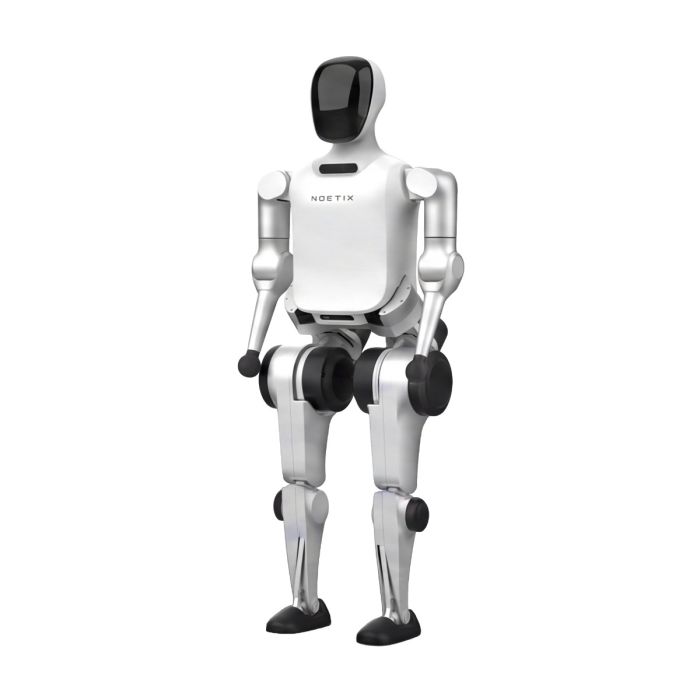
In stock
- BRAND:
- NOETIX
- MODEL:
- N2 EDU
- PART #:
- E1
- ORIGIN:
- China
- AVAILABILITY:
- SUBJECT TO AVAILABILITY
- SKU:
- Noetix-N2-EDU
Noetix N2 EDU Athlete Intelligence Humanoid Robot
Between a gait that works in simulation and a gait that holds up on a real floor lies most of the difficulty in humanoid robotics, and it is a gap that slides and videos cannot close. The Noetix N2 EDU Athlete Intelligence Humanoid Robot places that gap within reach of a teaching laboratory. It is a child-sized biped with electric joints strong enough to make locomotion a genuine engineering problem, an open Linux control stack that students can read and modify, and, in the EDU edition, the option of substantially more onboard computing for work on perception and learning. It is less a demonstration piece than a body on which a curriculum or a research programme can be built.
Robots Middle East supplies the Noetix N2 EDU to universities, schools, research centres and innovation programmes across the Middle East. Robots Middle East prepares the quotation, advises on the right configuration, arranges delivery and customs clearance to your site, and provides support after installation, so that your team deals with a single regional partner from first enquiry to first lesson.
Background
Noetix Robotics and the N2 series
The N2 is developed by Noetix Robotics, a company based in Beijing and founded in September 2023. For a firm of that age, its portfolio is notably focused on humanoid form factors, and the N2 sits within a range that extends from compact educational humanoids to larger embodied-intelligence platforms. The N2 series comprises a standard model and the EDU edition presented on this page; both share the same body, joint layout and drive system, and they differ in the computing options available to the developer. Buyers comparing the wider family will find it gathered under Bipedal Humanoids.
Athletic hardware, open software
The design philosophy of the N2 pairs two qualities that are not always found together. On the mechanical side, the robot uses pure electric drive through 48V DC geared motors with encoders, with a peak knee joint torque of 150 N·m, which gives the legs real authority over the robot's mass. On the software side, the control stack runs on an open Linux operating system with Python, C++ and ROS compatibility. Walking gaits are generated by deep reinforcement learning to produce anthropomorphic movement, and the robot supports speech and visual interaction powered by large language models. The result is a platform in which locomotion, perception and conversation can all be studied on the same machine.
Technical Specifications
| Specification | Value |
|---|---|
| Dimensions (N2 series) | 118 cm x 47 cm x 29 cm |
| Weight (N2 series) | 30 kg |
| Degrees of freedom | 18 DoF: 4 DoF per arm (8 total), 5 DoF per leg (10 total) |
| Drive | Pure electric drive; 48V DC geared motors with encoders |
| Peak knee joint torque | 150 N·m |
| Processor | Rockchip RK3588s 8-core |
| Edge compute (standard) | 6 TOPS |
| Edge compute (EDU edition option) | Upgradable to 67 TOPS with optional NVIDIA Jetson Orin Nano Super |
| Memory | 4+32GB/8GB |
| Payload | About 5 kg continuous-walking carrying capacity |
| Operating system and development | Open Linux OS; Python/C++; ROS compatible |
| AI and interaction | Deep reinforcement learning for anthropomorphic walking gaits; LLM-powered speech and visual interaction |
Specifications as published by the manufacturer; confirmed against the datasheet at quotation.
The manufacturer has not published the weight of the EDU configuration specifically, the box contents, the IP rating, the charging time, Wi-Fi and Bluetooth support, an official maximum running speed or the operating temperature range; Robots Middle East confirms these at quotation.
What does the EDU edition add to the standard N2?
The body of the N2 does not change between versions: the same 18 degrees of freedom, the same 48V electric drive and the same knee torque apply across the series. What the EDU edition opens up is computing headroom. The standard controller is a Rockchip RK3588s 8-core processor delivering 6 TOPS of edge compute, which is sufficient for running the robot's locomotion and interaction functions. The EDU edition offers the optional NVIDIA Jetson Orin Nano Super, raising onboard compute to 67 TOPS.
That difference matters most to those who intend to run their own models on the robot rather than simply use its built-in behaviours. Vision pipelines, on-device inference and experiments with learned control policies all benefit from processing that stays on the robot instead of being sent to an external workstation. A department teaching introductory programming may never need that headroom; a laboratory publishing work on embodied AI very probably will. The choice between the two editions is therefore best made by looking at the work planned for the second and third year of use, not only the first.
How is the Noetix N2 EDU programmed?
Because the control stack runs on an open Linux operating system, the N2 EDU behaves much like any other Linux-based development target. Students can write in Python for rapid experimentation or in C++ where performance matters, and ROS compatibility means that existing ROS knowledge, tools and teaching material carry over directly. For institutions that already teach ROS on wheeled robots or manipulators, the N2 EDU extends the same workflow to a legged, humanoid body.
The reinforcement-learning approach to gait gives a useful teaching reference point: the robot's walking is produced by learned policies rather than hand-tuned trajectories alone, which allows lecturers to connect the theory of reinforcement learning with behaviour that students can observe on the laboratory floor. The LLM-powered speech and visual interaction adds a further layer for projects in human-robot interaction.
Who is the Noetix N2 EDU Athlete Intelligence Humanoid Robot for?
The most natural buyers are universities and technical colleges running robotics, mechatronics or artificial intelligence programmes, where a humanoid platform with an open software stack supports both coursework and final-year projects. Research groups working on locomotion, reinforcement learning or embodied AI will value the EDU edition's optional Jetson upgrade, which keeps substantial inference on the robot itself. Secondary schools with advanced STEM tracks, innovation centres and national technology programmes can use the robot as a flagship platform that draws students towards engineering, and its child-sized proportions make it easier to accommodate in a teaching space than a full-size humanoid.
Organisations that need the N2 body but do not foresee heavy onboard computation may find the standard Noetix N2 Athlete Universal Humanoid Robot a closer fit. Those assembling a broader laboratory can review other platforms under Research Robots, including the Noetix E1 EDU Embodied Intelligence Humanoid Robot from the same manufacturer.
What is the Noetix N2 EDU Athlete Intelligence Humanoid Robot used for?
- Locomotion research — studying bipedal balance and walking on a robot with learned anthropomorphic gaits.
- Reinforcement learning teaching — linking policy-learning theory to behaviour students can watch and measure.
- ROS curricula — extending ROS courses from wheeled platforms to a legged humanoid body.
- Embodied AI development — running perception and inference on board with the optional Jetson upgrade.
- Human-robot interaction studies — exploring speech and visual interaction driven by large language models.
- STEM outreach — giving schools and innovation centres a humanoid that draws students into engineering.
Pricing and Availability
The Noetix N2 EDU is supplied on quotation, because the right configuration depends on whether your team needs the optional NVIDIA Jetson Orin Nano Super and on how the robot will be deployed. Robots Middle East discusses your programme and recommends the edition that suits it before any commitment. Delivery, customs clearance and after-sales support are arranged together with the quotation. To begin, request your quotation using the form available on this page.
Frequently Asked Questions
How large is the Noetix N2 EDU?
The N2 series measures 118 cm x 47 cm x 29 cm and weighs 30 kg, a child-sized format that suits teaching spaces.
How many degrees of freedom does the robot have?
It has 18 degrees of freedom: 4 in each arm and 5 in each leg.
What computing power does the EDU edition offer?
The standard Rockchip RK3588s 8-core processor delivers 6 TOPS. The EDU edition can be upgraded to 67 TOPS with the optional NVIDIA Jetson Orin Nano Super.
Can the robot be programmed with ROS?
Yes. It runs an open Linux operating system with ROS compatibility and supports development in Python and C++.
How much can the N2 EDU carry?
The N2 series has a carrying capacity of about 5 kg during continuous walking.
How are the robot's joints driven?
The N2 uses pure electric drive through 48V DC geared motors with encoders. Peak knee joint torque reaches 150 N·m.
Where can I buy the Noetix N2 EDU Athlete Intelligence Humanoid Robot and what does it cost?
You can buy it from Robots Middle East, which supplies it across the Middle East. The cost depends on the configuration you choose, and Robots Middle East provides it in a tailored quotation that you can request on this page.
Summary
The distance between a gait that works in theory and one that works on a real floor is where robotics students become engineers, and the Noetix N2 EDU is built to put that distance in front of them. Its electric drive and strong knee joints make locomotion a serious subject, its open Linux and ROS environment keeps the software accessible, and the EDU edition's optional Jetson upgrade gives research teams room to grow into embodied AI. For institutions across the Middle East planning their next step into humanoid robotics, with Robots Middle East handling quotation, delivery and support, this page is the starting point.