
PUDU T300 Standard Industrial Delivery Robot
In stock
- BRAND:
- PUDU ROBOTICS
- MODEL:
- T300 STANDARD
- ORIGIN:
- China
- AVAILABILITY:
- SUBJECT TO AVAILABILITY
- SKU:
- PUDU-T300-Standard
PUDU T300 Standard Industrial Delivery Robot
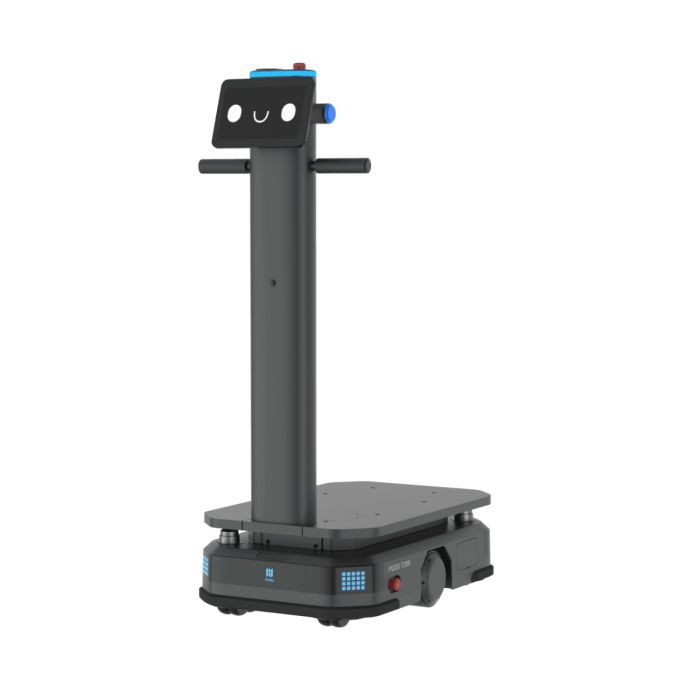
A delivery robot is usually judged by what it can carry, yet the more telling question is what it carries relative to itself. The PUDU T300 Standard Industrial Delivery Robot weighs 65 kg and has a maximum payload of 300 kg. On a fully loaded run, the cargo, not the machine, is the heavier part of the journey. That balance shapes the rest of the design: a high-strength load-bearing chassis underneath, a body slim enough for working corridors, and integration functions that allow it to travel between floors and through controlled doors without a member of staff walking alongside it.
Robots Middle East supplies the PUDU T300 Standard to manufacturers, warehouse operators and commercial facilities across the Middle East. Our team prepares the quotation, coordinates delivery to your site and supports the robot once it is in service. You therefore have one point of contact from the first enquiry through to daily operation, whether the robot is joining a production hall, a distribution centre or the service corridors of a large commercial building.
Background
Pudu Robotics and its step into industry
PUDU ROBOTICS built its reputation with service robots for hospitality and commercial premises, where machines share space with guests and staff and must move politely among them. The PUDU T300 marked a change of direction. Pudu Robotics announced it as its first robot designed expressly for industrial applications, and it made its debut at Hannover Messe 2024, one of the principal international showcases for industrial technology. That lineage is evident in the product: it applies the navigation and safety discipline of a robot made for crowded public spaces to the heavier, more repetitive work of a factory or warehouse floor.
An open, load-bearing platform
The Standard version, model WTID01, is a transport robot designed for industrial material handling and high-load commercial delivery. Its foundation is a high-strength load-bearing chassis that the manufacturer describes as offering strong openness and scalability, so the platform can be adapted to the way a site already moves its goods instead of the site having to adapt to the robot. Operators work with it through an interactive 10.1-inch touchscreen, intended to make day-to-day use straightforward and to keep operations efficient. Alongside the Standard sits the PUDU T300 Lifting, model WTIDL1, which adds lifting functionality to the same platform.
Technical Specifications
| Specification | Value |
|---|---|
| Maximum payload | 661 lbs (300 kg) |
| Machine weight | 65 kg (143.3 lbs) |
| Machine dimensions | 83.5 cm x 50 cm x 135 cm (32.8 in x 19.6 in x 53.1 in) |
| Run-time | 12h (unloaded), 6h (loaded) |
| Battery capacity | 30Ah |
| Charging time | 2h (from 0% to 90%) |
| Charging options | Automatic recharging and battery replacement |
| Cruise speed | Maximum 1.2m/s |
| Threshold crossing height | Maximum 20 mm (0.78in) |
| Groove crossing width | Maximum 35 mm (1.37 in) |
| Path clearance | Minimum 60cm (23.6 in) |
| Touchscreen | 10.1-inch |
| Multi-robot dispatch | Up to 20 robots simultaneously |
| Safety standard | ISO 3691-4 |
| Safety equipment | LiDAR sensors, depth cameras, collision protection sensors, emergency stop buttons |
Specifications are as published by the manufacturer and are confirmed against the datasheet at quotation.
The manufacturer has not published the ingress protection rating, the complete in-box contents, the wireless connectivity standards, the noise level or the sensor model details; these are confirmed at quotation.
How does the PUDU T300 Standard move between floors and through gates?
Carrying a heavy load is only half the task; the other half is reaching the drop-off point. In most buildings the obstacles are not the open aisles but the transitions: a lift to another floor, a security gate, a turnstile at the entrance to a restricted zone. The T300 Standard supports elevator access, gate and turnstile integration and remote call functions, which allows it to operate across spaces instead of being confined to a single hall.
These functions rest on its IoT capabilities: elevator and e-gate control, app-based and pager calling, and API interfaces for system integration. In practice, staff at a workstation can summon the robot from an app or a pager, the robot can call a lift and pass a controlled gate on its own, and the site's existing software can exchange instructions with it through the API. For larger deployments, the T300 uses a self-organised network to dispatch up to 20 robots simultaneously, so a fleet can share routes and tasks without each unit being managed individually.
The physical dimensions support the same aim. A minimum path clearance of 60cm (23.6 in) suits the narrower passages found in older buildings and crowded back-of-house areas, while the ability to cross thresholds of up to 20 mm (0.78in) and grooves of up to 35 mm (1.37 in) helps the robot deal with door sills, lift gaps and floor joints that would otherwise interrupt a route.
Can the PUDU T300 Standard keep up with round-the-clock operations?
A transport robot that stops for long periods simply moves the bottleneck elsewhere. The T300 Standard has a 30Ah battery that delivers a run-time of 12h unloaded and 6h loaded, and it charges from 0% to 90% in 2h. It offers both automatic recharging, where the robot returns to charge without intervention, and battery replacement, where a depleted battery is exchanged so that the robot can return to work immediately.
Taken together, these two options are how the manufacturer addresses uninterrupted service for round-the-clock operations. A site running a single shift may rely entirely on automatic recharging during quieter periods, whereas a plant working continuously can plan battery replacement into its routine so that the robot remains available throughout the day and night. Robots Middle East can help you match the charging approach to your shift pattern when preparing the quotation.
Who is the PUDU T300 Standard for?
The first group is manufacturers that move parts, components and work in progress between stores, production lines and inspection areas. For them, the combination of a 300 kg payload and a compact body allows heavy loads to travel through the same corridors that people use, and the robot is part of the wider family of factory robots designed for this kind of internal logistics.
The second group is warehouse and distribution operators who need to transfer totes, cartons and bins between zones without tying up staff on repetitive walking routes. The third is large commercial facilities, such as hotels, shopping centres and office complexes, where heavy deliveries must cross floors and controlled entrances in back-of-house areas, and where lift and gate integration matters as much as payload.
Where the task involves raising loads rather than simply carrying them, the PUDU T300 Lifting (WTIDL1) is the version to consider; it adds lifting functionality and weighs approximately 81 kg (178.5 lbs). Buyers whose loads fall into a different class can compare the PUDU T150 Light-Payload Industrial Delivery Robot and the PUDU T600 Heavy-Payload Industrial Delivery Robot, or browse the full range of industrial robots; our team will advise on which model fits your loads and routes.
What is the PUDU T300 Standard used for?
- Line-side supply: bringing parts and components from the store to the production line on a scheduled or on-demand basis.
- Work-in-progress transfer: moving partly finished goods between workstations, testing and packing areas.
- Warehouse tote and bin movement: shuttling loaded containers between picking, staging and dispatch zones.
- Multi-floor deliveries: using elevator access to carry heavy items between levels of a building without staff accompanying the load.
- Back-of-house commercial logistics: transporting linen, supplies and stock through the service areas of hotels, malls and large venues.
- Secure-area transport: passing gates and turnstiles under integrated control to reach restricted zones.
Pricing and Availability
The PUDU T300 Standard is offered on quotation, so that the configuration, the number of robots and the integration work reflect your site rather than a generic package. Delivery, customs clearance and after-sales support are arranged together with the quotation. To begin, share your loads, routes and any lifts or gates involved, and request a quotation for the PUDU T300 Standard Industrial Delivery Robot, available on this page.
Frequently Asked Questions
What is the maximum payload of the PUDU T300 Standard?
The maximum payload is 661 lbs (300 kg). The robot itself weighs 65 kg (143.3 lbs).
How long does the PUDU T300 Standard run on one charge?
The run-time is 12h unloaded and 6h loaded, from a 30Ah battery. Charging from 0% to 90% takes 2h, and battery replacement is available for continuous operation.
Can the PUDU T300 Standard use lifts and pass through gates?
Yes. It supports elevator access, gate and turnstile integration and remote call functions, together with elevator and e-gate control and API interfaces for system integration.
Which safety standard does the PUDU T300 Standard meet?
It is compliant with ISO 3691-4. Its safety measures include LiDAR sensors, depth cameras, collision protection sensors and emergency stop buttons.
How many T300 robots can work together?
Using its self-organised network, the T300 can dispatch up to 20 robots simultaneously.
How narrow a passage can the PUDU T300 Standard use?
It requires a minimum path clearance of 60cm (23.6 in). It crosses thresholds of up to 20 mm (0.78in) and grooves of up to 35 mm (1.37 in).
Where can I buy the PUDU T300 Standard and what does it cost?
Robots Middle East supplies the PUDU T300 Standard across the Middle East. The cost depends on the configuration, the fleet size and the integration required, so we provide it in a tailored quotation that you can request from this page.
Summary
The PUDU T300 Standard is built for journeys in which the load outweighs the machine carrying it. A 65 kg robot with a 300 kg payload, a 60cm path clearance and the ability to cross thresholds and grooves brings heavy goods into spaces that forklifts cannot reach and that hand carts make slow. Lift and gate integration, app and pager calling, API access and fleet dispatch of up to 20 robots extend its routes across floors and secure zones, while automatic recharging and battery replacement keep it available across shifts. As Pudu Robotics' first robot designed expressly for industry, it brings the company's experience of shared spaces to the factory and the warehouse. For organisations in the Middle East planning to let a robot take on the heavier part of the work, this page is the starting point.