
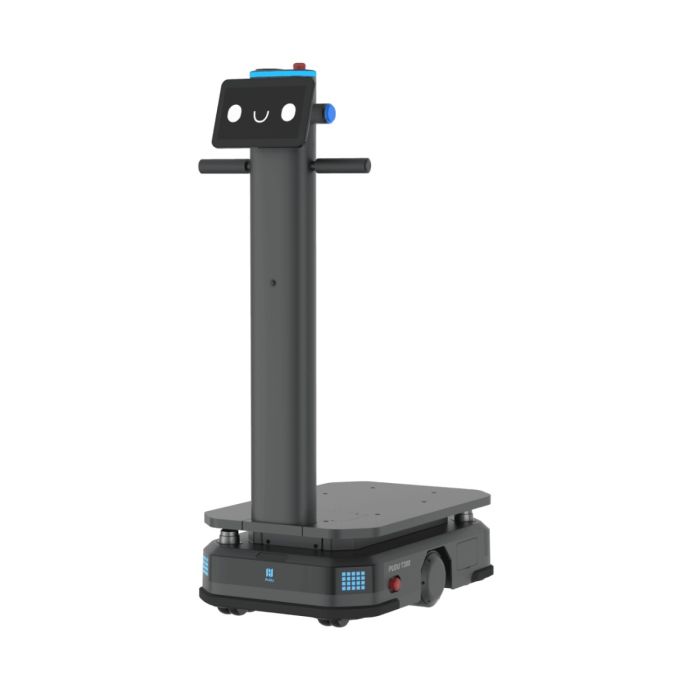
PUDU T150 Light-Payload Industrial Delivery Robot
In stock
- BRAND:
- PUDU ROBOTICS
- MODEL:
- T150
- ORIGIN:
- China
- AVAILABILITY:
- SUBJECT TO AVAILABILITY
- SKU:
- PUDU-T150
PUDU T150 Light-Payload Industrial Delivery Robot
Not every load on a factory floor deserves a forklift, yet far too many still travel by hand. Between the pallet truck and the push trolley lies a wide band of everyday cargo: tote boxes of components, finished sub-assemblies, packaging, tools and samples. They are too heavy or too frequent to carry comfortably, but too light to justify heavy machinery. The PUDU T150 Light-Payload Industrial Delivery Robot is designed for exactly that middle ground. It is a compact autonomous mobile robot that reads its surroundings with cameras and LiDAR, builds its own map and moves material between fixed points without rails, floor markers or a server room behind it.
Robots Middle East supplies the PUDU T150 to manufacturers, distribution centres and industrial facilities across the Middle East. It advises on the choice between the Standard and Lifting configurations and prepares a formal quotation for each project. Robots Middle East also coordinates delivery, commissioning and after-sales support, so a single point of contact serves the buyer from the first enquiry to routine operation.
Background
PUDU Robotics and its move into industry
PUDU Robotics built its reputation on service robots for restaurants, hotels and commercial buildings, where machines must navigate among people, furniture and unpredictable traffic. The T150 carries that navigation experience into industrial settings, where the priorities shift towards repeatable routes, recognised safety standards and integration with doors, lifts and production systems. The result is an industrial delivery robot whose design reflects lessons learned in crowded public spaces, applied to production aisles and warehouse lanes.
Two configurations on one platform
The T150 is offered in two configurations. The Standard version is optimised for cost-effective, point-to-point material delivery: it carries a load from one station to another and waits to be unloaded. The Lifting version is designed for automated integration and more advanced workflows. Its lifting mechanism raises material for transfer, so a handover at a station can happen without a person lifting the load across. Both share the same navigation concept, operating software and IoT integration, so a facility can run a mix of the two under one operating approach.
Technical Specifications
| Specification | PUDU T150 Standard | PUDU T150 Lifting |
|---|---|---|
| Machine dimensions | 835mm×500mm×1350mm (32.8 in × 19.7 in × 53.1 in) | — |
| Machine weight | 65KG (143.4lbs) | 81KG (178.57lbs) |
| Maximum payload | 150KG (330.7 lbs) | — |
| Lifting height | — | 60mm (2.36 in) |
| Maximum operating speed | 0.2~1.2 m/s (0.66~3.94 ft/s) | — |
| Minimum passable width | 60cm (23.6 in) | — |
| Navigation method | VSLAM + LiDAR SLAM | — |
| Charging time | 2h (0%-90%) | 2h (0%-90%) |
| Operating time | 12h (no-load) | 12h (no-load) |
| Step-climbing capability | 20 mm (0.79 in) | 20 mm (0.79 in) |
| Gap-crossing capability | 35 mm (1.38 in) | 35 mm (1.38 in) |
| Operating environment | 0 ℃~ 40 ℃ (32°F ~ 104°F) | 0 ℃~ 40 ℃ (32°F ~ 104°F) |
| Sensors | Dual RGBD cameras, 360° dual LiDAR | Dual RGBD cameras, 360° dual LiDAR |
| Safety compliance | ISO 3691-4, industrial-specific CE certification | ISO 3691-4, industrial-specific CE certification |
Specifications as published by the manufacturer; they are confirmed against the datasheet at quotation.
PUDU has not published the ingress protection rating, the package contents, the noise level, the battery type and voltage, the cargo deck dimensions, the Wi-Fi or network connectivity, or the maximum slope; Robots Middle East confirms these at quotation.
What does the Lifting version add to the T150?
The difference between the two configurations is the point at which a person stops being needed. With the Standard version, the robot brings the load to the station and someone removes it. Its payload of 150KG and its ability to pass through openings of 60cm make it well suited to the narrow aisles and crowded line-side areas typical of electronics assembly, parts staging and small-item storage. For many facilities, that is all the automation required: the walking is removed and the handling stays manual.
The Lifting version goes a step further. With a maximum lifting height of 60mm, it is designed for material lifting and transport tasks in industrial and warehouse environments, so a load can be raised and moved as part of an automated sequence. This is the configuration for operations that want the robot to connect directly with workstations, racks or conveyors rather than simply arrive beside them. The additional mechanism brings the machine weight to 81KG, compared with 65KG for the Standard version.
How does the T150 fit into an existing facility?
The T150 has been designed to adapt to the building rather than the reverse. Mapping takes place on board, and several robots network with one another directly, so no local servers or network deployment are required. Dual RGBD cameras and 360° dual LiDAR feed an AI-driven, multi-level navigation and obstacle-avoidance system. Combined with VSLAM + LiDAR SLAM on the Standard version, this gives precise positioning on floors shared with people, carts and machinery. The robot climbs steps of up to 20 mm and crosses gaps of up to 35 mm, which covers the thresholds and expansion joints found in most plants.
Operation is handled through an onboard touchscreen running PUDU's proprietary operating system, which is used for task dispatching, mode switching and configuration. Staff can also call the robot with button pagers, manage it through PUDU Link or connect it to existing systems via API. On the IoT side, the T150 supports e-gate control, elevator control, calling by pager and PUDU Link, so routes can pass through controlled doors and between floors.
For energy, the choice is between rapid battery swapping, auto-charging and wired power. Together, these options allow round-the-clock operation. A full charge from 0% to 90% takes 2h, and the operating time is 12h without load.
One regional point deserves attention: the operating environment is 0 ℃~ 40 ℃. In the Middle East, buyers should make sure that working areas stay within this range throughout the summer, particularly in facilities that are not fully climate-controlled.
Who is the PUDU T150 for?
The T150 suits manufacturers whose internal logistics consist of many light, repetitive trips rather than a few heavy ones. Electronics and component assembly plants, automotive parts suppliers, packaging operations and contract manufacturers in the free zones and industrial cities of the region are typical examples. Distribution centres and e-commerce warehouses can use it to shuttle picked goods between zones. Multi-storey facilities benefit from its elevator control. Operations teams that lack dedicated IT infrastructure will value the fact that no servers are needed.
Within the T150 range, the Standard version is the natural choice for straightforward station-to-station delivery where staff load and unload. The Lifting version suits integrators and plants building automated handovers into their workflows. Where loads are heavier than the T150 is designed for, Robots Middle East can also quote larger models such as the PUDU T300 Standard Industrial Delivery Robot, the PUDU T600 Heavy-Payload Industrial Delivery Robot and the PUDU T600 Underride Heavy-Payload Industrial Delivery Robot. Pallet work is handled by the PUDU MP2000 AI-Native Pallet Handling Robot. Further options are listed in our Factory Robots category.
What is the PUDU T150 used for?
- Loop delivery: running fixed circuits between stores, production lines and dispatch areas throughout the shift.
- Line-side replenishment: bringing components and consumables to workstations before stock runs out.
- Inter-line handling: moving work in progress from one production line or cell to the next.
- Warehouse distribution: shuttling picked goods between storage zones, packing benches and outbound areas.
- Automated station transfer: using the Lifting version to raise and move material as part of an integrated handover.
- Multi-floor logistics: passing controlled doors and travelling between levels through e-gate and elevator control.
Pricing and Availability
Robots Middle East quotes the PUDU T150 for each project, taking into account the configuration, the number of robots, the power option and the integration required with doors, lifts or site systems. Delivery, customs clearance and support are arranged together with the quotation, so the offer reflects the full scope of supply. To begin, please share your routes, loads and site conditions with our team; the quotation request is available on this page.
Frequently Asked Questions
How much can the PUDU T150 carry?
The Standard version carries a maximum payload of 150KG. For the Lifting version, our team will advise on the load suited to your application.
Does the T150 need servers or a dedicated network?
No. Mapping is performed on board, and multiple robots network with one another directly, without local servers or network deployment.
How is the robot charged?
The T150 supports rapid battery swapping, auto-charging and wired power. Charging from 0% to 90% takes 2h, and the operating time is 12h without load.
Can the T150 use lifts and automatic doors?
Yes. It supports elevator control and e-gate control, as well as calling by pager and management through PUDU Link.
Which safety standards does it meet?
The T150 meets ISO 3691-4 and holds industrial-specific CE certification.
Will it operate in a warehouse during a Gulf summer?
The operating environment is 0 ℃~ 40 ℃. Facilities that are not climate-controlled should make sure that working areas remain within this range, and Robots Middle East can review site conditions before quoting.
Where can I buy the PUDU T150 and what does it cost?
Robots Middle East supplies the PUDU T150 across the Middle East. Pricing is provided by formal quotation according to configuration, quantity and integration scope, and you may request one directly from this page.
Summary
The T150 fills the gap between the forklift and the trolley: the many light, repetitive journeys that keep a production floor supplied but are seldom anyone's actual job. The Standard version takes over point-to-point delivery with a 150KG payload and a slim footprint. The Lifting version adds a 60mm lift for automated handovers. Both navigate with dual cameras and LiDAR, connect to doors and lifts, and run without servers. For facilities ready to automate their middle-weight logistics, this page is the starting point.