
SEER Robotics Robotic Automatic Charging Station (SCS-C24100D)
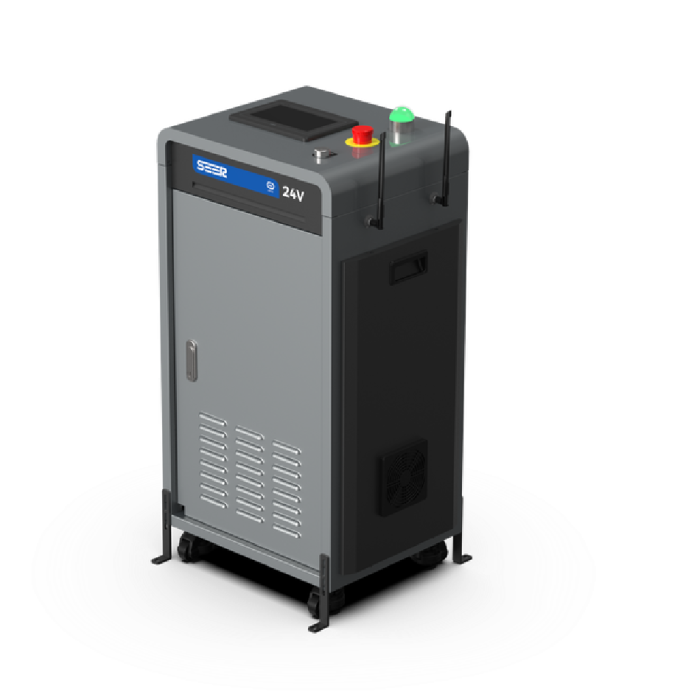
In stock
- BRAND:
- SEER ROBOTICS
- MODEL:
- SCS-C24100D
- PART #:
- SCS-C24100D
- ORIGIN:
- China
- Warranty:
- 12 MONTHS
- AVAILABILITY:
- SUBJECT TO AVAILABILITY
- SKU:
- SEER-Robotics-SCS-C24100D
SEER Robotics Robotic Automatic Charging Station (SCS-C24100D)
In motorsport, a pit stop is won twice: once by the speed of the crew, and once by knowing exactly what the car needs before it rolls in. Charging an autonomous forklift works in much the same way. The SEER Robotics Robotic Automatic Charging Station (SCS-C24100D) addresses both halves of that problem. It delivers up to 3 kW at 24 V / 100 A and reaches a full charge in as fast as 1 hour. It also lets the operator decide how each battery is charged, through protocol-based, state-based or voltage-based modes with user-customisable charging curves. The result is a charger that is quick where speed matters and deliberate where the battery calls for care.
Robots Middle East supplies the SCS-C24100D to warehouses, distribution centres, manufacturers and system integrators across the Middle East. Each quotation from Robots Middle East is prepared against the customer's fleet, power supply and site. Robots Middle East then arranges delivery and provides support after installation, so that the charger arrives as part of a planned deployment rather than as a loose component.
Background
SEER Robotics and the Robot Brain
SEER Robotics (06106.HK) describes itself as a platform-based embodied intelligent robotics company built around the Robot Brain. It serves more than 2,500 customers worldwide with intelligent robotics solutions. A company with that focus on controllers and fleet intelligence treats charging as part of the robot's operating system rather than as an afterthought. A charging station in such an ecosystem is not simply a power supply. It is a node that reports its status, accepts parameters and can be supervised alongside the vehicles it serves. The SCS-C24100D reflects that thinking: it can be monitored and controlled remotely through Roboshop, which places every charging event under the same supervision as the rest of the fleet.
A charger built around the battery, not the plug
Many chargers are defined by a single number: the current they can push. The SCS-C24100D is defined just as much by its decision-making. Three charging modes and adjustable charging curves let engineers match the charging behaviour to the battery in use, and the station is compatible with various lithium batteries to meet diverse robot charging needs. An integrated HMI brings data display, parameter adjustment, network setup, log event query and device control together on the unit itself, so the station is ready to operate independently upon deployment. For sites that bring robots online in stages, that independence matters: the charger can be commissioned and tested before wider fleet integration is complete.
Technical Specifications
| Specification | Value |
|---|---|
| Dimensions (L x W x H) | 580 x 460 x 980 mm |
| Output power and rating | Up to 3 kW output with 24 V / 100 A |
| Charging time | Full charge in as fast as 1 hour |
| AC input voltage | 110 V to 120 V / 220 V to 240 V |
| Input frequency | 50 / 60 Hz |
| DC output voltage | 16 V to 32 V |
| DC output current | 50 / 100 A |
| Maximum output power | 1500 / 3000W |
| Connector for manual charging | REMA160 |
| Network | Wi-Fi (recommended), Wired, 5G |
| Working temperature | 0°C to 40°C |
| Plug specification | GB 16A |
| Reference standard | EN 62477-1:2012+A11:2014+A1:2017+A12:2021 |
| Protection | Over-voltage, over-current, short circuit, leakage and over-temperature |
| Charging modes | Protocol-based, state-based and voltage-based, with user-customisable charging curves |
| HMI functions | Data display, parameter adjustment, network setup, log event query, device control |
| Remote monitoring | Via Roboshop |
| Battery compatibility | Various lithium batteries |
| Suitable product model | 24 V, autonomous forklift |
Specifications are as published by the manufacturer and are confirmed against the datasheet at quotation.
The manufacturer has not published the package contents, the charging cable length, the efficiency, the noise level, the mounting method or any certifications beyond the stated reference standard; these are confirmed at quotation.
How does the SCS-C24100D decide how to charge a battery?
The answer lies in its three charging modes. In broad terms, a protocol-based approach lets the charger work from information exchanged with the battery. A state-based approach follows the condition of the battery as charging progresses. A voltage-based approach works to voltage thresholds. Having all three on a single station means one charger can serve batteries that behave differently, rather than forcing a site to standardise on one charging method.
The customisable charging curves take this a step further. A fleet engineer can shape how energy is delivered, perhaps favouring speed during short breaks in a busy shift, or a gentler profile where battery longevity is the priority. Because those parameters can be set on the HMI or adjusted remotely through Roboshop, charging policy becomes something the operations team manages deliberately. It is no longer a fixed property of the hardware.
Speed remains part of the picture. With up to 3 kW available at 24 V / 100 A and a full charge in as fast as 1 hour, the station suits operations where vehicles must return to work quickly. The REMA160 connector for manual charging gives technicians a separate route to charge a vehicle by hand, for example during maintenance or when a forklift is moved off its normal route.
What safeguards protect the battery and the site during charging?
The SCS-C24100D is equipped with five safeguards: over-voltage, over-current, short circuit, leakage and over-temperature protection. Together they cover the most common ways a high-current charging session can go wrong, from a fault in the supply to heat building up during a demanding cycle. The station references EN 62477-1:2012+A11:2014+A1:2017+A12:2021, the standard it is designed against.
The working temperature range is 0°C to 40°C. Across much of the Middle East, that makes the choice of location a practical planning point. Facilities generally site charging equipment in conditioned or shaded areas, and Robots Middle East reviews the intended position as part of the quotation. The log event query function on the HMI also gives maintenance teams a record to consult when they need to understand what happened during a particular session.
Who is the SCS-C24100D for?
The station's stated application is a 24 V autonomous forklift, and its most natural buyers are the operators of such fleets. Warehouse and distribution managers will value the combination of fast charging and remote oversight, which helps keep vehicles available across long shifts. Manufacturers running driverless forklifts between production lines will find the configurable modes useful where several battery types are in service.
System integrators form a second group. The integrated HMI and the choice of Wi-Fi, wired or 5G networking make the station straightforward to commission on very different sites. Roboshop supervision lets an integrator hand over a fleet whose charging infrastructure is visible from the same place as the vehicles. Maintenance and facilities engineers, meanwhile, benefit from the five safeguards, the event logs and the manual REMA160 connection.
Not every fleet runs on a 24 V system. Buyers whose vehicles use a different battery voltage should compare the sibling versions the manufacturer lists, the SEER Robotics Robotic Automatic Charging Station (SCS-C4850D) and the SEER Robotics Robotic Automatic Charging Station (SCS-C48100D), whose own figures are confirmed at quotation. The full range is gathered under Charging Stations, and the vehicles these chargers support sit within Factory Robots.
What is the SCS-C24100D used for?
- Opportunity charging: topping up autonomous forklifts during short pauses between tasks, so that vehicles return to work sooner.
- Shift-change charging: bringing a vehicle to full charge between shifts, with a full charge in as fast as 1 hour.
- Mixed-battery fleets: serving various lithium batteries from one station by selecting the appropriate charging mode.
- Battery-care policies: shaping customisable charging curves to balance turnaround time against battery longevity.
- Manual charging during maintenance: connecting a vehicle by hand through the REMA160 connector when it is off its usual route.
- Remote fleet supervision: monitoring and controlling charging status through Roboshop from a central control room.
Pricing and Availability
The SCS-C24100D is supplied on quotation, so that the configuration, network connection and power arrangements can be matched to your fleet and site. Delivery, customs and support are arranged with the quotation. Please share the number and type of vehicles you operate, the batteries in use and the intended charging location, and Robots Middle East will prepare a tailored proposal. The quotation request form is available on this page.
Frequently Asked Questions
Which vehicles is the SCS-C24100D intended for?
The manufacturer states that the station suits a 24 V autonomous forklift. Its DC output voltage range is 16 V to 32 V.
How quickly can the station charge a forklift?
It delivers up to 3 kW at 24 V / 100 A and can reach a full charge in as fast as 1 hour.
Which batteries is it compatible with?
The station is compatible with various lithium batteries. Robots Middle East confirms compatibility with your specific battery when preparing the quotation.
Can the station be monitored remotely?
Yes. It can be monitored and controlled remotely via Roboshop, connecting over Wi-Fi (recommended), a wired network or 5G.
What power supply does it require?
The station accepts an AC input of 110 V to 120 V or 220 V to 240 V at 50 / 60 Hz, and the plug specification is GB 16A. The supply arrangement for your site is reviewed with the quotation.
Can it operate without a central fleet system?
Yes. The integrated HMI provides data display, parameter adjustment, network setup, log event query and device control, so the station is ready to operate independently upon deployment.
Where can I buy the SEER Robotics Robotic Automatic Charging Station (SCS-C24100D) and what does it cost?
Robots Middle East supplies the SCS-C24100D across the Middle East on quotation. The cost depends on your configuration and delivery requirements, and is set out in the quotation prepared for you.
Summary
Like a well-drilled pit crew, a good charging station has to be both fast and informed. The SCS-C24100D brings up to 3 kW of output and a full charge in as fast as 1 hour to 24 V autonomous forklifts. Its three charging modes and customisable curves let each battery be treated on its own terms. Five safeguards, an independent HMI and remote control through Roboshop complete a charger designed to be managed rather than merely plugged in. Robots Middle East quotes, delivers and supports it across the region, and for any fleet planning its next charging point, this page is the starting point.