
SEER Robotics Robotic Automatic Charging Station (SCS-C4850D)
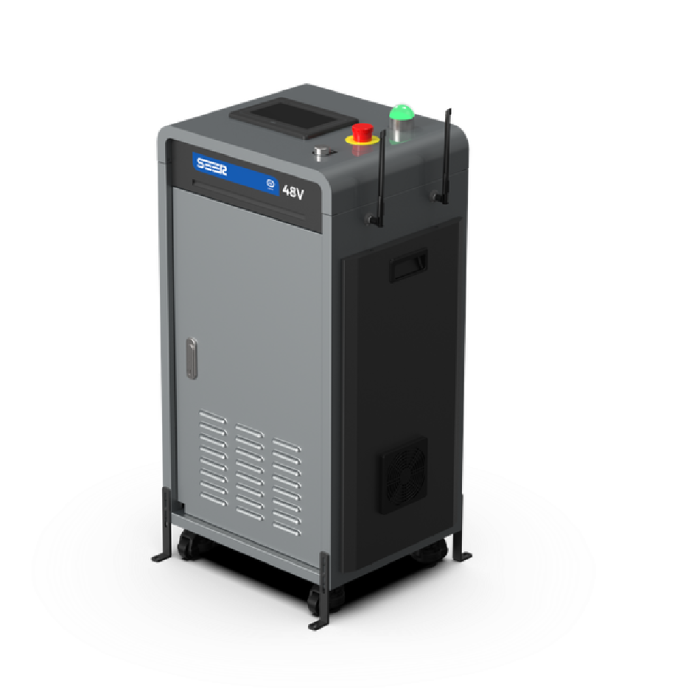
In stock
- BRAND:
- SEER ROBOTICS
- MODEL:
- SCS-C4850D
- PART #:
- SCS-C4850D
- ORIGIN:
- China
- Warranty:
- 12 MONTHS
- AVAILABILITY:
- SUBJECT TO AVAILABILITY
- SKU:
- SEER-Robotics-SCS-C4850D
SEER Robotics Robotic Automatic Charging Station (SCS-C4850D)
In most automation projects the autonomous forklift receives the attention, while the charger is often treated as a minor item near the end of the bill of materials. Yet the charger decides when each vehicle can return to work, how its battery is treated over thousands of cycles and whether the control room can see what is happening at the charging point. The SEER Robotics Robotic Automatic Charging Station (SCS-C4850D) is designed to be specified with that care. It is a floor-standing station for 48 V autonomous forklifts, combining high-power charging, a choice of charging strategies, layered electrical protection and remote supervision in a single unit.
Robots Middle East supplies the SCS-C4850D to warehouses, distribution centres, manufacturers and system integrators across the Middle East. We prepare formal quotations, coordinate delivery to your site and support your team from the planning stage through commissioning. If you are building a fleet of autonomous forklifts or adding charging capacity to an existing one, Robots Middle East will help you match the station to your vehicles and to the layout of your site.
Background
SEER Robotics and the Robot Brain
SEER Robotics, listed in Hong Kong as 06106.HK, describes itself as a platform-based embodied intelligent robotics company built around what it calls the Robot Brain. The company serves more than 2,500 customers worldwide with intelligent robotics solutions. Its work centres on the control and navigation of mobile robots, and its range includes the supporting infrastructure those robots need on the floor. Charging stations form one part of that range. The SCS-C4850D is designed to sit within a SEER-managed fleet rather than act as an isolated power supply.
A charger designed as part of the fleet
What sets a station of this kind apart from a conventional workshop charger is its integration. The SCS-C4850D can be monitored and controlled through Roboshop, SEER Robotics' software environment, so charging status forms part of the same operational picture as the vehicles themselves. It connects over Wi-Fi, which the manufacturer recommends, or over a wired network or 5G. A built-in HMI also allows the station to operate independently once it has been deployed. This dual character, networked when the fleet requires it and self-sufficient when it does not, is central to the product's positioning.
Technical Specifications
| Specification | Value |
|---|---|
| Dimensions (L x W x H) | 580 x 460 x 980 mm |
| AC input voltage | 110 V to 120 V / 220 V to 240 V |
| Input frequency | 50 / 60 Hz |
| DC output voltage | 32 V to 60 V |
| Maximum output power | 1500 / 3000W |
| Output voltage and current | Up to 3 kW at 48 V / 60 A |
| Charging time | Full charge in as fast as 1 hour |
| Connector for manual charging | REMA160 |
| Network | Wi-Fi (recommended), Wired, 5G |
| Working temperature | 0℃ to 40℃ |
| Reference standard | EN 62477-1:2012+A11:2014+A1:2017+A12:2021 |
| Suitable product model | 48 V, autonomous forklift |
| Battery compatibility | Various lithium batteries |
| Charging modes | Protocol-based, state-based and voltage-based, with user-customisable charging curves |
| Protection | Over-voltage, over-current, short-circuit, reverse connection, leakage, overheating |
| HMI functions | Data display, parameter adjustment, network setup, log event query, device control |
| Remote monitoring | Monitoring and control via Roboshop |
Specifications are as published by the manufacturer and are confirmed against the datasheet at quotation.
The manufacturer has not published the package contents, charging efficiency, cable length, mounting method or certifications, so these details are confirmed at quotation.
How does the SCS-C4850D adapt to different batteries and charging strategies?
Fleets are rarely uniform. Vehicles are bought in batches, batteries are replaced at different times and operators often reach their own conclusions about how hard to charge between shifts. The SCS-C4850D addresses this with compatibility across various lithium batteries and three distinct charging modes. Protocol-based charging allows the station and the battery to coordinate the process. State-based charging responds to the condition of the battery. Voltage-based charging works to defined voltage thresholds. On top of these modes, the charging curves can be customised by the user, so an engineering team can set a profile that reflects its own priorities, whether that means faster turnaround or a gentler regime.
Power is the other half of the answer. The station delivers up to 3 kW at 48 V / 60 A, and the manufacturer states a full charge in as fast as 1 hour. Its DC output range of 32 V to 60 V covers the operating window of a 48 V system. The AC input accepts both 110 V to 120 V and 220 V to 240 V at 50 / 60 Hz, which gives planners flexibility when the electrical supply varies from one site to another. For manual charging, the station provides a REMA160 connector, a practical option when a vehicle needs to be charged outside its automatic docking routine.
What protection and oversight does the SCS-C4850D provide?
A charging point is where high current meets a moving vehicle, often with no one standing beside it. The SCS-C4850D builds in safeguards against over-voltage, over-current, short-circuit, reverse connection, leakage and overheating. Together these six protections address the common electrical faults that can affect an unattended charge. The station references EN 62477-1:2012+A11:2014+A1:2017+A12:2021, the safety standard the manufacturer lists for this power equipment.
Oversight operates at two levels. At the station, the HMI provides data display, parameter adjustment, network setup, log event queries and device control, so a technician can diagnose a problem or change a setting on the spot. From a distance, Roboshop allows the operations team to monitor and control the station, keeping its status in view alongside the rest of the fleet. The log event query is particularly valuable after an incident, because it lets the team see what the station recorded rather than reconstructing events from memory.
Who is the SCS-C4850D for?
The clearest buyer is an operator running, or planning to run, 48 V autonomous forklifts, since this is the application the manufacturer specifies. Within that group, several segments stand out. Distribution and fulfilment centres with multi-shift operations benefit from the high output and short charging time. Manufacturers that move materials between production and storage value the protection features and the independent operation of the HMI. System integrators delivering SEER-based fleets will appreciate the Roboshop integration, which brings charging into the same supervisory layer as navigation and dispatch.
Facilities managers should also consider the working temperature of 0℃ to 40℃. In the region, many warehouses are climate-controlled, but where ambient conditions on a loading dock or in an unconditioned building can exceed that range, the station should be located in a suitably managed area. Buyers whose vehicles do not run on a 48 V system, or who are comparing different power levels, can review the other units in our Charging Stations range, such as the SEER Robotics Robotic Automatic Charging Station (SCS-C48100D) and the SEER Robotics Robotic Automatic Charging Station (SCS-C24100D). Robots Middle East will confirm which model fits your vehicles. The wider Factory Robots category shows the automation equipment these stations support.
What is the SCS-C4850D used for?
- Opportunity charging between tasks: topping up 48 V autonomous forklifts during natural pauses in the work cycle.
- Full recharges between shifts: using the high output to return vehicles to service quickly.
- Mixed-battery fleets: charging various lithium batteries with the mode and curve best suited to each.
- Centralised fleet supervision: monitoring and controlling charging through Roboshop together with the vehicles.
- Manual charging when required: connecting a vehicle through the REMA160 connector outside automatic routines.
- Maintenance and diagnostics: reviewing logged events and adjusting parameters at the HMI during service visits.
Pricing and Availability
Robots Middle East supplies the SCS-C4850D on a quotation basis, so each offer reflects the number of stations, the vehicles they will serve and the conditions at your site. Delivery, customs clearance and technical support are arranged together with your quotation. To start the process, share your fleet details and site requirements with our team using the request form available on this page.
Frequently Asked Questions
Which vehicles is the SCS-C4850D designed for?
The manufacturer specifies the station for 48 V autonomous forklifts. It is compatible with various lithium batteries used in such vehicles.
How quickly can the station charge a forklift?
It delivers up to 3 kW at 48 V / 60 A and can deliver a full charge in as fast as 1 hour. Actual times depend on the battery and the charging profile selected.
Can the charging behaviour be adjusted?
Yes. The station offers protocol-based, state-based and voltage-based charging, and the charging curves can be customised by the user.
How is the station connected to our network?
It supports Wi-Fi, which the manufacturer recommends, as well as wired and 5G connections. Through the network it can be monitored and controlled via Roboshop.
Does it work without a network connection?
The built-in HMI provides data display, parameter adjustment, network setup, log event queries and device control, so the station can operate independently after deployment.
What electrical protections are included?
The station protects against over-voltage, over-current, short-circuit, reverse connection, leakage and overheating. It references EN 62477-1:2012+A11:2014+A1:2017+A12:2021.
Where can I buy the SEER Robotics Robotic Automatic Charging Station (SCS-C4850D) and what does it cost?
You can purchase it from Robots Middle East, which supplies it across the Middle East. Pricing is provided by quotation according to your project, so please submit a request and our team will reply with a tailored offer.
Summary
The charger is easy to treat as an afterthought, but it is the piece of infrastructure every autonomous forklift returns to, many times a day. The SCS-C4850D rewards buyers who specify it deliberately: high-power charging for 48 V vehicles, compatibility with various lithium batteries, three charging modes with customisable curves, six layers of electrical protection and supervision both at the HMI and through Roboshop. Robots Middle East quotes, delivers and supports the station across the region. For a charging point that deserves a place in the fleet plan from the outset, this page is the starting point.