
SEER Robotics Robotic Automatic Charging Station (SCS-C48100D)
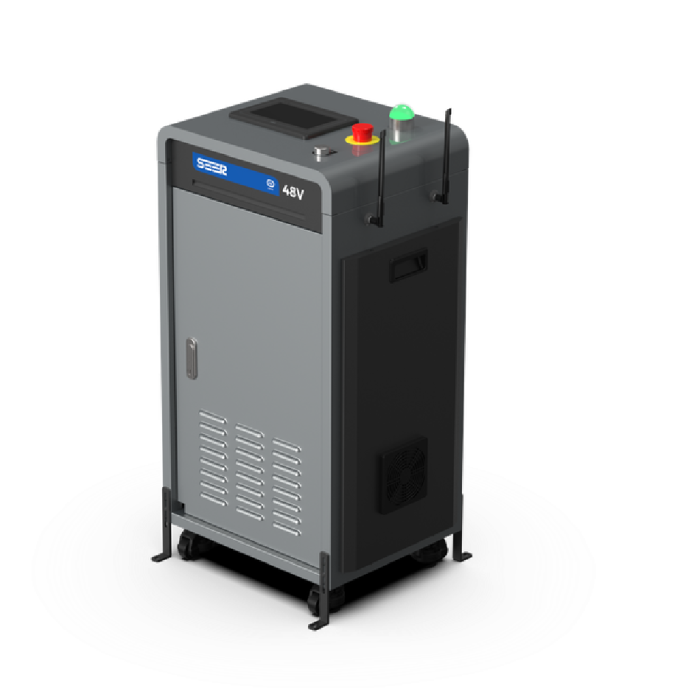
In stock
- BRAND:
- SEER ROBOTICS
- MODEL:
- SCS-C48100D
- PART #:
- SCS-C48100D
- ORIGIN:
- China
- Warranty:
- 12 MONTHS
- AVAILABILITY:
- SUBJECT TO AVAILABILITY
- SKU:
- SEER-Robotics-SCS-C48100D
SEER Robotics Robotic Automatic Charging Station (SCS-C48100D)
On a racing circuit, races are often decided in the pit lane, yet few spectators ever look at the equipment waiting there. Automated warehouses work in much the same way. The autonomous forklifts draw the eye, but when a fleet needs power, the charging point decides whether a shift keeps its rhythm or loses it. The SEER Robotics Robotic Automatic Charging Station (SCS-C48100D) is SEER Robotics' pit lane for 48 V autonomous forklifts. It is a standalone station that delivers up to 6 kW, allows vehicles to dock and charge without an operator, and offers a manual fast-charging connector for the moments when a person takes the wheel.
Robots Middle East sells the SCS-C48100D to logistics operators, manufacturers and system integrators throughout the Middle East. Each quotation from Robots Middle East is prepared against the customer's electrical supply, fleet and site layout. Robots Middle East also arranges delivery, customs clearance and after-sales support for the station, so that a project team has a single partner from its first enquiry to day-to-day operation.
Background
SEER Robotics and the Robot Brain
SEER Robotics (06106.HK) describes itself as a platform-based embodied intelligent robotics company built around what it calls the Robot Brain. It serves more than 2,500 customers worldwide with intelligent robotics solutions. For a buyer, this matters because a charging station is rarely bought alone. It sits inside a wider ecosystem of navigation, fleet control and software, and in this case it can be monitored and controlled remotely through Roboshop. A charger that belongs to the same family of thinking as the vehicles it serves is easier to integrate than an isolated piece of electrical equipment bolted to the end of a project.
A station built for the 48 V forklift class
The SCS-C48100D is positioned clearly: its suitable product model is listed as 48 V, autonomous forklift. Forklifts in this class carry heavy loads through long shifts, and their battery systems are among the larger packs in a mobile robot fleet. To serve them, the station combines high output power with three charging modes, charging curves that the user can customise, and a built-in human–machine interface. With that interface, the station is ready to operate independently once deployed, rather than depending on a separate control cabinet or a laptop on site. The result is a charger that behaves less like a power supply and more like a managed piece of fleet infrastructure.
Technical Specifications
| Specification | Value |
|---|---|
| Model | SCS-C48100D |
| Suitable product model | 48 V, autonomous forklift |
| Output power | Up to 6 kW |
| Output voltage / current | 48 V / 100 A |
| Full charge time | As fast as 1 hour |
| DC output voltage | 32 V to 60 V |
| AC input voltage | 380±10% V |
| Input frequency | 50 / 60 Hz |
| Plug specification | Industrial 32A |
| Connector for manual charging | REMA160 |
| Charging modes | Protocol-based, state-based and voltage-based; user-customisable charging curves |
| Charging options | Automatic and manual fast charging |
| Battery compatibility | Various lithium batteries |
| Protections | Over-voltage, over-current, short-circuit, reverse connection, leakage, overheating |
| HMI functions | Data display, parameter adjustment, network setup, log event query, device control |
| Remote monitoring | Via Roboshop |
| Network | Wi-Fi (recommended), Wired, 5G |
| Working temperature | 0℃ to 40℃ |
| Dimensions (L x W x H) | 580 x 460 x 980 mm |
| Reference standard | EN 62477-1:2012+A11:2014+A1:2017+A12:2021 |
Specifications are as published by the manufacturer and are confirmed against the datasheet at quotation.
The manufacturer has not published the package contents, the cooling method, the efficiency, any certifications or the mounting method; Robots Middle East confirms these at quotation.
How does the SCS-C48100D adapt to different lithium batteries?
Lithium battery packs are not all alike. Their chemistry, their battery management systems and the way they report their state differ from one supplier to the next. The SCS-C48100D addresses this with three charging modes. Protocol-based charging lets the station follow the instructions of the battery itself. State-based charging responds to the condition of the pack. Voltage-based charging works from the voltage seen at the terminals. On top of these modes, users can customise the charging curve, which allows an engineering team to match the charge profile to the battery maker's guidance rather than accept a single fixed profile.
The DC output range of 32 V to 60 V gives the station room to work across the voltage window of a 48 V system as it moves from discharged to fully charged. Combined with the stated compatibility with various lithium batteries, this makes the station a sensible choice for sites whose forklifts come from more than one source, or whose battery suppliers may change over the life of the fleet. Six protections, against over-voltage, over-current, short-circuit, reverse connection, leakage and overheating, sit underneath every mode, so flexibility does not come at the expense of safety.
What is the difference between automatic and manual charging on the SCS-C48100D?
In automatic operation, the forklift reaches the station on its own and charges without anyone on the floor needing to intervene. This is the mode that keeps an autonomous fleet truly autonomous: charging becomes another task the fleet schedules, alongside picking, transport and putting away. With up to 6 kW available at 48 V / 100 A, and a full charge in as fast as 1 hour, the station suits operations that want short, predictable charging windows.
Manual fast charging covers everything else. A vehicle that has been taken out of automatic service for maintenance, a truck driven in by an operator, or a forklift returning from an area outside the robot zone can be connected through the REMA160 connector. Because both options are built into one station, a site does not need a second, separate charger for these exceptions. The HMI then shows the charging data, records events in its log and lets staff adjust parameters on the spot, while Roboshop gives supervisors the same view from elsewhere on the network.
Who is the SCS-C48100D for?
The first group of buyers is warehouse and distribution operators already running, or planning, a fleet of 48 V autonomous forklifts. For them, the station turns charging into a managed, automated step of the workflow. The second group is system integrators who design and commission automated material-handling systems for clients across the region; the three charging modes and customisable curves give them a way to fit one station type to differing battery choices.
Manufacturers with automated intralogistics in production halls form a third group, particularly those who need to see charging data and event logs alongside the rest of their plant information. Facility and electrical engineers should note the supply side: the station takes 380±10% V AC at 50 / 60 Hz through an Industrial 32A plug, so it is planned as part of the site's three-phase industrial infrastructure. Operations and IT teams will value the choice of Wi-Fi (recommended), wired or 5G networking for remote supervision.
Buyers whose vehicles run on a different battery system, or who need a different class of charger, can compare the other stations in the Charging Stations range, including the SEER Robotics Robotic Automatic Charging Station (SCS-C4850D) and the SEER Robotics Robotic Automatic Charging Station (SCS-C24100D), each on its own page. Those planning the vehicles themselves will find them in the Factory Robots category.
What is the SCS-C48100D used for?
- Opportunity charging: autonomous forklifts top up between tasks without leaving the automated workflow.
- Fast full recharges: a full charge in as fast as 1 hour keeps shift changeovers short.
- Manual exceptions: operators connect vehicles through the REMA160 connector when automatic docking is not in use.
- Mixed battery fleets: three charging modes and custom curves serve various lithium batteries from one station type.
- Remote supervision: supervisors follow and control charging status through Roboshop over Wi-Fi, wired or 5G networks.
- Fault tracing and maintenance: the HMI's log event query helps technicians review what happened at the station.
Pricing and Availability
Robots Middle East supplies the SCS-C48100D on a quotation basis, so that every offer reflects the actual fleet, battery type, electrical supply and network environment of the site. When requesting a quotation, it helps to include the forklift model, the battery supplier, the number of vehicles and the expected duty cycle. Delivery, customs and support are arranged together with the quotation. To begin, a quotation request is available on this page.
Frequently Asked Questions
Which vehicles is the SCS-C48100D designed for?
Its suitable product model is listed as 48 V, autonomous forklift. It is compatible with various lithium batteries.
How quickly can it charge a forklift?
The station delivers up to 6 kW at 48 V / 100 A and can fully charge in as fast as 1 hour. Actual times depend on the battery and its state of charge when the vehicle arrives.
What electrical supply does the station need?
It takes an AC input of 380±10% V at 50 / 60 Hz and uses an Industrial 32A plug. Your electrical team should plan the connection point accordingly.
Can the station be monitored remotely?
Yes. It can be monitored and controlled remotely through Roboshop, with Wi-Fi (recommended), wired or 5G networking.
What safety protections are built in?
The station safeguards against over-voltage, over-current, short-circuit, reverse connection, leakage and overheating. Its reference standard is EN 62477-1:2012+A11:2014+A1:2017+A12:2021.
Is the station suitable for warm warehouses?
The working temperature is 0℃ to 40℃. In facilities across the region where indoor temperatures can climb in summer, the station should be placed in a ventilated or conditioned area, and Robots Middle East can advise on this during quotation.
Where can I buy the SEER Robotics Robotic Automatic Charging Station (SCS-C48100D) and what does it cost?
You can buy it from Robots Middle East, which supplies it throughout the Middle East. The cost is set out in a quotation prepared for your site, which you can request on this page.
Summary
Like a pit lane, a charging point earns its place by being fast, safe and predictable, so that attention can stay on the work of the fleet. The SCS-C48100D brings that discipline to 48 V autonomous forklifts: up to 6 kW output, automatic and manual fast charging, three charging modes with customisable curves, six built-in protections, a self-contained HMI and remote control through Roboshop. Robots Middle East quotes, delivers and supports the station for operators across the region. For a team planning how its autonomous fleet will keep moving, this page is the starting point.