
SIASUN Collaborative Robot (GCR25-1800)
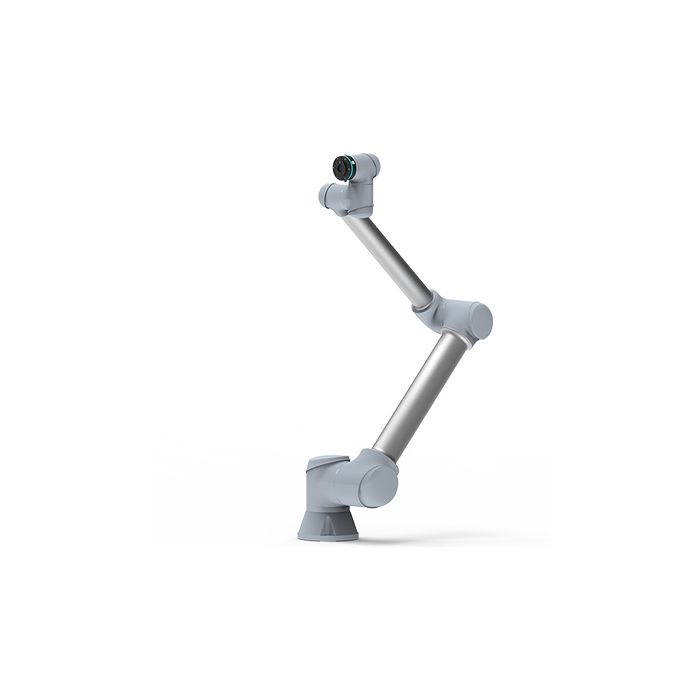
In stock
- BRAND:
- SIASUN
- PART #:
- GCR25-1800
- ORIGIN:
- China
- AVAILABILITY:
- FOR OPPORTUNITIES OVER 1 MILLION USD
- SKU:
- SIASUN-GCR25-1800
SIASUN Collaborative Robot (GCR25-1800)
Picture an operator taking hold of a robot arm, guiding it through the movement a task requires, and leaving the arm to repeat that movement for the rest of the shift. Heavy lifting has long belonged to machines that only a specialist programmer could instruct, working behind guarding that kept everyone else at a distance. The SIASUN Collaborative Robot (GCR25-1800) narrows that gap. It combines a 25kg maximum payload and an 1800mm reach with drag-and-drop teach programming and 16 TUV-certified safety features for human-machine collaboration, so the people who know the process can also teach the robot.
Robots Middle East supplies the GCR25-1800 to manufacturers, system integrators, logistics operators and research institutions across the Middle East. Each project receives its own quotation, and Robots Middle East coordinates delivery to site and supports the robot once it is in service.
Background
The GCR series and its general-purpose role
The GCR25-1800 is a high-end, general-purpose collaborative robot in SIASUN's GCR series. The series offers several arms with different combinations of payload and reach, and buyers compare them for a given cell. The full line-up can be browsed in the SIASUN GCR Series Cobots category. Within that family, the GCR25-1800 pairs heavy handling with a long working radius, the combination many plants look for when one arm must cover a wide area from a single mounting point.
As a class, collaborative robots are designed to work closer to people than traditional industrial arms. They suit plants where production changes often, where floor space is too limited for fenced cells, or where automation is introduced one station at a time rather than across an entire line. A general-purpose cobot earns its value through redeployment: the arm that palletises this quarter can be moved to machine tending next quarter.
Vision, force and software on one platform
The GCR25-1800 integrates 2D/3D vision depth fusion, high-sensitivity force perception and control. Vision lets an application locate parts that do not arrive in fixed positions. Force perception lets the arm respond to contact, which matters for insertion, fitting and finishing tasks that would otherwise need a skilled hand. Bringing these capabilities into the robot's own control reduces the number of separate systems an integrator has to align.
On the software side, the robot comes with a range of scenario-specific software packages and supports multiple external interfaces. It also offers cloud-based robot data monitoring and remote OTA upgrades. Programming is by drag-and-drop teaching, which lowers the threshold for use and makes everyday operation easier.
Technical Specifications
| Specification | Value |
|---|---|
| Product type | High-end, general-purpose collaborative robot, GCR series |
| Degrees of freedom | 6 |
| Max payload | 25kg |
| Reach | 1800mm |
| Repeatability | ±0.05mm |
| Max TCP speed | 2.5m/s |
| Max straight-line speed | 1.5m/s |
| IP class | IP54/IP65 |
| Safety | 16 TUV-certified safety features for human-machine collaboration |
| Sensing and control | 2D/3D vision depth fusion, high-sensitivity force perception and control |
| Programming | Drag-and-drop teach programming |
| Software and connectivity | Scenario-specific software packages, multiple external interfaces, cloud-based robot data monitoring, remote OTA upgrades |
Specifications are as published by the manufacturer and are confirmed against the datasheet at quotation.
The manufacturer has not published the joint ranges and speeds, the dimensions of the robot or its control cabinet, the noise level, the rated payload at the flange or the contents of the box; these details are confirmed at quotation.
What sets the GCR25-1800 apart from a conventional industrial robot?
A conventional industrial arm in this payload class is usually installed inside a guarded cell and programmed offline or through a teach pendant by trained staff. The GCR25-1800 starts from different assumptions. Its 16 TUV-certified safety features are designed for human-machine collaboration, and the final layout of any application is defined by a risk assessment of the complete cell. The aim is to let the robot share space with people where that assessment allows, instead of requiring the space around it to be cleared.
The second difference is how the robot learns a task. With drag-and-drop teach programming, a process engineer or experienced operator can show the arm the required path directly. For plants without a dedicated robotics team, this changes who can introduce and adjust automation. The third difference is the integrated sensing. Because 2D/3D vision depth fusion and high-sensitivity force perception are part of the platform, tasks that involve variable part positions or controlled contact can be addressed without assembling a separate stack of third-party systems.
The arm still has to perform. A repeatability of ±0.05mm, a maximum TCP speed of 2.5m/s and a maximum straight-line speed of 1.5m/s give it the precision and pace that production work demands, across an 1800mm reach.
How is the GCR25-1800 maintained and kept up to date?
Automation projects rarely stand still after commissioning: products change, cycle times are refined and new stations are added. The cloud-based robot data monitoring of the GCR25-1800 gives maintenance and production teams visibility of the robot's operation. Remote OTA upgrades allow its software to be updated without a technician attending each update. In a region where plants may be far from specialist service centres, both functions are of real practical value.
The multiple external interfaces connect the robot to the equipment around it, such as grippers, conveyors, machine tools and plant control systems. The scenario-specific software packages give integrators a head start on common applications instead of building every routine from scratch.
Who is the SIASUN Collaborative Robot (GCR25-1800) for?
The GCR25-1800 suits manufacturers that need to handle substantial loads across a wide working area, particularly at end-of-line palletising and in material handling between conveyors, racks and machines. System integrators will value the combination of integrated vision and force sensing, external interfaces and scenario-specific software packages, which shortens the route from concept to running cell. Small and medium-sized plants introducing their first robot benefit from drag-and-drop teach programming, which reduces reliance on specialist programmers. Universities and research laboratories can use the arm as a platform for work on vision-guided and force-controlled manipulation.
The sources also name a GCR25-1800-EX version; buyers interested in that version can request its specification from Robots Middle East. Where a project calls for a different balance of payload and reach, the other arms in the series can be compared in the Cobots category.
What is the SIASUN Collaborative Robot (GCR25-1800) used for?
- Palletising: stacking cartons and sacks at the end of the line, using the reach to serve a full pallet from one position.
- Machine tending: loading and unloading CNC machines, presses and moulding equipment alongside operators.
- Material handling: moving parts and packages between conveyors, racks and workstations.
- Vision-guided picking: locating and picking parts that arrive in variable positions, using 2D/3D vision depth fusion.
- Force-controlled assembly: insertion, fitting and fastening tasks that depend on high-sensitivity force perception.
- Research and training: teaching and developing collaborative applications in universities and technical institutes.
Pricing and Availability
The price of the GCR25-1800 depends on the configuration, the end effector, integration requirements and the project scope, so Robots Middle East prepares a quotation for each enquiry. Delivery, customs and support are arranged with the quotation. To begin, please share your application, payload and environment details through the enquiry form available on this page.
Frequently Asked Questions
What is the maximum payload of the GCR25-1800?
The maximum payload is 25kg. Robots Middle East can advise on suitability for your gripper and workpiece.
What reach and precision does the robot offer?
The GCR25-1800 has a reach of 1800mm and a repeatability of ±0.05mm. It has 6 degrees of freedom.
Can the robot work alongside people?
The robot carries 16 TUV-certified safety features for human-machine collaboration. Each application should still undergo a risk assessment of the complete cell, including the gripper and the workpiece.
How is the GCR25-1800 programmed?
It uses drag-and-drop teach programming, which lowers the threshold for use and makes operation easier. Scenario-specific software packages support common applications.
What IP class does the robot have?
The IP class is IP54/IP65. Robots Middle East confirms the configuration that suits your operating environment in the quotation.
Is there more than one version?
The sources name the GCR25-1800 and the GCR25-1800-EX. The specification of the EX version is provided on request.
Where can I buy the SIASUN Collaborative Robot (GCR25-1800) and what does it cost?
Robots Middle East supplies the GCR25-1800 across the Middle East. The cost depends on configuration and project scope and is set out in a tailored quotation, which you can request through this page.
Summary
The SIASUN Collaborative Robot (GCR25-1800) brings heavy-payload, long-reach automation within reach of the people who run the process. Its 25kg maximum payload, 1800mm reach and ±0.05mm repeatability handle demanding work. Drag-and-drop teach programming and 16 TUV-certified safety features for human-machine collaboration let operators and engineers teach and work beside the arm. Integrated vision and force sensing, external interfaces, cloud monitoring and OTA upgrades help it adapt as production changes. For a quotation from Robots Middle East that covers configuration, delivery and support, this page is the starting point.