
SIASUN Mecanum Wheel Compound Robot – MHR360 (MHR360)
In stock
- BRAND:
- SIASUN
- PART #:
- MHR360
- ORIGIN:
- China
- AVAILABILITY:
- FOR OPPORTUNITIES OVER 1 MILLION USD
- SKU:
- SIASUN-MHR360
SIASUN Mecanum Wheel Compound Robot – MHR360 (MHR360)
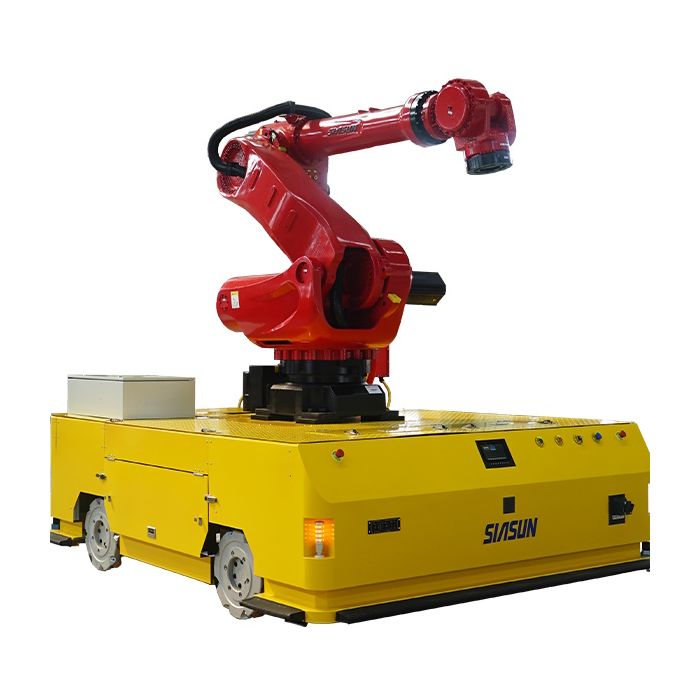
Mobility and stability usually pull in opposite directions. A robot arm bolted to a concrete floor is steady, but its working world ends where its reach ends. A vehicle can go anywhere on the shop floor, but the moment it carries a heavy load on an extended arm, it becomes a question of balance. The SIASUN Mecanum Wheel Compound Robot – MHR360 (MHR360) is built around that tension. Its Mecanum wheel platform carries a six-axis robot to the operation position by flexible routes, then an anti-tipping device is deployed and fully supports the platform before any work begins. The result is a machine that travels like a vehicle and works like an anchored robot, intended for installing large-weight aerospace components that require installation precision where traditional lifting methods are inconvenient.
Robots Middle East supplies the MHR360 to manufacturers, integrators and research organisations across the Middle East. Robots Middle East prepares the quotation, coordinates delivery to your facility and remains your point of contact for support after installation, so that the specification discussion, the commercial terms and the after-sales relationship sit with one team.
Background
SIASUN and its robotics lineage
SIASUN is a Chinese robotics manufacturer whose portfolio spans industrial robot arms, collaborative robots, mobile robots and automated production equipment. That breadth matters for a compound robot, because a machine of this kind is only as good as the integration between its mobile base, its manipulator and its safety systems. A manufacturer that builds both mobile platforms and arms is in a position to design the two halves together rather than bolting an arm onto a third-party vehicle. You can explore the wider range in the SIASUN category.
A Mecanum chassis designed around stability
The MHR360 is designed with Mecanum wheels as the main part of its chassis, which greatly increases the flexibility of its travelling routes. Mecanum wheels carry angled rollers around their rim; by controlling each wheel independently, a platform of this type can move sideways and diagonally as well as forwards and backwards, which is valuable in assembly bays where space between fixtures and structures is limited. SIASUN pairs this mobility with an anti-tipping design: the product has been precisely measured and tested so that it can complete its work within the load range and the limit radius of the robotic arm's operation, preventing tipping. Mobility gets the robot to the job; the anti-tipping device and the tested working envelope keep it steady once it is there.
Technical Specifications
| Specification | Value |
|---|---|
| Configuration | Mecanum wheel platform equipped with a six-axis robot |
| Chassis | Mecanum wheels as the main part of the chassis, for flexible travelling routes |
| Stabilisation | Anti-tipping device, on and fully supporting the Mecanum wheel platform before work begins at the operation position |
| Anti-tipping design | Measured and tested to complete work within the load range and the limit radius of the robotic arm's operation |
| Manual remote control | Travelling direction and speed controlled by adjusting the rocker and knob |
| Safety equipment | Buzzer, indicator light warning, safety laser obstacle avoidance, safety touch edge, vehicle emergency stop device |
| Charging | Portable charger for convenient and fast charging |
| Operating context | Can be operated on a variety of platforms for construction work |
Specifications are as published by the manufacturer and are confirmed against the datasheet at quotation.
The manufacturer has not published the dimensions, weight, payload, arm reach, battery capacity, travel speed, positioning accuracy, navigation method, power supply, IP rating or the contents of the box; Robots Middle East confirms these with you at quotation.
How does the MHR360 stay stable while the arm is working?
Stability on the MHR360 is a procedure as much as a feature. When the robot arrives at the operation position, the anti-tipping device must be switched on and must fully support the Mecanum wheel platform before the robot is allowed to carry out work. In practice this turns the machine from a vehicle into a temporary fixed base: the wheels have done their part, and the support system takes over the job of resisting the forces the arm creates as it moves a heavy component.
The second layer is the tested working envelope. The product has been precisely measured and tested to complete work within the load range and the limit radius of the robotic arm's operation, preventing tipping. For a buyer, the practical point is that stability depends on staying inside those limits, which is why the components you intend to install should be checked against them with Robots Middle East before ordering. A well-planned project defines the heaviest part, its centre of gravity and the furthest point the arm must reach before the order is placed.
What makes a compound robot different from a crane or a fixed robot arm?
A fixed robot arm offers repeatable motion, but the work has to be brought to it. For very large structures, such as aircraft sections or assemblies on construction platforms, moving the work is often impractical, so the robot has to go to the work instead. A crane or hoist can move heavy loads across a bay, yet positioning a component precisely from a hook relies heavily on operator skill and on lifting gear being available where it is needed.
The MHR360 sits between the two. Its Mecanum chassis travels to the operation position along flexible routes, guided by manual remote control in which the operator sets travelling direction and speed with the rocker and knob. Once in place and stabilised, the six-axis robot carries out the installation task that requires precision. The machine is designed specifically for large-weight aerospace components that require installation precision and are inconvenient to handle with traditional lifting methods, and it can be operated on a variety of platforms for construction work.
Safety is integrated rather than added. A buzzer and indicator light warning signal the robot's activity, safety laser obstacle avoidance and a safety touch edge are there to avoid collision with moving or stationary objects, and a vehicle emergency stop device allows operation to be halted. A portable charger supports convenient and fast charging between tasks.
Who is the MHR360 for?
The clearest fit is aerospace manufacturing and maintenance: assembly lines and hangars where heavy components must be installed with precision and where overhead lifting is awkward to use. Engineering teams responsible for final assembly, structural installation or retrofit work will recognise the problem the MHR360 is designed to address.
A second group is contractors and fabricators carrying out construction work on elevated or temporary platforms, as the robot can be operated on a variety of platforms for construction work. A third group is research institutes and university laboratories studying mobile manipulation, where a Mecanum base with an industrial-class arm provides a practical test platform for stabilisation and positioning strategies.
Where the task is moving heavy loads rather than installing them, a dedicated transport platform such as the SIASUN 5T Heavy-Duty Mobile Robot may be worth comparing; Robots Middle East can help you weigh the options against your process.
What is the MHR360 used for?
- Aerospace component installation: placing large-weight parts that demand installation precision.
- Work where lifting gear is impractical: replacing hoists and cranes in bays where traditional lifting is inconvenient.
- Construction work on platforms: operating on a variety of platforms for construction tasks.
- Assembly in confined bays: using Mecanum mobility to reach operation positions along flexible routes.
- Mixed human-robot work areas: relying on warnings, laser obstacle avoidance and touch edges to avoid collisions.
- Mobile manipulation research: studying stabilised, wheel-based manipulators in laboratory settings.
Pricing and Availability
Robots Middle East quotes the MHR360 against your application, so that the configuration, the confirmed specifications and the support package reflect the components and environment you describe. Delivery, customs and support are arranged with the quotation. To begin, share your component weights, working positions and site conditions, and request a quotation through the enquiry form available on this page.
Frequently Asked Questions
What does the MHR360 consist of?
It combines a Mecanum wheel platform with a six-axis robot. The Mecanum wheels form the main part of the chassis and give the robot flexible travelling routes.
How is the robot driven to the operation position?
Through manual remote control: the operator sets travelling direction and speed by adjusting the rocker and knob.
Must the anti-tipping device be used every time?
Yes. Once the MHR360 arrives at the operation position, the anti-tipping device must be on and fully supporting the Mecanum wheel platform before work begins.
What safety equipment is fitted?
The robot has a buzzer, indicator light warning, safety laser obstacle avoidance, a safety touch edge and a vehicle emergency stop device to avoid collision with moving or stationary objects.
How is the MHR360 charged?
It comes equipped with a portable charger for convenient and fast charging.
Can the MHR360 work on construction platforms?
Yes. The MHR360 can be operated on a variety of platforms for construction work.
Where can I buy the MHR360 and what does it cost?
You can buy the MHR360 from Robots Middle East, which supplies it across the Middle East. Pricing depends on your configuration and project scope and is provided in a formal quotation on request.
Summary
The MHR360 resolves the old conflict between mobility and stability by treating them as two stages of one task. Its Mecanum chassis travels to the work along flexible routes; its anti-tipping device and tested working envelope then give the six-axis robot a steady base for installing heavy aerospace components with precision. Integrated warnings, obstacle avoidance, touch edges and an emergency stop protect the people and structures around it. For teams in the Middle East evaluating a compound robot for precision installation, this page is the starting point.