
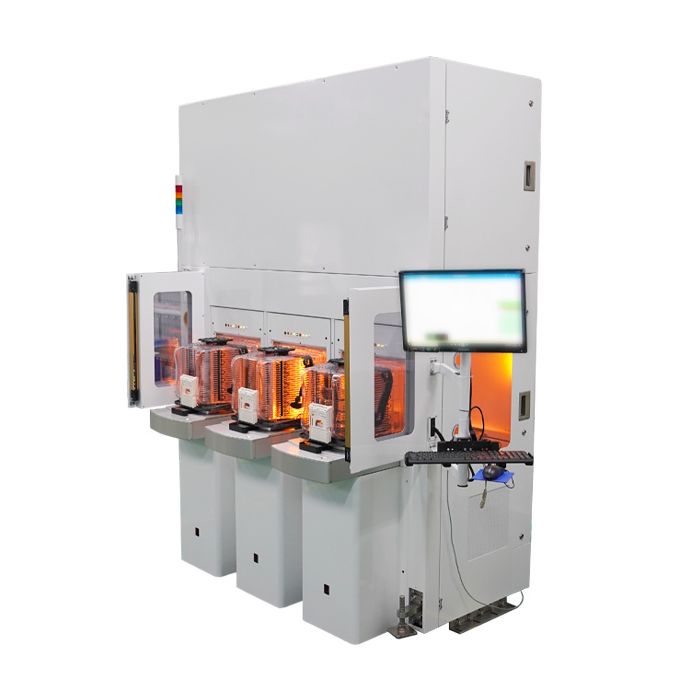
SIASUN TSS-3000 EFEM
In stock
- BRAND:
- SIASUN
- PART #:
- TSS-3000
- ORIGIN:
- China
- AVAILABILITY:
- FOR OPPORTUNITIES OVER 1 MILLION USD
- SKU:
- SIASUN-TSS-3000
SIASUN TSS-3000 EFEM
Every process tool in a fab has a doorway, and most of the risk a wafer faces gathers around it: a carrier is opened, the substrate is lifted out, turned, positioned and passed inward, with air currents, moving metal and people all within reach. The SIASUN TSS-3000 EFEM is SIASUN's answer to that doorway, an equipment front end module built to make the crossing between factory logistics and the process tool as clean, precise and uneventful as possible. Rather than adding complexity at the threshold, it sets out to remove disturbance from it: a redesigned internal airflow, a dual-arm robot that wastes few movements, and interlocks that keep wafers, operators and equipment out of harm's way.
Robots Middle East sells the SIASUN TSS-3000 EFEM and supplies it to semiconductor, microelectronics and research customers across the Middle East. Our team prepares the quotation, coordinates delivery to site and remains your point of contact for technical support once the module is in service, working with SIASUN wherever a configuration has to be adapted to a particular tool or line.
Background
SIASUN and its automation lineage
SIASUN is a Chinese robotics manufacturer whose catalogue extends from heavy-duty mobile robots and forklift-style autonomous vehicles to electronics automation and semiconductor handling equipment; the wider SIASUN range shows how broad that portfolio has become. The TSS-3000 belongs to the semiconductor side of the business, and it draws on the company's robotics work in a very direct way. The atmospheric robot, the aligner, the SMIF unit and the buffer at the heart of the module are all developed in-house by SIASUN, which gives the system high stability. For a buyer, core components that come from one engineering team mean that the robot, its alignment station and its carrier interface were conceived to work together rather than assembled from separate suppliers and reconciled afterwards.
Where the TSS-3000 sits in the fab
In a semiconductor line, the front end module is the atmospheric stage between the carriers arriving from the factory floor and the chambers of the process tool itself. The TSS-3000 is a wafer front-end transfer device and an interface system compatible with SEMI standards. Wafers can be loaded by hand, or the module can receive carriers delivered by a mobile robot (MR) or an overhead hoist transport (OHT) system, so the same front end serves a line that still relies partly on operators as well as one moving towards full automation. SIASUN also offers non-standard customisation according to the user's actual requirements, which matters because front ends are rarely identical from one process tool to the next.
Technical Specifications
| Specification | Value |
|---|---|
| Product type | Wafer front-end transfer equipment; SEMI-compatible interface system |
| Carrier handling | Manual loading, or carriers delivered by MR or OHT |
| Robot | Dual-arm robot with external axis; pick and place by two-axis compound motion |
| Cleanliness class | Class 1 (internal space designed to meet ISO Class 1) |
| Wafer placement position accuracy | ±0.1mm |
| Wafer placement angle accuracy | ±0.2° |
| Dimensions | 2100*750*2500mm |
| Weight | ≤1100kg |
| Safety | Multiple interlock protection, from software to hardware |
| In-house core components | Atmospheric robot, aligner, SMIF, buffer |
| Customisation | Non-standard customisation to user requirements |
Specifications are as published by the manufacturer and are confirmed against the datasheet at quotation.
SIASUN has not published the supported wafer sizes, the number of load ports, the power requirements, the compressed air and vacuum requirements, the communication interface or the contents of the delivery for this model; each of these is confirmed at quotation.
How does the dual-arm robot change wafer transfer in the TSS-3000?
The throughput of a front end module is often decided by its robot rather than by the process tool behind it. A single-arm robot has to complete one movement before it can begin the next: collect a processed wafer, put it away, return for a fresh one, then load it. The TSS-3000 uses a dual-arm robot mounted on an external axis, and it picks and places wafers through a compound motion of two axes. In practical terms, one arm can hold the incoming wafer while the other removes the outgoing one, and the external axis carries the robot along the module so that it reaches every station without needing a larger, heavier arm.
This arrangement greatly improves wafer transfer efficiency while lowering maintenance costs. The second point deserves as much attention as the first: fewer wasted strokes mean less wear on joints and drives, and a robot developed by the same team that built the aligner and buffer is easier to service as one system. Combined with a wafer placement position accuracy of ±0.1mm and an angle accuracy of ±0.2°, the robot is designed to hand wafers on to the tool in a consistent position, cycle after cycle. The module also has a small footprint, which helps where floor space in the cleanroom is limited.
What does ISO Class 1 cleanliness mean for the wafers inside?
ISO cleanroom classes run from the least demanding to the most demanding, and Class 1 sits at the strictest end of the scale. Achieving it inside an enclosure that contains a moving robot, an aligner and opening carriers is not trivial, because every movement disturbs the air and can lift particles towards the wafer surface. SIASUN addresses this with an entirely new internal gas flow structure, designed so that the internal space of the TSS-3000 meets ISO Class 1 and the wafer stays clean throughout transfer.
The practical consequence for a fab is that the front end does not become the weakest point of contamination control. A process tool can only be as clean as the environment its wafers pass through on the way in, and an EFEM operating at Class 1 internally allows the surrounding room to be specified to a less demanding standard without exposing the substrates. Alongside the airflow design, the module carries multiple interlock protections spanning software and hardware, which safeguard the wafers during transfer as well as the safety of personnel and equipment.
Who is the SIASUN TSS-3000 EFEM for?
The first audience is semiconductor manufacturers equipping or upgrading process tools that need a SEMI-compatible front end, particularly where carriers arrive by OHT or mobile robot and the line is being automated step by step. Equipment builders form the second group: integrators who design etch, deposition, inspection or metrology tools can use the TSS-3000 as the atmospheric handling stage and take advantage of SIASUN's non-standard customisation to match their own chamber layout. University laboratories, national research centres and pilot lines are a third segment, because manual loading remains possible while the module still delivers the cleanliness and placement accuracy of a production front end.
The TSS-2000 is another version in the same range; its figures are not covered on this page, so no comparison is drawn here. If you are weighing the two, Robots Middle East can set out the differences against SIASUN's datasheets when preparing your quotation.
What is the SIASUN TSS-3000 EFEM used for?
- Process tool front ends — transferring wafers from their carriers into etch, deposition or similar tools.
- Automated material flow — receiving carriers delivered by OHT systems or mobile robots without operator handling.
- Manual and pilot lines — accepting hand-loaded carriers where full automation is not yet in place.
- Inspection and metrology — presenting wafers in a repeatable position and orientation for measurement tools.
- Contamination-sensitive processes — keeping substrates within a Class 1 environment during transfer and alignment.
- Custom tool integration — serving as a tailored front end where an equipment builder needs a non-standard layout.
Pricing and Availability
The SIASUN TSS-3000 EFEM is supplied on quotation, because the final configuration depends on your tool, your carriers and any customisation SIASUN carries out for your line. Robots Middle East reviews your requirements, confirms details such as wafer size, load ports and utilities, and prepares a proposal tailored to your project. Delivery, customs clearance and technical support are arranged together with the quotation. To begin, use the quotation request available on this page.
Frequently Asked Questions
What is the SIASUN TSS-3000 EFEM ?
It is a wafer front-end transfer module and SEMI-compatible interface system that moves wafers from their carriers to a process tool. Wafers can be loaded manually or by carriers delivered by a mobile robot or OHT system.
How clean is the internal environment?
The module is rated at cleanliness Class 1, achieved through a new internal gas flow structure designed so that the internal space meets ISO Class 1.
How accurately does it place wafers?
The wafer placement position accuracy is ±0.1mm and the wafer placement angle accuracy is ±0.2°.
How large and heavy is the module?
The TSS-3000 measures 2100*750*2500mm and weighs ≤1100kg, which should be considered when planning floor loading and cleanroom layout.
Which wafer sizes and how many load ports does it support?
Robots Middle East confirms the wafer sizes and the number of load ports at quotation, together with power, compressed air, vacuum and communication interface requirements.
Can the TSS-3000 be customised?
Yes. SIASUN offers non-standard customisation according to the user's actual requirements, and the details are agreed during the quotation process.
Where can I buy the SIASUN TSS-3000 EFEM and what does it cost?
Robots Middle East supplies the TSS-3000 across the Middle East. The cost depends on configuration and customisation, so it is provided in a formal quotation that you can request from this page.
Summary
The doorway of a process tool is where a wafer is most exposed, and the SIASUN TSS-3000 EFEM is designed to make that crossing as quiet as possible. A dual-arm robot on an external axis keeps movements economical, an internal airflow designed for ISO Class 1 keeps particles away, placement accuracy of ±0.1mm and ±0.2° keeps hand-offs consistent, and layered interlocks protect wafers, people and equipment. With core components developed by SIASUN itself and the option of non-standard customisation, it adapts to manual lines as readily as to fully automated ones. Robots Middle East quotes, delivers and supports it throughout the region; for anyone planning a cleaner, more reliable front end, this page is the starting point.