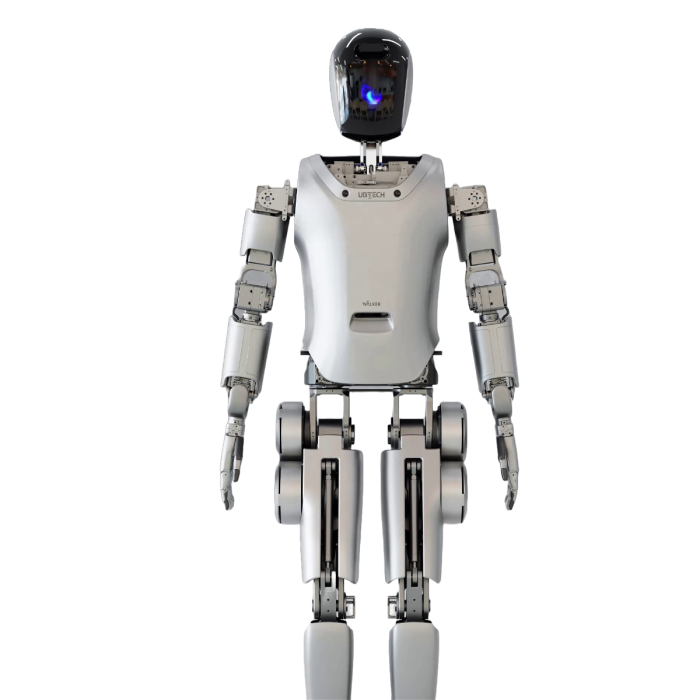
UBTECH Walker S Industrial Humanoid Robot
In stock
- BRAND:
- UBTECH
- PART #:
- Walker S
- ORIGIN:
- China
- AVAILABILITY:
- SUBJECT TO AVAILABILITY
- SKU:
- UBTECH-Walker-S
UBTECH Walker S Industrial Humanoid Robot
On a moving automotive line, the work never waits. Carriers advance, assemblies shift position, and anything stationed beside the track must keep pace with a target that is always in motion. Conventional automation answers that problem by rebuilding the line around the machine. The UBTECH Walker S Industrial Humanoid Robot takes the opposite route: it walks on the mobile production line itself, watches components through its own sensors and reports back to the factory's management system as it works. It is a humanoid conceived not for a lobby or a showroom but for smart manufacturing and enterprise automation, where stability, perception and data count for more than a friendly greeting.
Robots Middle East supplies the UBTECH Walker S to manufacturers, logistics operators, research institutions and system integrators across the Middle East. Our team prepares each quotation, coordinates delivery to your site and remains your point of contact for support once the robot has arrived, so that a pilot project can be planned with a single partner from first enquiry to commissioning.
Background
UBTECH Robotics and the road to Walker S
UBTECH Robotics was established in 2012 and has concentrated, since its foundation, on the research and development of core humanoid robot technology. In 2023 the company developed Walker S as a humanoid robot designed specifically for industrial applications, and collaborated with several leading new energy vehicle companies to plan, in phases, how humanoid robots would be introduced into manufacturing scenarios. In the same year, UBTECH ROBOTICS CORP LTD, stock code 9880.HK, was listed on the main board of the Hong Kong Stock Exchange on 29 December 2023. For an industrial buyer, that combination of a long research focus and a publicly listed manufacturer offers a useful reference point when assessing a new category of equipment.
The first production test came in the automotive sector. Walker S was deployed in the final assembly workstation of NIO's advanced manufacturing base F2, marking the world's first instance of a humanoid robot collaborating with humans to complete automotive assembly and quality inspection tasks on a factory production line. That deployment shaped the robot's identity: a machine built to share a working environment with people, rather than to be fenced off from them.
From perception to production: the key technology
Walker S brings together three layers of capability. The first is physical: newly equipped force-compliant drive joints and rigid-flexible coupling hybrid structures enable the robot to walk stably on mobile production lines, while 41 servo joints with force feedback give it controlled, responsive movement. The second is perceptual: multiple visual, audio and distance sensors, innovative multi-modal sensor fusion and dynamic environment exploration allow it to perceive its surroundings, the people around it and the objects it handles. The third is cognitive: Walker S integrates deeply with a large language model, gaining advanced intent understanding and fine-grained planning on top of its multimodal perception and motion control, so that it can carry out a variety of tasks in different environments. The robot runs the Robot Operating System ROSA 2.0.
Technical Specifications
| Specification | Value |
|---|---|
| Product type | Industrial humanoid robot for smart manufacturing and enterprise automation |
| Height | 1.7 m |
| Servo joints | 41, with force feedback |
| Vision | Built-in high-resolution RGBD visual sensors |
| Additional sensing | Multiple visual, audio and distance sensors; multi-modal sensor fusion |
| Drive and structure | Force-compliant drive joints; rigid-flexible coupling hybrid structures |
| Navigation | 3D semantic mapping; walking route design with obstacle avoidance |
| Object recognition and grasping | 6D pose recognition of complex objects from 3D Point Cloud information; hand-eye coordinated grasping |
| AI integration | Deep integration with a large language model for intent understanding and fine-grained planning |
| Operating system | Robot Operating System ROSA 2.0 |
| Factory integration | Automatic connection to the manufacturing management system for real-time production status exchange |
| Quality inspection accuracy (Walker S series) | Exceeding 99% |
| SPS sorting | Picks and places two types of components to specified locations within 10 seconds |
| Year developed | 2023 |
Specifications are as published by the manufacturer and are confirmed against the datasheet at quotation.
The manufacturer has not published the weight, payload, dimensions, walking speed, battery capacity, battery life, power consumption, connectivity, degrees of freedom per hand, IP rating, operating temperature, package contents or manufacturer part number; each of these is confirmed at quotation.
How does Walker S find its way and handle parts on a live production line?
A factory floor is not a laboratory. Trolleys move, colleagues cross aisles and the line itself carries work past the robot. Walker S addresses this with its built-in high-resolution RGBD visual sensors, which it uses to observe its surroundings, create 3D semantic maps and design walking routes that avoid obstacles, so that it operates safely and precisely. A semantic map does more than record geometry: it allows the robot to distinguish what the objects around it are, which is the foundation for planning a task rather than merely avoiding a collision.
Handling is the second half of the problem. By processing 3D Point Cloud information, Walker S recognises the 6D pose of complex objects, meaning both their position and their orientation, and completes the grasp through hand-eye coordination. In the SPS scenario, this allows it to sort automatically, picking up and placing two types of components at specified locations within 10 seconds, which improves sorting accuracy and helps optimise the production process. In quality inspection, the Walker S series conducts visual checks on completely or partially assembled modules in moving automotive production lines, with an accuracy rate exceeding 99%.
What does Walker S bring to a factory's data systems?
Many automation projects falter not on the hardware but on the gap between a machine and the information systems that run the plant. Walker S connects automatically to the manufacturing management system and exchanges production status information in real time, keeping data synchronised throughout the factory. The robot therefore becomes a participant in the production record, not an isolated island whose output must be logged by hand.
Its large language model integration adds a further dimension. Intent understanding and fine-grained planning mean that tasks can be framed at a higher level, with the robot working out the steps itself on the basis of its perception and motion control. For plant managers, this points towards a workforce in which a single platform can move between tasks as production demands shift, rather than a dedicated machine for every station.
Who is the UBTECH Walker S for?
The clearest fit is the automotive and new energy vehicle sector, where Walker S was first deployed and where its quality inspection and assembly capabilities were developed. Plants with mobile production lines, mixed human and machine workstations and a need for consistent visual inspection are its natural setting. Component and electronics manufacturers with part assembly, screw-bolt tightening or line-side material handling requirements form a second group, as do logistics and distribution operators handling parcels and sorting tasks.
Research institutions, universities and system integrators across the region are a third audience. For them, Walker S offers a platform on which to study human-robot collaboration, multi-modal perception and the integration of a humanoid into manufacturing management systems. Those surveying the wider field may wish to browse our Bipedal Humanoids category or the full UBTECH Walker range.
Buyers who want to compare later generations of UBTECH's industrial line can review the UBTECH Walker S1 Industrial Humanoid Robot and the UBTECH Walker S2 Industrial Humanoid Robot. Organisations whose requirement lies in visitor reception rather than production should look instead at the UBTECH Walker C Commercial Reception Humanoid Robot.
What is the UBTECH Walker S used for?
- Parcel handling: moving parcels within logistics and production environments alongside human staff.
- SPS sorting: picking and placing components at specified locations to improve sorting accuracy.
- Quality inspection: visual checks on fully or partially assembled modules on moving automotive lines.
- Screw-bolt tightening: carrying out fastening tasks at workstations designed for human operators.
- Part assembly: joining components on the line, as demonstrated in automotive final assembly.
- Process material handling: delivering materials between stations as production progresses.
Pricing and Availability
The UBTECH Walker S is supplied on a quotation basis, because every industrial deployment differs in its tasks, site conditions and integration requirements. Robots Middle East reviews your application, intended tasks and site conditions before any commitment is made. Delivery, customs and support are arranged with the quotation. To begin, send us a brief description of your production environment and intended tasks; the quotation request form is available on this page.
Frequently Asked Questions
How tall is the UBTECH Walker S?
Walker S stands 1.7 m tall, a human scale that suits workstations designed around people.
How many joints does Walker S have?
It has 41 servo joints with force feedback, combined with force-compliant drive joints for stable movement.
Can Walker S work on a moving production line?
Yes. Its force-compliant drive joints and rigid-flexible coupling hybrid structures enable it to walk stably on mobile production lines.
Which operating system does Walker S run?
Walker S runs the Robot Operating System ROSA 2.0.
Has Walker S been used in a real factory?
Yes. It was deployed in the final assembly workstation of NIO's advanced manufacturing base F2, working with people on automotive assembly and quality inspection tasks.
Can Walker S share data with our manufacturing systems?
Yes. It connects automatically to the manufacturing management system and exchanges production status information in real time, keeping data synchronised throughout the factory.
Where can I buy the UBTECH Walker S and what does it cost?
You can buy the UBTECH Walker S from Robots Middle East, which supplies it across the Middle East. Pricing depends on your configuration and project scope, so it is provided in a tailored quotation that you can request on this page.
Summary
A moving production line asks a great deal of any machine placed beside it: it must keep its footing, see what is passing, act within seconds and leave a reliable record of what it has done. The UBTECH Walker S answers each of those demands with a human-scale body of 41 force-feedback servo joints, RGBD vision and 3D semantic mapping, 6D pose recognition for grasping, deep language-model integration and a live connection to the factory's management system. Proven in automotive final assembly and backed by a manufacturer with more than a decade of humanoid research, it offers manufacturers in the region a practical route into humanoid automation. Robots Middle East will prepare your quotation, arrange delivery and support your deployment; for any organisation weighing a humanoid for its own line, this page is the starting point.