
UBTECH Walker Humanoid Robot
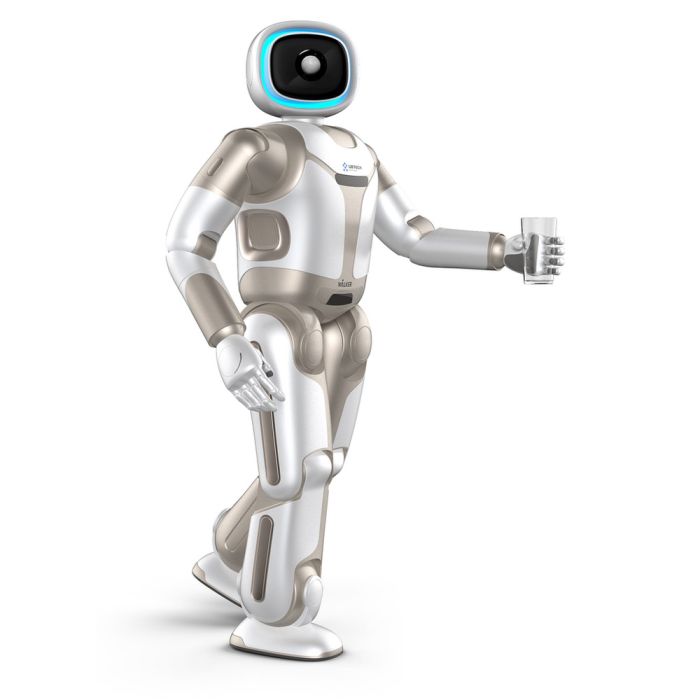
UBTECH Walker is a family of humanoid robots developed by UBTECH Robotics that targets human-centric environments—initially home and office assistance and later industrial and manufacturing scenarios. UBTECH describes the “Walker Robot” as a next-generation humanoid with 36 high-performance servo joints and multi-sensor perception (including force, vision, hearing, and spatial awareness) aimed at household and office use cases.
In stock
- BRAND:
- UBTECH
- PART #:
- Walker
- ORIGIN:
- China
- AVAILABILITY:
- SUBJECT TO AVAILABILITY
- SKU:
- UBTECH-Walker
UBTECH Walker Humanoid Robot
Most smart home controllers are a speaker on a shelf or an app on a telephone. They can dim a lamp, but they cannot cross a room, recognise the person who is speaking or turn to face them. The UBTECH Walker Humanoid Robot places that controller inside a body that stands 145cm tall, walks on carpet, tiles, grass and stairs, and moves through 36 high-performance servo joints. It listens, looks and replies through text, voice, vision and movement. Beneath that domestic surface sits a software stack built on Ubuntu and ROS that any robotics laboratory will recognise. The Walker can therefore be judged in two ways: as an assistant for the spaces people live and work in, and as an open humanoid platform for those who build the next generation of service robots.
Robots Middle East supplies the UBTECH Walker Humanoid Robot to customers across the Middle East, from private households and corporate headquarters to universities, research centres and innovation showrooms. Our team prepares each quotation against the manufacturer's current datasheet. We advise on the processor configuration best suited to the intended work and arrange delivery, commissioning and after-sales support within the region, so that the robot arrives ready for the role you have planned for it.
Background
UBTECH and the home robot mission
UBTECH is one of the established names in humanoid and service robotics. Its portfolio runs from educational robots to full-size humanoids for commercial and industrial settings. The company describes the Walker as a solid step forward in its mission to bring robots into every home. That ambition explains the shape of the machine. Homes and offices are arranged around human proportions, with doors, stairs, worktops and switches placed for a person's reach and stride. A robot that shares those proportions can move through such spaces without the building being adapted for it. The Walker carries that idea through every part of its design, from the legs that negotiate a threshold to the hands that reach towards an object on a table.
Integrated drive units and layered perception
Each joint of the Walker is driven by an integrated unit that combines a frameless torque motor, precise harmonic reduction, a drive controller and a dual encoder. In general terms, this arrangement delivers compact torque, fine positional control and accurate feedback on where each limb is at any moment. Those qualities matter in a bipedal robot that must balance while it moves. The joints communicate over EtherCAT, a high-speed real-time bus designed for tightly synchronised motion control. Above the drive layer sits a sensory system covering force, vision, hearing and spatial awareness. This combination allows the Walker to adjust its gait, register contact and interpret what is happening around it, rather than simply replaying pre-recorded movements.
Technical Specifications
| Specification | Value |
|---|---|
| Product type | Humanoid service robot |
| Servo joints | 36 high-performance servo joints |
| Height | 145cm |
| Weight | 77kg |
| Sensory systems | Force, vision, hearing and spatial awareness |
| Integrated drive unit | Frameless torque motor, precise harmonic reduction, drive controller, dual encoder |
| Arm load | Extended state single arm 1.5kg |
| Arm span | Single arm 540mm |
| Wi-Fi | 802.11 a/b/g/n 5G/2.4 GHz dual-band |
| Ethernet | RJ45 interface |
| EtherCAT | High-speed real-time bus |
| Battery | Lithium iron phosphate 54.6V/10Ah/ 6 kg |
| Charging time | 2h |
| Usage time | 2h |
| Processor | Intel i7 7500U, frequency 2.7Ghz; Intel i5 6200U, frequency 2.3Ghz |
| Operating system | Ubuntu + Linux RT Preempt + ROS + Android |
| Emulation platform | URDF+Gazebo |
| Navigation | Built-in visual navigation (U-SLAM) with autonomous path planning |
| Recognition | Faces, objects and scenes through stereo vision |
| Interaction | Multimodal: text, voice, vision, movement and environment |
| Smart home | Open interface for lights, appliances, sockets and other home devices |
Specifications are as published by the manufacturer and are confirmed against the datasheet at quotation.
The manufacturer has not published the maximum walking speed, the payload when walking, the IP rating, the camera resolution, the noise level, the operating temperature or the contents of the box; we confirm each of these with you at quotation.
How does the UBTECH Walker find its way around a building?
The Walker navigates by sight. Its built-in visual navigation system, U-SLAM, gathers rich information from its surroundings, including contours, colours and depths. It then uses that information to build an understanding of the space and to plan its own route through it. Autonomous path planning means the robot can be sent to a destination rather than steered step by step. This distinction separates a service robot from a remote-controlled demonstrator.
Getting there is the job of the legs. Through gait planning and control, the Walker achieves stable walking on several types of terrain. UBTECH illustrates these as carpet, hard floor, grass, stairs, uphill slopes, tiles and obstacles. For buyers in the region this list is a practical one. A villa may combine marble halls with carpeted majlis rooms and a garden, and an office may have stairs between levels. A wheeled platform would deal with some of those surfaces and fail at others. A humanoid that adapts its gait aims to treat them as one continuous environment.
What does the UBTECH Walker offer developers?
The Walker runs Ubuntu with a Linux RT Preempt real-time kernel, ROS and Android. For research teams this means the robot speaks the language of their existing tools. ROS packages, middleware and workflows transfer directly, while the real-time kernel supports the deterministic timing that balance and motion control require. Android handles the interaction layer that end users see and hear.
Equally important is the emulation platform. UBTECH supports URDF and Gazebo, so a team can model the Walker, test a new walking routine or manipulation behaviour in simulation, and only then deploy it to the physical robot. This protects valuable hardware during experimentation and shortens development cycles. Connectivity follows the same logic: dual-band Wi-Fi for untethered operation, an RJ45 Ethernet interface for reliable wired links in the laboratory, and the EtherCAT bus internally. Two processor options are listed, the Intel i7 7500U and the Intel i5 6200U, and Robots Middle East will confirm the configuration supplied in your quotation.
Who is the UBTECH Walker Humanoid Robot for?
The first audience is households and private clients who want a humanoid assistant that joins the smart home rather than sitting beside it. The Walker's open smart home interface, face recognition and natural conversation suit families who value technology that responds to people directly.
The second audience is universities, research institutes and corporate innovation teams. For them the Walker is a full-size bipedal platform with an open, ROS-based stack and simulation support. It suits work on locomotion, perception, human–robot interaction and embodied intelligence.
The third audience is organisations that use robots to communicate: technology showrooms, exhibitions, museums and executive offices. In these settings a walking, talking humanoid makes a strong first impression. Where the brief is chiefly front-of-house or industrial, buyers may also wish to compare the UBTECH Walker C Commercial Reception Humanoid Robot or the UBTECH Walker S Industrial Humanoid Robot, whose names reflect those roles. The full family is gathered in the UBTECH Walker category. Other two-legged platforms appear under Bipedal Humanoids. Our team will set out the differences between these models when preparing your quotation.
What is the UBTECH Walker Humanoid Robot used for?
- Smart home assistance: controlling lights, appliances and sockets through its open smart home interface.
- Humanoid research: studying bipedal locomotion, balance and gait planning on a full-size robot.
- Software development: building and testing ROS applications, first in URDF and Gazebo, then on hardware.
- Human–robot interaction studies: exploring multimodal communication through text, voice, vision and movement.
- Reception and demonstration: greeting and recognising visitors in showrooms, exhibitions and corporate lobbies.
- Education and outreach: showing students how perception, navigation and motion control work together.
Pricing and Availability
The Walker is supplied on quotation. Each order depends on the processor configuration, the intended application and the level of commissioning and training required. Robots Middle East prepares a written quotation that reflects these choices and is checked against the manufacturer's current datasheet. Delivery, customs clearance and after-sales support are arranged with the quotation, so that a single document covers the whole project. To begin, simply use the quotation request available on this page.
Frequently Asked Questions
How tall and heavy is the UBTECH Walker?
The Walker stands 145cm tall and weighs 77kg. These proportions let it work at the heights of everyday furniture, switches and worktops.
How long does the battery last?
The lithium iron phosphate battery, rated 54.6V/10Ah/ 6 kg, provides a usage time of 2h. It recharges in a charging time of 2h.
How much can the Walker hold in its arms?
In the extended state, a single arm carries a load of 1.5kg, with a single-arm span of 540mm. A payload figure for carrying objects while walking has not been published.
Can the Walker control smart home devices?
Yes. Its open smart home interface lets it help users control lights, appliances, sockets and other home devices independently, according to the use case.
Does the Walker recognise people?
The Walker recognises faces, objects and scenes through stereo vision. It combines this with voice and text to hold natural, multimodal conversations.
Does the Walker support ROS?
Yes. It runs Ubuntu with Linux RT Preempt, ROS and Android, and supports URDF and Gazebo for simulation before deployment on the robot.
Where can I buy the UBTECH Walker Humanoid Robot and what does it cost?
You can buy the Walker from Robots Middle East, which supplies and supports it across the Middle East. Pricing depends on the configuration and the scope of the project, so please request a tailored quotation from our team.
Summary
The UBTECH Walker Humanoid Robot turns the smart home controller from a box on a shelf into a companion that walks over to meet you. It recognises your face, understands your request and switches on the lights. It reaches the room on legs that cope with carpet, tiles, grass and stairs, guided by U-SLAM visual navigation and driven by 36 high-performance servo joints. For developers, the same machine is an open ROS platform with URDF and Gazebo simulation, real-time control and full network connectivity. Robots Middle East quotes, delivers and supports the Walker throughout the region. For anyone ready to bring a humanoid into a home, a laboratory or a showroom, this page is the starting point.