
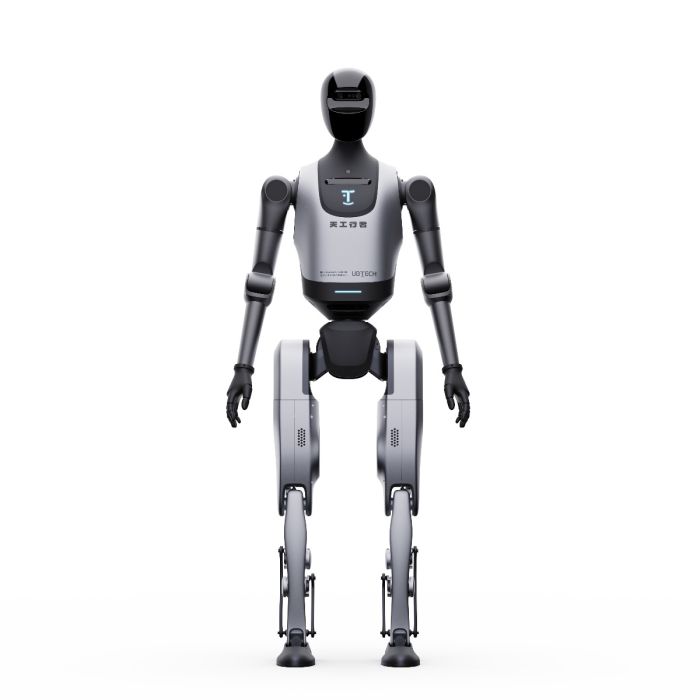
UBTech Walker Tienkung Voice And Vision Humanoid Robot
In stock
- BRAND:
- UBTECH
- MODEL:
- WALKER TIENKUNG VOICE AND VISION
- ORIGIN:
- China
- Warranty:
- 12 MONTHS
- AVAILABILITY:
- SUBJECT TO AVAILABILITY
- SKU:
- UBTECH-Walker-Tienkung
UBTech Walker Tienkung Voice And Vision Humanoid Robot
In a research laboratory, the instruments that earn their keep are rarely the ones bought to answer a single question. They are the ones that answer questions nobody had thought to ask when the purchase order was signed. The UBTech Walker Tienkung Voice and Vision Humanoid Robot is designed with that kind of longevity in mind. It is a full-size, fully electric humanoid running robot that can be fitted with a voice module and a large language model for natural-language conversation. It also exposes its joints and sensors to the researchers who use it. A team may start with speech experiments, move on to walking studies on slopes, and later collect teleoperation data for learning algorithms, all on the same machine.
Robots Middle East sells the Walker Tienkung Voice and Vision to universities, research institutes and educational organisations across the Middle East. Robots Middle East prepares the quotation, arranges supply and delivery to the customer's site, and remains the point of contact for support once the robot is in service. Enquiries are handled in a formal, consultative manner, so that the configuration discussed matches the research or teaching programme it is intended to serve.
Background
A joint development between UBTECH and Beijing's humanoid centre
The Walker Tienkung series was jointly developed by UBTECH Robotics Corp., Ltd. and Beijing Humanoid Robotics Innovation Center Co., Ltd. UBTECH brings long experience of building humanoid and service robots, from its UBTECH Walker family to commercial reception and industrial models. The innovation centre contributes a research-led perspective on how full-size humanoids should be engineered and opened up for study. Together they position the Tienkung series explicitly for scientific research and educational scenarios rather than for consumer or front-of-house use.
The series comes in three versions: the base Walker Tienkung (TK2101), the Walker Tienkung · Voice & Vision (TK2201) described on this page, and the Walker Tienkung · Embodied Intelligence (TK2301). Each shares the same full-size, fully electric humanoid concept, while the versions differ in the capabilities they are built to support.
Positioning: an open humanoid that can also hold a conversation
Full-size humanoid robots generally serve one of two purposes. Some are built to demonstrate, performing well-rehearsed routines for an audience. Others are built to be studied, and that demands access to the robot's internals. The Walker Tienkung Voice and Vision belongs firmly to the second category. It provides full-body joint and sensor interfaces that support teleoperation, data acquisition and secondary development, so researchers can read from, command and extend the robot rather than simply watch it.
What the Voice & Vision version adds is a route to spoken interaction. It can integrate a voice module and a large language model, supporting natural-language interaction between people and the robot. For laboratories working on human–robot interaction, this places conversational research and locomotion research on one shared platform, rather than splitting them across separate systems.
Technical Specifications
| Specification | Value |
|---|---|
| Model | Walker Tienkung · Voice & Vision |
| Robot type | Full-size, fully electric humanoid running robot |
| Developers | UBTECH Robotics Corp., Ltd. and Beijing Humanoid Robotics Innovation Center Co., Ltd. |
| Intended use | Scientific research and educational scenarios |
| Voice interaction | Can integrate a voice module and a large language model; supports natural-language interaction |
| Locomotion | Stable walking on irregular terrain such as slopes and sandy ground |
| Interfaces | Full-body joint and sensor interfaces; supports teleoperation, data acquisition and secondary development |
| Net weight | ≈61kg |
| Peak joint torque | 300Nm |
| Packing list | Robot body × 1, Power adapter × 1, Remote controller × 1, Safety rope × 1, User Manual (electronic) × 1, Warranty Card (electronic) × 1, Factory inspection report × 1 |
Specifications are as published by the manufacturer and are confirmed against the datasheet at quotation.
The manufacturer has not published the maximum payload, the IP rating, the maximum walking speed, the operating temperature range or the rating of the power adapter; these are confirmed at quotation.
What does the Voice and Vision version add to the Walker Tienkung platform?
The ability to integrate a voice module and a large language model is specified for the Voice & Vision and Embodied Intelligence versions; it is not listed for the base Walker Tienkung. For a buyer, this is the practical distinction. The base model suits teams whose work is purely mechanical or control-oriented. The Voice & Vision version allows the same humanoid body to take part in spoken exchanges, so researchers can study how people address a robot of human size, how instructions given in natural language translate into behaviour, and how dialogue and movement interact.
None of this comes at the expense of the physical platform. The robot retains its ability to walk steadily on slopes and sandy ground, its 300Nm peak joint torque and its open joint and sensor interfaces. A conversation experiment and a locomotion experiment therefore do not need separate machines. For departments where several research groups share equipment, that convergence can simplify both procurement and scheduling.
How open is the Walker Tienkung Voice and Vision for secondary development?
Openness is the core of the design. Interfaces reach across the full body, covering joints as well as sensors, and are intended for three kinds of work. The first is teleoperation, in which a human operator drives the robot directly. The second is data acquisition, in which motion and sensor data are recorded for later analysis or for training learning-based controllers. The third is secondary development, in which teams write their own software on top of the platform.
In practice, this means a laboratory is not restricted to the behaviours supplied at the factory. It can replace control strategies, test new perception pipelines and build datasets from its own trials. The supplied remote controller and safety rope reflect the reality of experimental work with a full-size biped: early trials are supervised and protected. The electronic user manual and the factory inspection report give the team a documented baseline before modifications begin. Robots Middle East can discuss the software environment and the documentation package as part of the enquiry.
Who is the Walker Tienkung Voice and Vision for?
The principal buyers are university laboratories and research institutes working on humanoid robotics, particularly where human–robot interaction sits alongside locomotion or control. Groups studying conversational agents in physical form will find the voice and large-language-model integration directly relevant. Engineering faculties that want a single full-size platform for teaching and for postgraduate projects are another natural fit, because the open interfaces let students progress from observing the robot to programming it.
Innovation centres and national research programmes across the region that are building expertise in embodied artificial intelligence may also consider it, especially where data collection through teleoperation forms part of the plan. Teams whose work centres specifically on embodied intelligence should compare this model with the UBTech Walker Tienkung Embodied Intelligence Humanoid Robot, the version named for that purpose, which also supports voice interaction. Buyers looking for a humanoid for factory tasks rather than research may find the UBTECH Walker S Industrial Humanoid Robot a closer match. The wider Research Robots category sets out further alternatives.
What is the Walker Tienkung Voice and Vision used for?
- Human–robot dialogue research: studying natural-language interaction with a full-size humanoid through an integrated voice module and large language model.
- Locomotion on irregular terrain: testing and refining walking control on slopes, sandy ground and other uneven surfaces.
- Teleoperation studies: driving the robot remotely through its open interfaces to explore operator control and shared autonomy.
- Dataset collection: recording joint and sensor data during trials to train and evaluate learning-based controllers.
- Secondary development: building and validating new control, perception or interaction software on a documented humanoid platform.
- University teaching: giving engineering and computer-science students hands-on experience with a full-size humanoid in laboratory courses.
Pricing and Availability
The Walker Tienkung Voice and Vision is supplied on quotation, as the final configuration depends on the research programme, the software requirements and the site where it will operate. Robots Middle East will review your intended application and prepare a formal proposal tailored to it. Delivery, customs clearance and after-sales support are arranged as part of the quotation. To begin, please submit your requirements through the quotation request available on this page.
Frequently Asked Questions
Who developed the Walker Tienkung series?
The series was jointly developed by UBTECH Robotics Corp., Ltd. and Beijing Humanoid Robotics Innovation Center Co., Ltd. It is designed for scientific research and educational scenarios.
Can the robot understand spoken language?
Yes. The Voice & Vision version can integrate a voice module and a large language model, supporting natural-language interaction.
What kind of ground can it walk on?
It is capable of stable walking on irregular terrain such as slopes and sandy ground.
How much does the robot weigh?
The Walker Tienkung · Voice & Vision has a net weight of ≈61kg.
What is included in the delivery?
The packing list comprises the robot body, a power adapter, a remote controller, a safety rope, an electronic user manual, an electronic warranty card and a factory inspection report.
Are the payload and IP rating available?
Not yet. Robots Middle East provides the maximum payload, IP rating, maximum walking speed, operating temperature and power adapter rating with the formal quotation.
Where can I buy the UBTech Walker Tienkung Voice and Vision Humanoid Robot and what does it cost?
You can buy it from Robots Middle East, which supplies it across the Middle East. The cost depends on configuration and delivery requirements, so it is provided in a formal quotation requested from this page.
Summary
The instruments a laboratory values most are the ones that keep generating new questions, and the Walker Tienkung Voice and Vision is built in that spirit. It combines a full-size, fully electric humanoid body that walks steadily on slopes and sand with full-body joint and sensor interfaces for teleoperation, data acquisition and secondary development. It adds a voice and large-language-model pathway for natural conversation. Developed jointly by UBTECH and the Beijing Humanoid Robotics Innovation Center for research and education, it lets a single machine serve dialogue studies, locomotion experiments and teaching. Robots Middle East quotes, delivers and supports it across the region, and for any team planning its next humanoid programme, this page is the starting point.