
Unitree G1-D Ultimate B U7 Wheel Base Dual-Arm Humanoid Robot
In stock
- BRAND:
- UNITREE ROBOTICS
- MODEL:
- U7
- PART #:
- G1-D-U7
- ORIGIN:
- China
- Warranty:
- 12 MONTHS
- AVAILABILITY:
- SUBJECT TO AVAILABILITY
- SKU:
- Unitree-G1-D-U7
Unitree G1-D Ultimate B U7 Wheel Base Dual-Arm Humanoid Robot
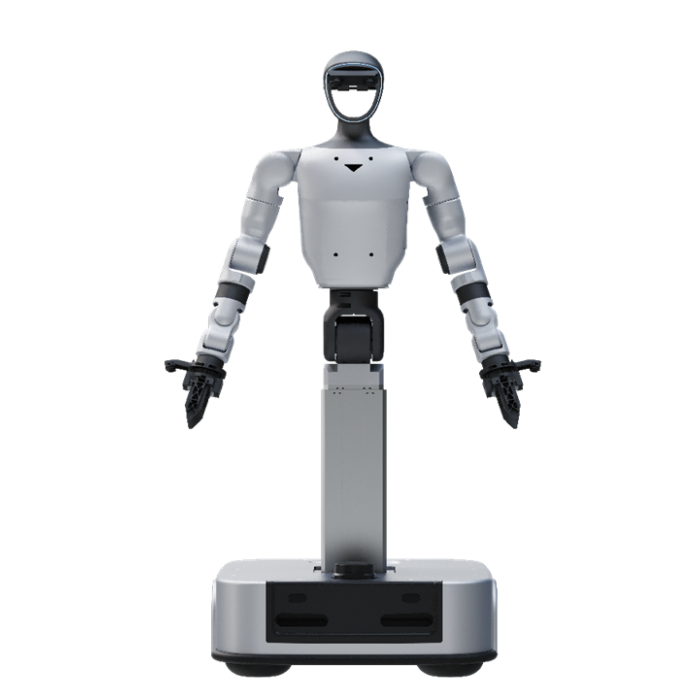
Workplaces are built to human heights. Counter tops, shelf tiers, trolley decks and machine hoppers sit where a standing person can reach them, and they rarely sit at the same level twice in one room. A robot that meets them at a single fixed height has to be met halfway, usually by rebuilding the work around it. The Unitree G1-D Ultimate B U7 Wheel Base Dual-Arm Humanoid Robot takes the opposite approach. It travels to the task on a wheeled chassis and raises or lowers its humanoid upper body on a lifting column, so that the robot adapts to the room rather than the room adapting to the robot.
Robots Middle East supplies the G1-D Ultimate B U7 to universities, research institutes, system integrators and industrial teams across the Middle East. Robots Middle East prepares the quotation for the exact configuration, arranges delivery to the customer's site and remains the point of contact for technical support once the robot is in service.
Background
Unitree Robotics and the G1-D line
The G1-D is manufactured by Yushu Technology Co., Ltd., the company known internationally as Unitree Robotics. Unitree built its reputation on agile legged machines, first quadrupeds and later full-size humanoids, and its G1 humanoid has become a familiar platform in research and teaching laboratories. The G1-D line takes that humanoid upper body into a different setting. Instead of walking, the robot is mounted on a base, and the range is divided into Standard versions on a fixed base and Ultimate versions on a wheeled base. The Ultimate B U7 belongs to the second group, where mobility and adjustable height are the point of the design.
A mobile lifting design
The defining feature of the Ultimate version is what Unitree calls a mobile lifting design, combining wheels with a lifting mechanism. The chassis uses differential drive and supports 360° in-place rotation, which allows the robot to turn on the spot in an aisle or beside a workstation rather than manoeuvring in wide arcs. Above the chassis, a column changes the working height of the torso and arms, taking the overall height from 1260mm at its lowest setting to 1680mm at its highest. Perception is distributed across the whole machine: LiDAR, depth cameras, physical collision sensors and low-obstacle detection sensors in the chassis; a head HD binocular camera for the wider scene; and an HD camera at each wrist for close-range work while grasping. An 8-core high-performance CPU provides the basic computing power on board.
Technical Specifications
| Specification | Value |
|---|---|
| Mobile operation design | Mobile lifting design that combines wheels and lifting mechanisms |
| Chassis drive type | Differential drive, supports 360° in-place rotation |
| Overall dimensions (min. column height) | 1260x525x570mm |
| Overall dimensions (max. column height) | 1680x525x570mm |
| Total weight (incl. battery) | Approx. 90kg |
| Max. single arm payload | Approx. 3kg |
| Column lifting speed | Approx. 60mm/s |
| Chassis sensors | LiDAR *1 + Depth Camera *2 + Physical Collision Sensor *2 + Low-Obstacle Detection Sensor *2 |
| Perception sensors | Head HD Binocular Camera *1 + Wrist HD Camera *2 |
| Basic computing power | 8-core High-performance CPU |
| Battery life | Approx. 6 hours |
| Manufacturer | Yushu Technology Co., Ltd. (Unitree Robotics) |
Specifications are as published by the manufacturer and are confirmed against the datasheet at quotation.
The manufacturer has not published the ingress protection rating, the chassis battery voltage, the maximum climbable slope, the operating temperature range, the charger specification, the wheel and chassis motor power, the camera resolution or the hand degrees of freedom for each end effector; these details are confirmed at quotation.
What does the wheel base add over a fixed-base G1-D?
A fixed-base robot defines a cell. Everything the arms handle has to be brought to them, at a height chosen once when the robot is installed. That arrangement is entirely sound for a dedicated bench, but it ties the robot to one place and one working level. The Ultimate B U7 removes both constraints. Differential drive and in-place rotation let it move between stations and line itself up with a table, a rack or a cart without a large turning circle, while the lifting column lets the same arms work near a low tray or a higher shelf.
The sensor arrangement follows from that mobility. A robot that drives among people and furniture needs to see where it is going and to know when it has touched something, which is why the chassis carries LiDAR and depth cameras alongside physical collision and low-obstacle detection sensors. The wrist cameras then take over at the final stage of a reach, giving the manipulation software a close view of the object between the fingers.
The arms themselves are sized for light work: the maximum payload of a single arm is approx. 3kg. That places the G1-D Ultimate B U7 among platforms for handling small parts, packages, tools, samples and everyday objects, rather than heavy lifting. Buyers whose task involves heavier items should discuss this with Robots Middle East early, so that the application can be assessed honestly.
How long can the G1-D Ultimate B U7 work between charges?
Unitree gives a battery life of approx. 6 hours, which is enough for a substantial laboratory session, a working shift of demonstrations or an extended trial in an operational setting. Teams planning longer daily use should agree a charging routine around those six hours from the outset, so that sessions are scheduled around the robot's availability rather than interrupted by it.
Two further figures matter when a deployment is planned. The robot weighs approx. 90kg including its battery, which bears on floor loading, lift access and transport within a building. The column rises at approx. 60mm/s, so height changes are deliberate rather than sudden, a sensible trait for a machine that works close to people and equipment.
Who is the Unitree G1-D Ultimate B U7 for?
The clearest fit is the research group working on mobile manipulation: combining navigation, whole-body positioning and dual-arm grasping in one experiment, on one platform, without building a custom mobile base. University laboratories and research institutes will find that the wheeled chassis and lifting column open up tasks that a stationary robot cannot attempt.
System integrators form a second group. For teams evaluating humanoid manipulation in logistics, retail, hospitality or light manufacturing, a robot that can move between workstations is a more realistic test of an application than one bolted to a bench. Educational institutions and corporate innovation centres make up a third group, using the platform to teach robotics or to show stakeholders how embodied AI might fit into their operations.
Where the work will stay at one bench, a fixed-base version may suit better. The Standard versions, such as the Unitree G1-D Standard A U1 Fixed base Dual-Arm Humanoid Robot or the Unitree G1-D Standard E U5 Fixed base Dual-Arm Humanoid Robot, are intended for stationary cells. Buyers who want the wheeled base in another package can compare the Unitree G1-D Ultimate A U6 Wheel Base Dual-Arm Humanoid Robot; Robots Middle East sets out the differences between packages in the quotation. The full range is listed in the Unitree G1-D category.
What is the Unitree G1-D Ultimate B U7 used for?
- Mobile manipulation research — studying how navigation, height adjustment and dual-arm grasping combine in a single task.
- Embodied AI and data collection — gathering wrist and head camera data across many locations and working heights for training policies.
- Shelf and rack handling trials — testing the picking and placing of light items at different shelf levels in a mock warehouse or shop.
- Laboratory assistance — moving between benches to fetch, present or arrange samples, tools and containers.
- Teaching and curriculum work — giving students a complete humanoid platform for courses in perception, motion planning and control.
- Application pilots and demonstrations — showing customers or management how a wheeled humanoid could operate in a real facility.
Pricing and Availability
The G1-D Ultimate B U7 is supplied by quotation, so that the configuration, the software package and the support level match the intended use. Robots Middle East reviews the application with the buyer and prepares the package to suit it. Delivery, customs clearance and technical support are arranged together with the quotation. To begin, a request for a formal quotation is available on this page.
Frequently Asked Questions
Does the G1-D Ultimate B U7 walk like the G1 humanoid?
No. It moves on a wheeled chassis with differential drive, which supports 360° in-place rotation, and adjusts its working height with a lifting column.
How heavy an object can each arm handle?
The maximum payload of a single arm is approx. 3kg. The platform therefore suits light objects such as small parts, packages and tools.
How tall is the robot?
The overall dimensions are 1260x525x570mm at minimum column height and 1680x525x570mm at maximum column height.
What sensors does it carry?
The chassis has LiDAR, depth cameras, physical collision sensors and low-obstacle detection sensors. For perception, there is a head HD binocular camera and an HD camera at each wrist.
How long does the battery last?
Unitree gives a battery life of approx. 6 hours, which covers a substantial working session in a laboratory or a pilot site.
Can it be used in dusty or damp environments?
No ingress protection rating or operating temperature range has been published for this model. Robots Middle East reviews the intended environment with the buyer before a deployment in demanding conditions is planned.
Where can I buy the Unitree G1-D Ultimate B U7 Wheel Base Dual-Arm Humanoid Robot and what does it cost?
Robots Middle East supplies it across the Middle East on a quotation basis. The cost depends on the chosen configuration, delivery and support, and is set out in a formal quotation requested through this page.
Summary
The rooms where useful work happens were not designed for robots, and they will not be redesigned for one. The G1-D Ultimate B U7 accepts that. Its wheeled chassis brings the humanoid upper body to the bench, the shelf or the cart; its lifting column sets the arms at the height the task demands; and its layered sensors, from chassis LiDAR to wrist cameras, keep it aware of its surroundings as it does so. With light-duty arms, a battery life of approx. 6 hours and an 8-core CPU on board, it is a platform for research, teaching and application trials in which mobility matters as much as manipulation. For a configuration matched to your application, with delivery and support from Robots Middle East, this page is the starting point.