
Unitree G1-D Standard B U2 Fixed Base Dual-Arm Humanoid Robot
In stock
- BRAND:
- UNITREE ROBOTICS
- MODEL:
- U2
- PART #:
- G1-D-U2
- ORIGIN:
- China
- Warranty:
- 12 MONTHS
- AVAILABILITY:
- SUBJECT TO AVAILABILITY
- SKU:
- Unitree-G1-D-1
Unitree G1-D Standard B U2 Fixed Base Dual-Arm Humanoid Robot
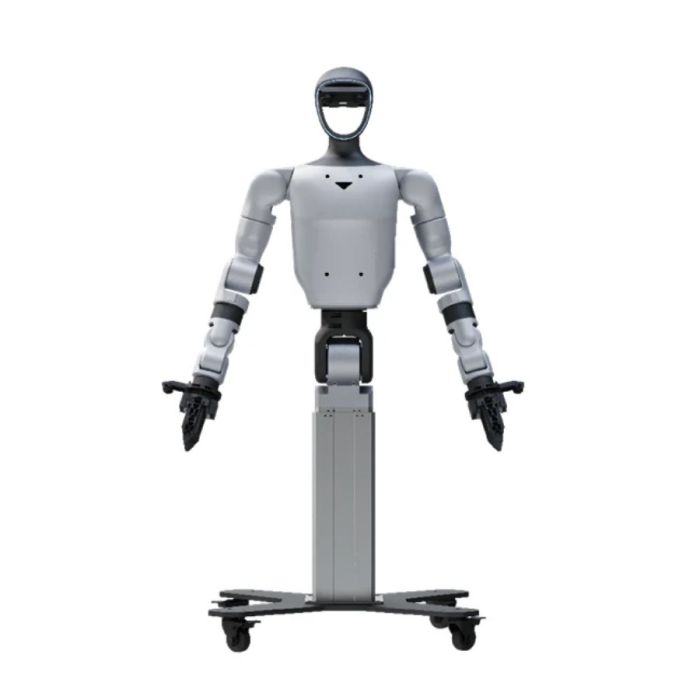
Between the single industrial arm bolted into a cell and the full walking humanoid sits a less publicised option: a humanoid upper body that keeps the human proportions of its arms and hands but gives up its legs. The Unitree G1-D Standard B U2 Fixed base Dual-Arm Humanoid Robot belongs to that middle ground. It offers the reach, the posture and the paired hands that let a robot work at a bench much as a person would, while removing the balance problem that absorbs so much engineering effort on legged machines. For teams whose questions concern grasping, handling and coordination rather than gait, that trade is often the more productive one.
Robots Middle East sells the G1-D Standard B U2 to universities, research institutes, system integrators and industrial innovation teams across the Middle East. Robots Middle East prepares each quotation for the specific configuration requested, arranges delivery to the customer's site in the region, and provides support once the robot is in service, so that a project can move from enquiry to first experiment through a single point of contact.
Background
Unitree Robotics and its humanoid line
Unitree Robotics is a Chinese robotics manufacturer that first became widely known for its quadruped robots and has since extended its catalogue into humanoid platforms. Its approach has generally been to build compact, agile machines that research groups and developers can acquire and programme themselves, rather than closed systems sold only as finished automation. The humanoid range grew out of that philosophy, and the G1-D family applies it to a specific problem: giving manipulation researchers a humanoid body that is ready for arm and hand work without first having to master locomotion.
Where the G1-D Standard B U2 sits in the family
The G1-D family is offered in several versions. The sources for this product name the Standard A U1, the Standard B U2 and the Standard D U4, and the wider catalogue also lists fixed-base Standard C U3 and Standard E U5 versions alongside wheel-base Ultimate versions. The Standard B U2 is a fixed-base configuration: the robot is mounted in place and its capability is concentrated in two articulated arms and two hands. The full range can be explored in the Unitree G1-D category. Because each version is defined as a package, the figures below belong to the Standard B U2 alone and should not be read across to its siblings.
Technical Specifications
| Specification | Value |
|---|---|
| Base type | Fixed base |
| Arm structure | Two articulated arms |
| Degrees of freedom | Seven per arm |
| Payload per arm | 3 kg |
| Arm reach | 450 mm |
| Hand dimensions | 175 × 88 × 77 mm |
| Hand weight | Approximately 650 g |
| Hand operating voltage | 12–58V, with low standby current |
Specifications are as published by the manufacturer and are confirmed against the datasheet at quotation.
The manufacturer has not published the IP rating, operating temperature, power consumption, charger specification, operating system or wrist camera resolution; these are confirmed with the quotation.
What does a fixed base change for manipulation work?
On a walking humanoid, every movement of the arms shifts the robot's centre of mass, and the balance controller must compensate before the hands can act with any precision. A fixed base removes that layer entirely. The shoulders stay where they were mounted, so the workspace of each arm is defined by its own geometry rather than by the posture of the legs beneath it. For the Standard B U2, that geometry is concrete: each arm offers seven degrees of freedom and a reach of 450 mm.
Seven degrees of freedom matters more than it might first appear. An arm with six joints can generally place its hand at a given position and orientation in only a limited number of ways. A seventh joint adds redundancy, allowing the elbow to be moved while the hand holds still. In practice, that lets the robot reach around an obstacle, approach an object from a more natural angle or avoid a joint limit in the middle of a task, which is exactly the behaviour that human-like manipulation research tends to study.
The payload of 3 kg per arm frames the kind of objects the robot is intended to handle: tools, containers, components and everyday items rather than heavy industrial loads. Combined with two arms working together, it supports bimanual tasks such as holding a part with one hand while operating on it with the other, passing an object between hands or manipulating something too awkward for a single gripper.
How do the hand figures affect integration?
The hand data is unusually practical for planning. Each hand measures 175 × 88 × 77 mm and weighs approximately 650 g, figures that help an integrator judge clearances around fixtures, the size of objects that can be grasped comfortably and how the hand's own mass sits within the arm's payload. When designing a workstation, those dimensions can be drawn directly into a layout before the robot arrives.
The hands operate across a voltage range of 12–58V with low standby current for power efficiency. For a laboratory planning long sessions of data collection or repeated trials, low standby draw means the hands can remain powered between tasks without a significant penalty, which keeps a test schedule moving and reduces the temptation to power down and re-initialise between runs.
Who is the Unitree G1-D Standard B U2 Fixed base Dual-Arm Humanoid Robot for?
The clearest fit is the academic research group working on manipulation, imitation learning or human–robot interaction, where a humanoid arm and hand arrangement makes results more transferable to human-scale tasks, and where a stationary platform keeps experiments repeatable from one trial to the next. University teaching laboratories form a second segment: a fixed-base robot is easier to supervise, simpler to position in a classroom and allows students to concentrate on kinematics, control and perception.
System integrators and corporate innovation teams evaluating humanoid manipulation for future deployment represent a third group. For them, the Standard B U2 provides a way to prototype bench-level tasks, such as sorting, assembly assistance or inspection handling, with concrete arm and hand figures against which a proof of concept can be scoped.
Buyers should compare the Standard B U2 with its siblings before deciding. Those wishing to review a different fixed-base package can look at the Unitree G1-D Standard A U1 or the Unitree G1-D Standard D U4, while teams whose task requires the platform to travel between stations may wish to examine a wheel-base version such as the Unitree G1-D Ultimate A U6 Wheel Base Dual-Arm Humanoid Robot. Robots Middle East can set out the differences between packages as part of the quotation.
What is the Unitree G1-D Standard B U2 Fixed base Dual-Arm Humanoid Robot used for?
- Manipulation research — studying grasping, re-grasping and dexterous handling on a stable, repeatable humanoid platform.
- Bimanual coordination — developing tasks in which both arms cooperate, such as holding and working on the same object.
- Robot learning and data collection — gathering demonstration data for imitation and reinforcement learning at a fixed workstation.
- Teaching and training — giving students hands-on experience of redundant-arm kinematics, control and perception.
- Workcell prototyping — testing whether a humanoid upper body can perform a bench task before wider investment.
- Human–robot interaction studies — exploring handovers and shared tasks with a robot of human-like proportions.
Pricing and Availability
The G1-D Standard B U2 is supplied by quotation, because the final package, accessories and support requirements vary from one project to the next. Robots Middle East prepares a written quotation covering the exact configuration requested. Delivery to your site, customs clearance and after-sales support are arranged together with the quotation. The request form for a tailored quotation is available on this page.
Frequently Asked Questions
Does the G1-D Standard B U2 walk?
No. It is a fixed-base configuration, mounted in place so that its capability is concentrated in its arms and hands. Wheel-base versions exist elsewhere in the G1-D family for projects that need mobility.
How many degrees of freedom do the arms have?
Each of the two articulated arms has seven degrees of freedom. The extra joint gives the arm redundancy, allowing the elbow to move while the hand keeps its position.
What can each arm lift?
The payload is 3 kg per arm, with an arm reach of 450 mm. That suits tools, components and everyday objects at bench scale.
How large and heavy are the hands?
Each hand measures 175 × 88 × 77 mm and weighs approximately 650 g. The hands operate at 12–58V with low standby current.
Can both arms work on the same object?
Yes. With two articulated arms of seven degrees of freedom each, one hand can hold an object while the other works on it, or the two can pass an item between them.
Can the figures for other G1-D versions be applied to this one?
No. Each G1-D version is a distinct package, and the figures on this page belong to the Standard B U2 only. Sibling versions should be compared on their own data.
Where can I buy the Unitree G1-D Standard B U2 Fixed base Dual-Arm Humanoid Robot and what does it cost?
You can buy it from Robots Middle East, which supplies it across the Middle East. The cost depends on the configuration and services required and is set out in a tailored quotation requested through this page.
Summary
The G1-D Standard B U2 occupies the space between a single industrial arm and a fully mobile humanoid, and it does so deliberately. By giving up its legs, it gains a stable platform on which two seven-degree-of-freedom arms, each carrying 3 kg across a 450 mm reach, and two compact hands can be studied and deployed without the distraction of balance. The arm and hand figures are concrete enough to plan a workstation around before the robot arrives. For research groups, teaching laboratories and integrators in the region who want humanoid manipulation at the bench, supplied, delivered and supported by Robots Middle East, this page is the starting point.
Specifications
General
Physical
Mobility
Performance
Connectivity
Battery + Power
Shipping
Feature
| Height, width and thickness (standing): 1270x450x200mm |
| Height, width and thickness (folded): 690x450x300mm |
| Total freedom (joint motor): 23 |
| Freedom of one leg: 6 |
| Waist Freedom: 1 |
| Freedom of one arm: 5 |
| Single-handed freedom: Dexterous hand and double-freedom wrist optional |
| Maximum knee torque: 90N.m |
| Maximum arm load: 2kg |
| Calf + thigh length: 0.6m |
| Arm span: approx. 0.45m |
| Extra large joint movement space Lumbar Z-axis joint: ±155° |
| Knee joint: 0~165° |
| Hip joint: P±154°, R-30~+170°, Y±158°” |
| Full joint hollow internal alignment: Yes |
| Joint encoder: dual encoder |
| Heat dissipation system: localized air-cooled heat dissipation |
| Power supply: 13 series battery |
| Base Computing Power: 8-core high performance CPU |
| Sensor: Depth camera + 3D LIDAR |
| WiFi 6, Bluetooth 5.2: Yes |
| Stereo speakers and microphone array as standard |
| Smart battery (quick release) 1pc |
| Charger 1pc |
| Handheld remote control 1 set |
| Endurance: about 2h |
| Intelligent OTA upgrade: support |
| Secondary development: no |
| Warranty: 8 months |
What's included
Related Products
Out of stock