
Unitree G1-D Ultimate D U9 Wheel Base Dual-Arm Humanoid Robot
In stock
- BRAND:
- UNITREE ROBOTICS
- MODEL:
- U9
- PART #:
- G1-D-U9
- ORIGIN:
- China
- Warranty:
- 12 MONTHS
- AVAILABILITY:
- SUBJECT TO AVAILABILITY
- SKU:
- Unitree-G1-D-U9
Unitree G1-D Ultimate D U9 Wheel Base Dual-Arm Humanoid Robot
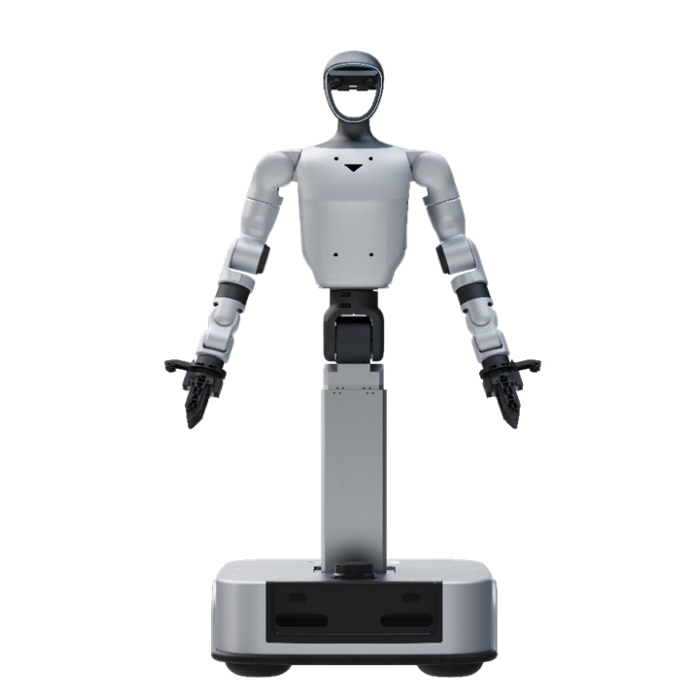
Every useful manipulation dataset begins with a person guiding a robot through a task, and the value of that data depends on how faithfully the machine follows the hand that guides it. When the operator sits in one room and the task moves around a building, a robot bolted to a bench soon becomes the bottleneck. The Unitree G1-D Ultimate D U9 Wheel Base Dual-Arm Humanoid Robot addresses this with a humanoid upper body that travels: two arms with seven degrees of freedom each, mounted on a lifting column above a two-axis waist, carried by a differential-drive chassis and controlled through a teleoperation link with a system latency of under 100ms.
Robots Middle East sells and supplies this robot to universities, research centres, system integrators and industrial teams across the Middle East. Robots Middle East prepares each quotation for the exact configuration requested, arranges delivery to the customer's site and remains the point of contact for technical support after the robot has been commissioned.
Background
Unitree Robotics and the G1-D family
Unitree Robotics built its reputation on agile legged robots before extending its range into humanoid platforms. The G1-D family applies that experience to a different problem: rather than walking, it concentrates on dexterous upper-body work in laboratories, workshops and service environments. The family is offered in Standard and Ultimate packages, and the G1-D Ultimate D, catalogued as the G1-D-U9, is one of the Ultimate configurations that place the dual-arm upper body on a wheeled base.
Positioning: mobile manipulation and data collection
The key idea behind the Ultimate configurations is that height, rotation and travel are handled by the robot itself rather than by the layout of the room. A lifting column changes the working height, the waist turns and bends the torso, and the chassis moves the whole assembly between workstations. Combined with head and wrist cameras and a low-latency teleoperation system, this makes the platform well suited to research groups that collect demonstration data for learning-based control, as well as to teams evaluating how a humanoid could take on handling tasks spread across a facility.
Technical Specifications
| Specification | Value |
|---|---|
| Arm degrees of freedom | 7×2 |
| Waist degrees of freedom | 2 |
| Column degrees of freedom | 1 |
| Base degrees of freedom | 2 |
| Dimensions at minimum column height | 1260x525x570mm |
| Dimensions at maximum column height | 1680x525x570mm |
| Vertical workspace | 0-2m |
| Waist range of motion | Z-axis: ±155°, Y-axis: -2.5° to +135° |
| Lifting accuracy | ±0.5mm |
| Maximum mobility speed | 1.5m/s |
| Chassis drive type | Differential drive, supports 360° in-place rotation |
| Chassis sensors | LiDAR *1 + Depth Camera *2 + Physical Collision Sensor *2 + Low-Obstacle Detection Sensor *2 |
| Perception sensors | Head HD Binocular Camera *1 + Wrist HD Camera *2 |
| Basic computing power | 8-core High-performance CPU |
| Optional high computing power module | Multiple brands and models available, such as Orin NX 16GB (100TOPS) |
| Connectivity | Wi-Fi 6, Bluetooth 5.2 |
| System teleoperation latency | <100ms |
| Teleoperation sampling rate | 60Hz |
Specifications are as published by the manufacturer and are confirmed against the datasheet at quotation.
The manufacturer has not published the IP rating, the hand weight, the operating temperature, the charging time or the arm reach; these are confirmed at quotation.
What does the wheeled base change compared with a fixed-base G1-D?
The Standard G1-D packages are listed as fixed-base robots: they work wherever they are installed, and the task has to be brought to them. The Ultimate configurations, including this one, add two base degrees of freedom through a differential-drive chassis that can rotate 360° on the spot and travel at up to 1.5m/s. In practical terms, the robot can turn to face a new bench without manoeuvring, cross a laboratory between tasks and position itself before the arms begin to work.
Mobility of this kind is only useful if the robot is aware of its surroundings, and the chassis is equipped accordingly. A LiDAR unit and two depth cameras give it a view of the space around it, two low-obstacle detection sensors watch for objects close to the floor, and two physical collision sensors register contact. Above the chassis, the lifting column moves the upper body between its minimum and maximum heights with a lifting accuracy of ±0.5mm, so a vertical workspace of 0-2m is covered from floor level to above head height. The waist then adds rotation of ±155° about the Z-axis and bending from -2.5° to +135° about the Y-axis, which lets the arms reach downwards to low trays or turn towards a side table without moving the base.
How does the G1-D Ultimate D U9 support teleoperation and data collection?
Teleoperation is the route by which many teams generate training data for embodied AI, and the quality of each demonstration depends on how promptly the robot responds to the operator. This platform specifies a system teleoperation latency of under 100ms and a sampling rate of 60Hz, so the motion of the operator and the motion of the robot remain closely aligned throughout a recorded task.
The visual record is captured by a head HD binocular camera and two wrist HD cameras, giving both a scene-level view and a close view of each gripper as it works. Onboard processing starts with an 8-core high-performance CPU, and an optional high computing power module can be added for heavier perception or learning workloads, with multiple brands and models available, such as Orin NX 16GB (100TOPS). Wi-Fi 6 and Bluetooth 5.2 handle wireless connectivity. Together, these elements allow a team to record, process and replay manipulation tasks on the robot itself, rather than relying on a separate rig.
Who is the Unitree G1-D Ultimate D U9 Wheel Base Dual-Arm Humanoid Robot for?
The clearest fit is a research group working on embodied AI, imitation learning or mobile manipulation that needs tasks recorded in more than one location. Universities and research centres that run robotics programmes will also find a platform that brings together navigation, perception and dual-arm control in one machine, which is valuable for teaching and for postgraduate projects alike.
System integrators and innovation teams in logistics, manufacturing and services can use it to assess how a humanoid upper body might handle picking, transfer or inspection tasks across a site before committing to a wider deployment. Laboratories in healthcare, pharmaceuticals and materials science that move samples between benches are another natural audience.
Where the work stays at a single bench and mobility adds nothing, a fixed-base package such as the Unitree G1-D Standard A U1 Fixed base Dual-Arm Humanoid Robot may suit the application better. Buyers comparing the wheeled packages can also consider the Unitree G1-D Ultimate A U6 Wheel Base Dual-Arm Humanoid Robot, and Robots Middle East can advise on the differences between the lettered packages. The full range is presented in the Unitree G1-D category.
What is the Unitree G1-D Ultimate D U9 Wheel Base Dual-Arm Humanoid Robot used for?
- Demonstration data collection – recording teleoperated manipulation tasks with head and wrist camera views for training learning-based policies.
- Mobile manipulation research – studying how navigation, torso motion and dual-arm control are coordinated in a single task.
- Laboratory sample handling – moving items between benches, shelves and instruments at different working heights.
- Industrial process evaluation – trialling picking, transfer and inspection tasks on a real site before a wider rollout.
- Robotics education – giving students one platform on which to explore perception, mobility and manipulation.
- Service and retail prototyping – developing concepts in which a humanoid fetches, arranges or presents objects for people.
Pricing and Availability
The cost of this robot depends on the configuration selected, including any optional high computing power module, and is therefore given by quotation. Robots Middle East prepares each quotation for the requested package, so that the configuration quoted is the configuration delivered. Delivery, customs and support are arranged together with the quotation. To begin, please submit your requirements through the quotation request available on this page.
Frequently Asked Questions
How many degrees of freedom do the arms have?
Each arm has seven degrees of freedom, written as 7×2 for the pair. The waist adds two further degrees of freedom, the column one and the base two.
How high can the robot work?
The vertical workspace is 0-2m. The lifting column changes the robot's height from 1260x525x570mm at its minimum to 1680x525x570mm at its maximum, with a lifting accuracy of ±0.5mm.
How does the chassis move?
The chassis uses differential drive, supports 360° in-place rotation and reaches a maximum mobility speed of 1.5m/s. It carries a LiDAR unit, two depth cameras, two physical collision sensors and two low-obstacle detection sensors.
Is the robot suitable for teleoperation?
Yes. The system teleoperation latency is under 100ms with a sampling rate of 60Hz, and the head binocular camera and two wrist cameras provide the operator's views.
Can additional computing power be added?
The basic computing power is an 8-core high-performance CPU. An optional high computing power module is available in multiple brands and models, such as Orin NX 16GB (100TOPS).
Which wireless connectivity does the robot offer?
The robot supports Wi-Fi 6 and Bluetooth 5.2 for wireless connectivity.
Where can I buy the Unitree G1-D Ultimate D U9 Wheel Base Dual-Arm Humanoid Robot and what does it cost?
You can buy it from Robots Middle East, which supplies it across the Middle East. The cost depends on the configuration and is provided in a quotation prepared for your requirements.
Summary
A demonstration is only as good as the link between operator and machine, and a dataset is only as broad as the places the robot can reach. This dual-arm Unitree humanoid joins the two: a low-latency teleoperation system and three cameras capture each task, while the lifting column, the two-axis waist and the differential-drive chassis carry the arms to the work, from floor level to above head height and from one bench to the next. For research groups, integrators and educators who need manipulation that is not confined to a single spot, and who wish to plan a configuration, delivery and support with Robots Middle East, this page is the starting point.