
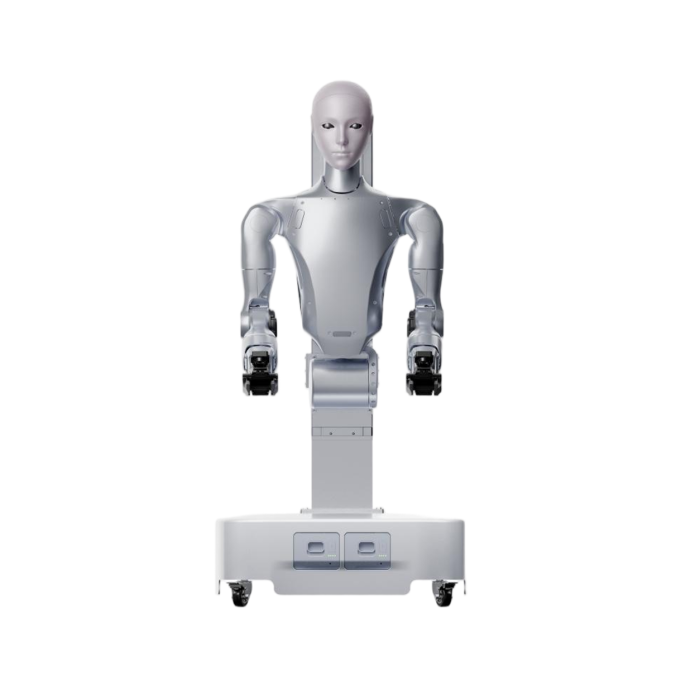
Unitree H2-D Standard F Humanoid Robot
In stock
- BRAND:
- UNITREE ROBOTICS
- MODEL:
- H2-D-Standard-F
- PART #:
- H2-D-Standard-F
- ORIGIN:
- China
- Warranty:
- 12 MONTHS
- AVAILABILITY:
- SUBJECT TO AVAILABILITY
- SKU:
- Unitree-H2-D-Standard-F
Unitree H2-D Standard F Humanoid Robot
Buying a robot usually means buying a snapshot: the machine performs on delivery day exactly as it did on the test bench, and it stays that way. The Unitree H2-D Standard F Humanoid Robot is built on a different premise. Its frame, joints and battery are fixed at the factory, but the algorithms that move it are designed to evolve continuously through over-the-air updates. What arrives is a full-height humanoid body whose behaviour can keep improving long after it has been unpacked. For organisations weighing a humanoid purchase, this changes the question from "what can it do today?" to "what platform are we committing to?"
Robots Middle East supplies the Unitree H2-D Standard F Humanoid Robot to universities, research centres, integrators, exhibition operators and corporate innovation teams across the Middle East. Robots Middle East prepares each quotation against the exact configuration requested, coordinates delivery to the customer's site, and remains the point of contact for support after the robot is in service.
Background
Unitree Robotics and the H2 family
Unitree Robotics built its reputation on legged machines, first with quadrupeds and then with humanoids that brought dynamic walking within reach of laboratories and businesses outside the largest research institutions. The H2 is the company's full-size humanoid line. The sources name three versions within it: the H2, the H2 EDU and the H2 Plus. The figures in this article are those of the H2, which is the basis of the Standard configurations sold under the H2-D Standard name.
The family follows a recognisable Unitree pattern: a common mechanical platform, with versions distinguished by computing, development access and fitted equipment rather than by a different body. That makes it important to read the full product name, including the configuration letter, when comparing listings. The wider range of lettered configurations can be compared in the H2-D Standard category.
A human-scale body with evolving software
The H2 stands 1820 mm tall, which places it firmly in the adult-human size class rather than among the smaller research humanoids. Its 31 degrees of freedom are distributed with seven in each arm and six in each leg, and its joints deliver up to 360 N.m of torque, together with precise dynamic movement replication. The structure combines aerospace-grade aluminium, titanium alloy and high-strength engineering plastics.
The defining characteristic of this platform, however, is its software model. The H2's algorithms evolve continuously via OTA, so motion behaviours can be refined over the life of the robot without returning it to the factory. For a buyer, this means the hardware specification sets the physical envelope, while the robot's capabilities within that envelope are expected to develop over time.
Technical Specifications
| Specification | Value (H2) |
|---|---|
| Standing dimensions | 1820 x 456 x 218 mm |
| Weight with battery | Approximately 70 kg |
| Total degrees of freedom | 31 |
| DoF per arm | 7 |
| DoF per leg | 6 |
| Joint torque | 360 N.m |
| Max. arm joint torque | 120 N.m |
| Max. arm payload | Peak: ~15 kg; nominal: ~7 kg |
| Battery | 15 Ah (0.972 kWh) |
| Battery life | Approximately 3 h |
| Basic onboard computing | PC1: Intel Core i5 |
| Vision sensor | Wide-angle humanoid binocular camera |
| Voice interaction | Array microphones + high-power speaker |
| Connectivity | Wi-Fi 6, Bluetooth 5.2 |
| Materials | Aerospace-grade aluminium + titanium alloy + high-strength engineering plastics |
| Included accessories | Charger and manual remote controller |
| Software updates | Algorithms evolve continuously via OTA |
Specifications are as published by the manufacturer and are confirmed against the datasheet at quotation.
The manufacturer has not published the top walking speed, the IP rating, the camera resolution, the operating temperature range, the charging time or the noise level; Robots Middle East confirms these at quotation.
Can the Unitree H2-D Standard F Humanoid Robot be programmed by the buyer?
This is the first question to settle before ordering, because the answer shapes what the robot can be used for. The base H2 has one computing unit, an Intel Core i5, with no PC dedicated to user development, and secondary development is not supported. The base H2 also comes with no robotic hands included.
In practice, this positions the base platform as a machine that is operated rather than reprogrammed. It is controlled with the included manual remote controller, interacts through its array microphones and high-power speaker, perceives its surroundings through a wide-angle binocular camera, and gains new behaviours through Unitree's OTA updates rather than through code written by the owner. For demonstration, presentation and evaluation work, that is often an advantage: there is less to configure, and the robot's behaviour is maintained by the manufacturer.
Teams that intend to write their own control software, or that need hands for manipulation, should raise this at the outset. The sources name the H2 EDU and H2 Plus as further versions of the family, and Robots Middle East sets out which version and which fitted equipment the F configuration carries, including whether any end effectors are supplied, before a quotation is issued.
What can the H2 carry, and for how long?
Each arm has seven degrees of freedom and a maximum arm joint torque of 120 N.m. The maximum arm payload is approximately 7 kg nominal, with a peak of approximately 15 kg. The nominal figure is the one to plan sustained tasks around; the peak describes what the arm can handle briefly.
Energy comes from a 15 Ah battery rated at 0.972 kWh, giving a battery life of approximately 3 h. That is enough to cover a teaching session, a series of trials or a shift at an exhibition stand, but organisations planning longer events should schedule charging breaks and discuss their daily operating pattern with Robots Middle East.
Who is the Unitree H2-D Standard F Humanoid Robot for?
The clearest fit is an organisation that wants a full-height humanoid to demonstrate, observe and present, without taking on a software development programme. Universities and technical colleges can use it to show students how a bipedal machine balances, walks and coordinates 31 joints. Innovation centres, museums and corporate visitor spaces can use its voice interaction and human proportions to engage audiences in a way a smaller robot cannot.
Integrators and procurement teams evaluating humanoids for future deployment form a second group. For them, the H2 offers a realistic sense of how a human-scale robot occupies a room, how it handles payloads close to its nominal limit, and how its battery budget fits a working day.
Research groups that need to develop their own algorithms should note the base H2's restrictions on secondary development, and ask Robots Middle East about the development-oriented versions named in the H2 family. Buyers whose work is confined to a bench or workstation may wish to compare this walking configuration with the Unitree H2-D Standard Fixed Base Dual-Arm Humanoid Robot, and other lettered options such as the Unitree H2-D Standard A Humanoid Robot are available for comparison before deciding.
What is the Unitree H2-D Standard F Humanoid Robot used for?
- Teaching locomotion: showing students how a full-size biped balances and walks across a classroom or laboratory floor.
- Public engagement: greeting visitors and speaking with them at exhibitions, museums and corporate showrooms.
- Human-robot interaction studies: observing how people respond to a machine of adult height sharing their space.
- Deployment evaluation: testing whether a human-scale humanoid fits the corridors, doorways and workflows of a real facility.
- Payload trials: assessing how the arms handle objects within their nominal and peak payload range.
- Technology demonstrations: presenting the state of humanoid robotics to stakeholders, investors and partners.
Pricing and Availability
Robots Middle East quotes the Unitree H2-D Standard F Humanoid Robot individually, so that the configuration, the fitted equipment and the documentation match the buyer's intended use. Delivery, customs clearance and after-sales support are arranged together with the quotation. A tailored quotation for the Unitree H2-D Standard F Humanoid Robot is available on this page.
Frequently Asked Questions
How tall is the Unitree H2-D Standard F Humanoid Robot?
The H2 platform has standing dimensions of 1820 x 456 x 218 mm and weighs approximately 70 kg with its battery.
How many degrees of freedom does it have?
The H2 has 31 degrees of freedom in total, with seven in each arm and six in each leg.
How much can the arms lift?
The maximum arm payload is approximately 7 kg nominal and approximately 15 kg at peak.
How long does the battery last?
The 15 Ah (0.972 kWh) battery gives a battery life of approximately 3 h. Robots Middle East can advise on planning charging around longer sessions.
Can I develop my own software for it?
The base H2 has no PC dedicated to user development, and secondary development is not supported. Robots Middle East can advise on the development-oriented versions named in the H2 family.
Does the robot receive software updates?
Yes. The H2's algorithms evolve continuously via OTA, so motion behaviours can be refined after delivery.
Where can I buy the Unitree H2-D Standard F Humanoid Robot and what does it cost?
You can buy it from Robots Middle East, which supplies it across the Middle East. The cost depends on the configuration and is set out in an individual quotation requested through this page.
Summary
The Unitree H2-D Standard F Humanoid Robot is best understood as a platform rather than a finished snapshot. Its physical envelope is clearly defined: an adult-height frame of aluminium, titanium alloy and engineering plastics, 31 degrees of freedom, up to 360 N.m of joint torque and approximately three hours of battery life. Within that envelope, its behaviour is designed to keep improving through Unitree's OTA updates. For organisations that want to operate, demonstrate and evaluate a full-size humanoid rather than reprogramme one, it is a well-defined choice, and for anyone ready to settle the configuration with Robots Middle East, this page is the starting point.