
Unitree H2-D Standard L Humanoid Robot
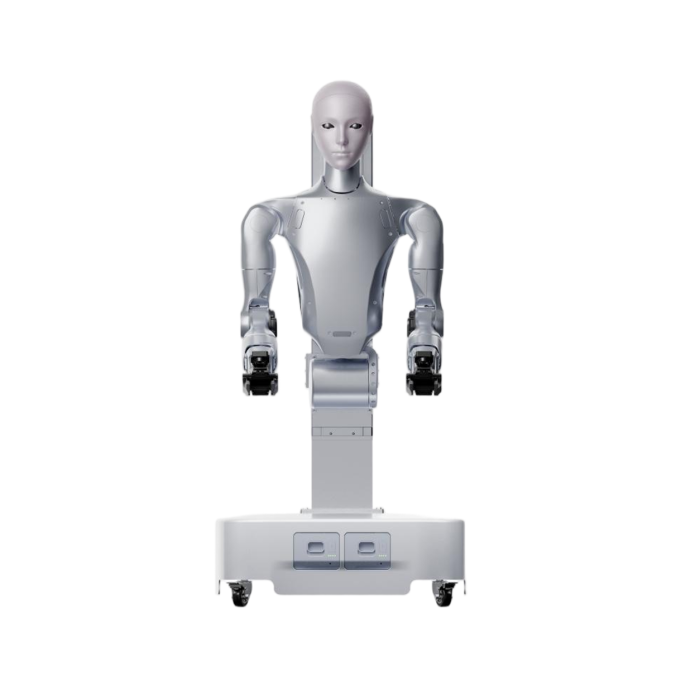
In stock
- BRAND:
- UNITREE ROBOTICS
- MODEL:
- H2-D-Standard-L
- PART #:
- H2-D-Standard-L
- ORIGIN:
- China
- Warranty:
- 12 MONTHS
- AVAILABILITY:
- SUBJECT TO AVAILABILITY
- SKU:
- Unitree-H2-D-Standard-L
Unitree H2-D Standard L Humanoid Robot
Strength and finesse seldom arrive in the same machine. A robot built to drive its legs hard tends to be clumsy at the wrist, and one designed for delicate manipulation is often fragile underfoot. The Unitree H2-D Standard L Humanoid Robot belongs to Unitree's H2 family, which sets out to close that gap. It distributes 31 degrees of freedom across a full-size body, rates its leg joints to 360 N.m and gives each arm seven degrees of freedom. For a laboratory, a university or an integrator, the more useful question is not whether such a body impresses on video. It is what can be built on top of it, and how far the platform will carry a programme once the demonstrations are over.
Robots Middle East supplies the Unitree H2-D Standard L Humanoid Robot to research institutions, universities, technology companies and system integrators across the Middle East. Robots Middle East prepares the quotation for this configuration, arranges delivery to your site and provides support after handover. A single point of contact therefore accompanies the project from the first enquiry through to day-to-day operation.
Background
Unitree Robotics and its path to full-size humanoids
Unitree Robotics, based in Hangzhou, China, built its reputation on agile quadruped robots before applying its expertise in joint actuators, motion control and compact electronics to the humanoid form. Its humanoid range has since grown into a family of bipedal machines aimed at developers, educators and industrial evaluators. Across these generations the company has kept its focus on dynamic balance and responsive actuation, and these qualities underpin the H2 family.
Where the H2 family sits
The H2 is Unitree's full-size humanoid. It has standing dimensions of 1820 x 456 x 218 mm and weighs approximately 70 kg with its battery. Its structure combines aerospace-grade aluminium, titanium alloy and high-strength engineering plastics. Unitree pairs the 31 degrees of freedom and 360N.m joint torque with precise dynamic movement replication, so the robot can reproduce human motion closely rather than merely approximating it. The Standard L is one of several lettered packages within the H2-D Standard range.
Technical Specifications
| Specification | H2 | H2 EDU |
|---|---|---|
| Standing dimensions | 1820 x 456 x 218 mm | 1820 x 456 x 218 mm |
| Weight with battery | Approximately 70 kg | Approximately 70 kg |
| Total degrees of freedom | 31 | 31 |
| DoF per arm | 7 | 7 |
| Max. leg joint torque | 360 N.m | 360 N.m |
| Max. arm payload | Peak: ~15 kg; nominal: ~7 kg | Peak: ~15 kg; nominal: ~7 kg |
| Battery | 15 Ah (0.972 kWh) | 15 Ah (0.972 kWh) |
| Battery life | Approximately 3 h | Approximately 3 h |
| Basic onboard computing | PC1: Intel Core i5 | PC1: Intel Core i5 |
| Computing for custom development | — | PC2: Intel Core i7 |
| High-performance computing module | — | Up to Jetson AGX Thor (2070 TOPS) |
| Vision sensor | Wide-angle humanoid binocular camera | Wide-angle humanoid binocular camera |
| Connectivity | Wi-Fi 6, Bluetooth 5.2 | Wi-Fi 6, Bluetooth 5.2 |
| Charger | Yes | Yes |
| Manual remote controller | Yes | Yes |
| Materials | Aerospace-grade aluminium + titanium alloy + high-strength engineering plastics | Aerospace-grade aluminium + titanium alloy + high-strength engineering plastics |
Specifications are as published by the manufacturer and are confirmed against the datasheet for the Standard L configuration at quotation.
Unitree has not published the top speed, the IP rating, the hand type for this configuration, whether a lidar is fitted, the charging time or the operating temperature range; Robots Middle East confirms these details at quotation.
What does the H2 EDU add over the standard H2?
Mechanically, the two versions are the same robot. Both share the same dimensions, weight, 31 degrees of freedom, leg torque, arm payload, battery, binocular camera and wireless connectivity. The difference lies in what sits behind the body. The standard H2 carries a single onboard computer, PC1 with an Intel Core i5, which handles the robot's basic operation. The H2 EDU adds a second computer, PC2 with an Intel Core i7, reserved for custom development. It can also be equipped with a high-performance computing module of up to Jetson AGX Thor, rated at 2070 TOPS.
The distinction matters for how a team intends to work. A group that will mainly use Unitree's own motion capabilities, or that runs its heavier computation on external workstations, may find the basic computing sufficient. A group that wants to run its own perception pipelines, learning-based controllers or large models on the robot itself needs the dedicated development computer and the accelerator headroom that the EDU specification describes. Please state your intended software workload in your enquiry so that Robots Middle East can match the configuration to it.
How much can the H2 carry, and for how long?
The H2's maximum arm payload is a peak of ~15 kg and a nominal ~7 kg. The nominal figure is the sensible basis for planning repeated handling tasks, while the peak figure describes the robot's margin rather than its everyday working load. Combined with seven degrees of freedom in each arm, this allows meaningful manipulation trials with tools, containers and components, not just gestures.
Energy comes from a 15 Ah battery storing 0.972 kWh, which gives a battery life of approximately 3 h. For research and evaluation work, that window shapes the day: experiments, data collection runs and demonstrations should be scheduled in blocks that fit within it. Teams planning continuous sessions should build charging periods into their schedule.
Who is the Unitree H2-D Standard L Humanoid Robot for?
The clearest fit is the research laboratory working on embodied intelligence, locomotion or human-robot interaction. Such a laboratory needs a human-scale body with enough joints and torque to make its results transferable to real environments. Universities form a second group: a full-size humanoid gives students in mechatronics, control and artificial intelligence a platform that reflects the problems industry is now addressing.
System integrators and corporate innovation teams make up a third segment. They need to assess whether humanoid robots can take on handling, inspection or service roles in facilities designed for people, and the H2's payload and battery figures provide a realistic basis for those feasibility studies. Technology centres, science museums and national innovation programmes in the region may also value the platform for public engagement, where natural, human-like movement is central to the experience.
Developers who intend to run substantial custom software onboard should review the computing differences described above, since the H2 EDU specification is the one that adds dedicated development hardware. Buyers comparing packages can also consult the other lettered configurations, such as the Unitree H2-D Standard A Humanoid Robot and the Unitree H2-D Standard B Humanoid Robot, or browse the wider Unitree H2-D range.
What is the Unitree H2-D Standard L Humanoid Robot used for?
- Embodied AI research — training and testing learning-based controllers on a full-size humanoid body.
- Motion imitation studies — using dynamic movement replication to study how human motion transfers to a robot.
- Manipulation trials — evaluating grasping and handling with seven-degree-of-freedom arms under realistic loads.
- University teaching — giving students practical experience of locomotion, perception and control on one platform.
- Industrial feasibility studies — assessing humanoid roles in logistics, manufacturing and facility operations.
- Exhibitions and public engagement — presenting advanced robotics to visitors at innovation centres and events.
Pricing and Availability
Robots Middle East supplies the Unitree H2-D Standard L Humanoid Robot on a quotation basis. This ensures that the configuration, computing package and accessories match your project before any commitment is made. Delivery, customs clearance and after-sales support are arranged together with your quotation. To begin, please send your requirements using the quotation request available on this page.
Frequently Asked Questions
How many degrees of freedom does the H2 have?
The H2 has 31 degrees of freedom in total, including seven in each arm.
How long does the battery last?
The 15 Ah (0.972 kWh) battery gives a battery life of approximately 3 h.
Which computer runs onboard?
The H2 carries PC1 with an Intel Core i5 for basic onboard computing. The H2 EDU adds PC2 with an Intel Core i7 for custom development and a high-performance module of up to Jetson AGX Thor (2070 TOPS).
How does the robot perceive its surroundings?
The H2 uses a wide-angle humanoid binocular camera for vision.
How is the robot connected and controlled?
The H2 offers Wi-Fi 6 and Bluetooth 5.2 connectivity. Unitree also lists a manual remote controller and a charger for the robot.
What is the H2 made of?
The H2 is built from aerospace-grade aluminium, titanium alloy and high-strength engineering plastics.
Where can I buy the Unitree H2-D Standard L Humanoid Robot and what does it cost?
You can buy it from Robots Middle East, which supplies it across the Middle East. The cost depends on the configuration you select and is provided in a formal quotation upon request.
Summary
The Unitree H2-D Standard L Humanoid Robot is built on a premise that few humanoids fulfil: legs strong enough to carry a full-size body with confidence, combined with arms articulated enough for genuine manipulation. Its 31 degrees of freedom, 360 N.m leg torque, nominal arm payload and three-hour battery window define a platform for serious research, teaching and industrial evaluation. The computing package determines how much of your own development can run on the robot itself. Robots Middle East prepares the quotation and supports the robot after delivery. For any organisation that wants both strength and finesse in one humanoid, this page is the starting point.