
Unitree R1-A5 Fixed Base Dual-Arm Humanoid Robot
In stock
- BRAND:
- UNITREE ROBOTICS
- MODEL:
- R1-A5
- ORIGIN:
- China
- Warranty:
- 12 MONTHS
- AVAILABILITY:
- SUBJECT TO AVAILABILITY
- SKU:
- Unitree-R1-A5
Unitree R1-A5 Fixed Base Dual-Arm Humanoid Robot
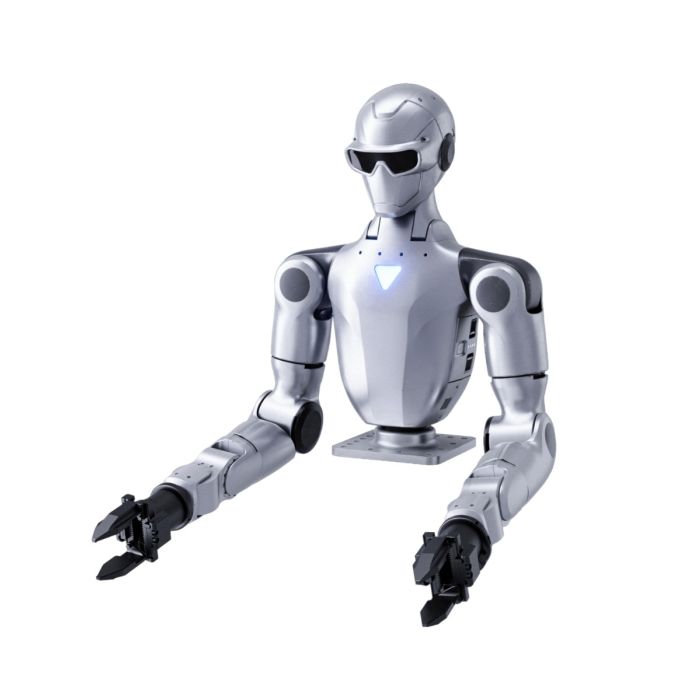
Ask a conventional industrial arm to pass you a tool and the request goes nowhere: it has no eyes of its own, no ears and no voice, and someone must add all of them before the first useful exchange can happen. The Unitree R1-A5 Fixed Base Dual-Arm Humanoid Robot starts from the other end. It comes with a binocular camera in its head, a 4-array microphone, dual speakers and a pair of articulated arms on a turning waist, so seeing, listening, speaking and reaching share one compact torso from the outset. What it deliberately leaves out is locomotion. The base stays exactly where it is placed, and all of the engineering is concentrated on what happens above it.
Robots Middle East supplies the Unitree R1-A5 to universities, research centres, system integrators and corporate innovation teams across the Middle East. We prepare the quotation for the configuration you require, coordinate delivery to your site and remain your point of contact for technical support once the robot is in service.
Background
Unitree Robotics and the R1 family
Unitree Robotics built its reputation on agile legged machines and has since become one of the most visible names in humanoid robotics, with platforms widely used in research and education. The R1 line is its family of compact humanoids, and Unitree has extended its R1 dual-arm humanoid robot family with the new R1-A5 and R1-A7 models. The published specification also names two further versions, the R1-A5-D and the R1-A7-D, so the R1-A5 sits within a small, clearly structured range rather than standing alone. You can explore the wider line-up in the Unitree R1 category.
A humanoid upper body on a fixed base
The R1-A5 is a fixed-base dual-arm humanoid. It keeps the elements of the human form that matter for interaction and manipulation, namely a head that turns and tilts, a waist that rotates and two arms that work together, while removing the legs, balance control and floor space that a walking robot demands. The result is a platform that can be set on a bench, a counter or a stand and put to work immediately. Its arms carry interchangeable end effectors, its head carries the stereo vision, and an optional NVIDIA Jetson Orin module brings on-board computing for perception and AI workloads. Because secondary development is supported, the R1-A5 is intended as a platform to be programmed, not a closed appliance.
Technical Specifications
| Specification | Value |
|---|---|
| Configuration | Fixed-base dual-arm humanoid |
| Total degrees of freedom | 13 (5 per arm, 1 waist, 2 head) |
| DOF per arm | 5 |
| Waist DOF | 1 |
| Head DOF | 2 |
| Forearm + upper arm length | 420mm |
| Payload per arm | About 2 kg |
| Dimensions | 700×357×190mm |
| Joint motion range | Waist: Yaw ±150°; Head: Yaw ±115°, Pitch ±36° |
| Joint output bearing | Crossed Roller + Deep Groove Ball |
| Cooling system | Local Air Cooling |
| High-computing module | Optional NVIDIA Jetson Orin (40-100 TOPS) |
| End effector | Optional two-finger gripper / three-finger dexterous hand / five-finger dexterous hand |
| Power supply | External Power or Li-ion Battery |
| Camera module | Binocular Camera + Optional Wrist Camera |
| Microphone | 4-Array |
| Speaker | Dual Speakers (3W×2) |
| WiFi 6 & Bluetooth 5.2 | Yes |
| Secondary development | Yes |
| Smart OTA update | Yes |
Specifications are as published by the manufacturer and are confirmed against the datasheet at quotation.
The manufacturer has not published the weight, battery capacity, power consumption, IP rating, repeatability, operating temperature, maximum arm speed or the contents of the box; these are confirmed with your quotation.
What does the R1-A7 add over the R1-A5?
The two models share the same architecture: one waist joint, two head joints, crossed roller and deep groove ball bearings at the joint outputs, local air cooling, the 4-array microphone, the dual 3W speakers, WiFi 6 and Bluetooth 5.2, secondary development and smart OTA updates. The difference lies in the arms. The R1-A5 has 5 degrees of freedom per arm and a forearm plus upper arm length of 420mm, whereas the R1-A7 has 7 degrees of freedom per arm and a length of 555mm. The R1-A7 is correspondingly longer overall, at 835×357×190mm against the 700×357×190mm of the R1-A5.
In practice, the additional joints of the R1-A7 give each arm redundancy, allowing it to approach the same point from different angles and to work around obstacles more freely. The R1-A5, by contrast, offers a more compact footprint and a simpler kinematic chain, which many teams prefer for teaching, for well-defined tabletop tasks and for interaction scenarios where the robot faces people rather than awkward workpieces. The D versions, the R1-A5-D and the R1-A7-D, keep the same arm configurations but are listed with shrunk and raised dimensions, indicating a height-adjustable form for installations where working height matters.
Why choose a fixed-base humanoid rather than a walking one?
A walking humanoid spends a great deal of its capability simply staying upright, and its operators spend a great deal of their time protecting it, clearing space and managing falls. A fixed-base platform removes that overhead entirely. The R1-A5 can operate from external power for long sessions on a bench, or from a Li-ion battery where a cable is inconvenient, and its position remains known and stable for calibration and repeated trials. For research groups whose questions concern grasping, bimanual coordination, visual servoing or spoken interaction, this stability is an advantage rather than a compromise: each experiment starts from the same place, and the data reflect the manipulation task rather than the balance controller.
Who is the Unitree R1-A5 Fixed Base Dual-Arm Humanoid Robot for?
University laboratories and research institutes form the core audience. The combination of binocular vision, an optional wrist camera, interchangeable hands and open secondary development makes the R1-A5 a practical platform for embodied AI, imitation learning and human-robot interaction studies. Engineering faculties and technical colleges will find that its compact torso suits teaching, where students can study coordinated arm and head motion without the safety demands of a mobile robot.
System integrators and corporate innovation teams can use the R1-A5 to prototype service and assistance concepts, from reception desks to product demonstrations, before committing to a larger deployment. Museums, exhibition stands and visitor centres benefit from a humanoid that turns its head towards a voice and responds through its own speakers.
Where a project needs greater reach or more dexterous arm postures, the R1-A7, with its 7 degrees of freedom per arm and longer arms, is the better match. Where the working height must change between a seated and a standing user, the D versions are worth considering. The configurations available for this model are gathered in the Unitree R1-A5 category, and Robots Middle East will advise on the most suitable choice.
What is the Unitree R1-A5 Fixed Base Dual-Arm Humanoid Robot used for?
- Manipulation research: studying grasping and bimanual coordination with interchangeable grippers and dexterous hands.
- Embodied AI development: running perception and learning models on the optional NVIDIA Jetson Orin module.
- Human-robot interaction: exploring voice-driven exchanges through the microphone array, speakers and moving head.
- Robotics education: teaching kinematics, vision and programming on a stable, bench-mounted humanoid.
- Service prototyping: testing reception, guidance or assistance concepts before a wider roll-out.
- Exhibitions and demonstrations: engaging visitors with a humanoid that looks, listens and gestures in place.
Pricing and Availability
The final configuration of the R1-A5 depends on the choices you make, particularly the end effector, the optional wrist camera, the optional computing module and the power arrangement. Robots Middle East therefore prepares an individual quotation for each enquiry, reflecting the exact specification your project requires. Delivery, customs clearance and technical support are arranged together with the quotation. To request yours, please use the quotation form available on this page.
Frequently Asked Questions
How many degrees of freedom does the R1-A5 have?
The R1-A5 has 13 degrees of freedom: 5 in each arm, 1 in the waist and 2 in the head.
Can the R1-A5 walk or move around?
No. It is a fixed-base humanoid designed to operate from a stationary position, with its waist providing yaw rotation of ±150°.
Which end effectors can be fitted?
The manufacturer lists an optional two-finger gripper, three-finger dexterous hand or five-finger dexterous hand. Your choice is specified at quotation.
Does the R1-A5 run on battery power?
It can be powered externally or by a Li-ion battery. The battery capacity has not been published and is confirmed with your quotation.
Can I develop my own software for it?
Yes. The R1-A5 supports secondary development and receives smart OTA updates, and it offers WiFi 6 and Bluetooth 5.2 connectivity.
How does the R1-A5 differ from the R1-A7?
The R1-A7 has 7 degrees of freedom per arm and a forearm plus upper arm length of 555mm, against 5 degrees of freedom and 420mm on the R1-A5. The remaining architecture is shared.
Where can I buy the Unitree R1-A5 Fixed Base Dual-Arm Humanoid Robot and what does it cost?
You can buy it from Robots Middle East, which supplies customers across the Middle East. The cost depends on the configuration you select, so please request a quotation through this page.
Summary
Where an industrial arm must be taught to see, hear and speak, the Unitree R1-A5 brings those senses with it and concentrates its design on the upper body: a head with binocular vision, a 4-array microphone and dual speakers, a rotating waist and two 5-degree-of-freedom arms with interchangeable hands. Leaving out locomotion makes it stable, compact and straightforward to deploy on a bench, while optional on-board computing and open secondary development keep it ready for serious research. For teams in the Middle East who want humanoid interaction and manipulation without the burden of a walking platform, supplied, delivered and supported by Robots Middle East, this page is the starting point.