
Unitree R1 Basic Humanoid Robot
In stock
- BRAND:
- UNITREE ROBOTICS
- MODEL:
- R1 BASIC
- ORIGIN:
- China
- Warranty:
- 8 MONTHS
- AVAILABILITY:
- SUBJECT TO AVAILABILITY
- SKU:
- Unitree-Robotics-R1-Basic
Unitree R1 Basic Humanoid Robot
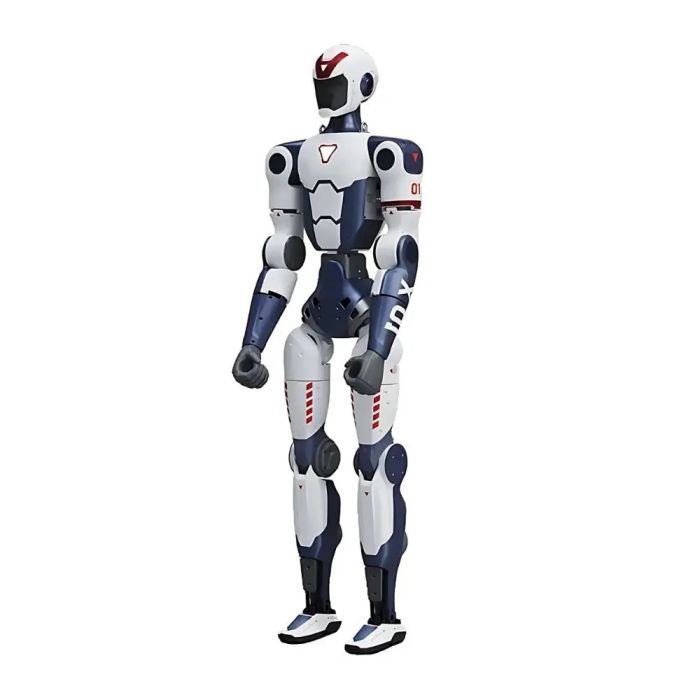
A rally car prepared for a special stage has its rear seats, carpets and sound system taken out, because everything that stays on board has to earn its place on the stage. The Unitree R1 Basic Humanoid Robot applies the same discipline to a humanoid. It is the configuration of Unitree's R1 stripped back to the body and the way it moves. It has no hands, no articulated head and no development tools. What remains is a frame able to perform cartwheels, handstand walking, boxing and running. For buyers who care about what a humanoid can show an audience, rather than what it can be programmed to do, that reduction is the whole point of the product.
Robots Middle East sells the R1 Basic and supplies it to customers across the Middle East, from exhibition organisers and science centres to universities and teams preparing for robotics competitions. Our team prepares each quotation, arranges delivery to your site and supports you after handover, so that the robot arrives ready for its first performance and stays in service afterwards.
Background
Unitree Robotics and the R1 line
Unitree Robotics built its reputation on agile legged machines, first with quadruped robots and later with humanoids designed to move dynamically rather than simply walk. The R1 continues that lineage. It is offered in several configurations: the R1 Basic, the R1 Edu Standard, the R1 Edu Smart and the R1 Edu Pro A, B, C and D. All of them share the athletic R1 platform but differ in what is added to it. Choosing between them is therefore a practical decision about the work the robot will do, not a question of prestige.
A configuration defined by what it leaves out
Within that range, the R1 Basic is the most affordable configuration. Unitree positions it for entry use, for exhibitions and for real-machine validation in sports and competition settings. It does not support development tools. Instead it centres on preset standard motions, remote operation and software updates delivered over the internet. It also comes without hands, which suits it to demonstrations and competition use built around its athletic performance rather than manipulation. The result is a humanoid you operate rather than one you program, and that distinction shapes every other part of this page.
Technical Specifications
| Specification | Value |
|---|---|
| Dimensions L x W x H (standing) | 1210x357x190mm |
| Weight (with battery) | About 25 kg |
| Total degrees of freedom | 24 |
| Head DOF | Not Supported |
| Waist DOF | 2 |
| Arm DOF | 5 |
| Leg DOF | 6 |
| Calf + thigh length | 675mm |
| Hands | Not included |
| Main CPU | 8-core high-performance processor |
| Cooling system | Local air cooling |
| Wi-Fi | Wi-Fi 6 |
| Bluetooth | Bluetooth 5.2 |
| Microphone array | 4-mic array |
| Battery | 6,000mAh / 194.4Wh / 37.8V quick-release lithium battery |
| Operating time | Roughly 1 hour |
| Charging time | About 1 hour |
| Development tools | Not supported |
| Included items | Robot x1, battery x1, charger x1, joystick x1 |
Specifications as published by the manufacturer; confirmed against the datasheet at quotation.
The manufacturer has not published the joint torque, the IP rating, the maximum walking speed, the charger input rating, the operating temperature range or the camera resolution; these are confirmed at quotation.
What can the R1 Basic do without development tools?
A robot without a software development kit can sound limited, but that misreads the R1 Basic. Its repertoire is built in. The robot runs preset standard motions, and an operator drives it remotely with the joystick supplied in the box. New behaviour reaches it through software updates over the internet rather than through code written by the owner. For an exhibition team, this removes a whole layer of work: nobody has to maintain a codebase, and the machine behaves the same way at every show.
The motions themselves are the reason to buy. The R1 Basic handles cartwheels, handstand walking, boxing and running. These are full-body movements, and the joint layout explains how the robot achieves them. Its 24 degrees of freedom are spread across the body: 2 at the waist, 5 in the arm figure and 6 in the leg figure, with no head degree of freedom. The waist joints let the torso take part in the movement instead of riding on top of the legs, while the legs, with a combined calf and thigh length of 675mm, carry the stride and the landing. The head stays fixed, which keeps the build simple and puts the robot's articulation where an audience notices it.
Onboard, an 8-core high-performance processor with local air cooling runs the system, and Wi-Fi 6 and Bluetooth 5.2 handle connectivity. A 4-mic array completes the published hardware. None of this is exposed for development on the Basic, but all of it serves the performance.
How long does the R1 Basic run between charges?
The R1 carries a 6,000mAh / 194.4Wh / 37.8V quick-release lithium battery. Its operating time is roughly 1 hour, and charging takes about 1 hour as well. For anyone planning a demonstration programme, those two figures set the rhythm of the day: a session of performances, a battery change or a recharge, then the next session.
The quick-release design matters here. Swapping a battery is faster than waiting for a full charge, so a venue running several shows a day can keep the robot on stage with less downtime. The box contains one battery and one charger. If your schedule calls for longer continuous availability, raise it when you request a quotation, and Robots Middle East will plan the supply around your programme.
Who is the R1 Basic for?
The clearest fit is the exhibition and events sector. Trade-show stands, product launches and corporate events across the region need a centrepiece that draws people in, and a humanoid performing a cartwheel does that without any explanation. Museums and science centres form a second group. They want reliable, repeatable demonstrations that staff can run with a joystick rather than a laptop.
Sports and competition teams are the third segment. Unitree positions the R1 Basic for real-machine validation in these settings, meaning that motions can be tested on physical hardware rather than only in simulation. Finally, entry users such as schools, innovation labs and first-time buyers can use the Basic to become familiar with a dynamic humanoid before committing to a larger programme.
Some buyers will be better served by a sibling. If your plans involve writing your own software, the R1 Basic is the wrong choice, because it does not support development tools. The Edu configurations, such as the R1 Edu Pro A and the R1 Edu Pro B, are the ones to compare, and our team will confirm the features of each at quotation. If your work requires grasping or handling objects, the Basic's lack of hands rules it out. Look instead at the R1 Edu Pro C with BrainCo Revo 2 Basic Dexterous Hands or the R1 Edu Pro D with BrainCo Revo 2 Touch Dexterous Hands.
What is the R1 Basic used for?
- Exhibition centrepieces: a humanoid performing dynamic motions that draws visitors to a stand.
- Science centre demonstrations: repeatable shows run by staff with the supplied joystick.
- Competition preparation: real-machine validation of athletic motions for sports and competition settings.
- Entry-level familiarisation: a first humanoid for teams learning how dynamic robots behave and are operated.
- Brand activations and media: launches, filmed content and events where movement makes the message.
- Educational outreach: showing students what humanoid robotics can achieve, without a programming curriculum.
Pricing and Availability
Robots Middle East supplies the R1 Basic on the basis of a written quotation prepared for your organisation and your location. Tell us how you plan to use the robot, where it will be deployed and how many performance sessions you expect, and we will confirm the configuration and the datasheet figures with you. Delivery, customs clearance and after-sales support are arranged together with the quotation. To begin, use the quotation request available on this page.
Frequently Asked Questions
Does the R1 Basic come with hands?
No. The R1 Basic comes without hands and is suited to demonstrations and competition use that rely on its athletic performance. For grasping, the R1 Edu Pro C and R1 Edu Pro D product pages describe configurations with BrainCo dexterous hands.
Can I program the R1 Basic?
The R1 Basic does not support development tools. It is centred on preset standard motions, remote operation and software updates over the internet.
What is included in the box?
The delivery contains the robot, one battery, one charger and one joystick.
How long does the battery last?
The quick-release lithium battery provides an operating time of roughly 1 hour, and charging takes about 1 hour.
How many degrees of freedom does the R1 Basic have?
It has 24 degrees of freedom in total: 2 at the waist, 5 listed for the arm and 6 listed for the leg. The head has no degree of freedom.
What connectivity and audio hardware does it have?
The R1 Basic offers Wi-Fi 6 and Bluetooth 5.2, and it carries a 4-mic array. An 8-core high-performance processor with local air cooling runs the system.
Where can I buy the Unitree R1 Basic and what does it cost?
You can buy the R1 Basic from Robots Middle East, which supplies it across the Middle East. The cost depends on your configuration and delivery requirements and is set out in a written quotation, which you can request from this page.
Summary
Like a stage-prepared rally car, the R1 Basic is defined as much by what has been removed as by what remains. There are no hands, no head articulation and no development layer to manage. In their place is a humanoid frame with 24 degrees of freedom, an articulated waist and a repertoire of cartwheels, handstand walking, boxing and running, operated by joystick and kept current through software updates. It suits exhibitions, science centres, competition teams and first-time buyers who want performance without a programming project, while those who need code or hands have clear alternatives in the Edu line. For organisations in the Middle East ready to put a performing humanoid in front of an audience, this page is the starting point.