
Unitree R1 Edu Pro B Humanoid Robot (R1 EDU U4)
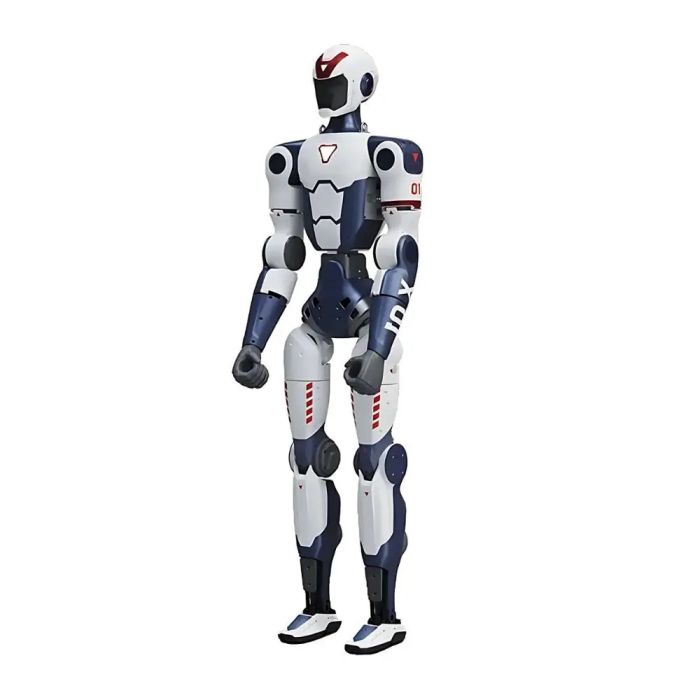
In stock
- BRAND:
- UNITREE ROBOTICS
- MODEL:
- R1 EDU PRO B
- PART #:
- R1 EDU U4
- ORIGIN:
- China
- Warranty:
- 12 MONTHS
- AVAILABILITY:
- SUBJECT TO AVAILABILITY
- SKU:
- Unitree-Robotics-R1-EDU-U4
Unitree R1 Edu Pro B Humanoid Robot (R1 EDU U4)
Most of a research humanoid's working life is not spent striding across a stage. It is spent suspended from a gantry in a laboratory while it is rewritten: a controller retuned, a grasp policy retrained, a sensor log replayed for the tenth time. Seen from that bench, the questions that matter change. Can the team reach every layer of the software? Does the robot report enough about what its hands are doing? Can a flat battery be swapped without ending the session? The Unitree R1 Edu Pro B Humanoid Robot (R1 EDU U4) answers those questions directly. It pairs a compact bipedal body with dual Dex3 dexterous hands that carry 33 tactile sensors each, an NVIDIA Jetson Orin for onboard AI, and a developer ecosystem built around ROS 2 MoveIt2, Isaac Sim and SDK2.
Robots Middle East sells the Unitree R1 Edu Pro B and supplies it to universities, research institutes, innovation centres and corporate laboratories across the Middle East. Robots Middle East prepares each quotation, arranges delivery to the customer's site and provides support once the robot is in service, so that a research group or teaching department deals with one regional partner from the first enquiry to the first experiment.
Background
Unitree and the R1 family
Unitree Robotics is known for legged robots that have moved from specialist research towards classrooms, exhibition halls and development teams. The R1 is its compact humanoid line, and the sources name a clear ladder of versions: the R1 AIR, the R1, the R1 EDU, and a set of EDU Pro configurations that includes the Pro A (U3), the Pro B (U4), the Pro C (U5) and the Pro D (U6). The EDU branch is the one opened up for secondary development, which means that institutions buy it to programme it rather than only to operate it. Across the family, a 2-DOF head improves environmental perception, and the robot integrates a Large Multimodal Model for voice and images.
Where the Pro B sits: touch-sensing hands
The defining feature of the Pro B is its hands. Each of the dual Dex3 dexterous hands offers 7 degrees of freedom and 33 tactile sensors, and those sensors provide real-time contact feedback during grasping and manipulation. Together with the arms, waist and bipedal body, the configuration reaches 40 total degrees of freedom. An NVIDIA Jetson Orin delivering 100 TOPS of onboard AI compute gives the tactile and visual data somewhere to be processed on the robot itself, which matters when a grasp has to be corrected within the same motion rather than after a round trip to an external workstation.
Technical Specifications
The table separates the figures listed for the R1 EDU platform from those specific to the R1 EDU Pro B (U4).
| Specification | R1 EDU | R1 EDU Pro B (U4) |
|---|---|---|
| Dimensions (height x width x thickness, standing) | 1230x357x190mm | — |
| Height (standing) | — | 123 cm |
| Weight with battery | About 29kg | — |
| Total degrees of freedom | — | 40 (bipedal body, arms, waist and hands) |
| Hands | — | Dual Dex3 dexterous hands, 7 DOF each |
| Tactile sensors | — | 33 per hand |
| Arm payload | — | 2 kg per arm |
| Joint motor | Low inertia high-speed internal rotor PMSM (permanent magnet synchronous motor, better response speed and heat dissipation) | — |
| Basic computing | 8-Core High-Performance Processor | — |
| AI compute | — | NVIDIA Jetson Orin, 100 TOPS |
| Camera | Binocular camera | — |
| Audio | — | 4-mic array and speaker |
| Wireless | WiFi 6, Bluetooth 5.2 | — |
| Battery | — | Hot-swap system, approximately 1 hour of runtime |
| Developer ecosystem | — | ROS 2 MoveIt2, Isaac Sim, SDK2 |
| Secondary development | YES (EDU) | — |
Specifications are as published by the manufacturer and are confirmed against the datasheet at quotation.
The manufacturer has not published the walking speed, the IP rating, the battery capacity, the operating temperature, the charging time or the operating system; these are confirmed at quotation.
What does the Pro B configuration add to the R1 EDU?
The R1 EDU establishes the platform: a standing robot of 1230x357x190mm, driven by low-inertia internal-rotor permanent magnet synchronous motors and equipped with a binocular camera, an 8-core processor, WiFi 6 and Bluetooth 5.2. It is open to secondary development, which is the reason an EDU unit belongs in a laboratory rather than a showroom.
The Pro B builds on that foundation in three directions. The first is the hands: the Dex3 pair brings 7 degrees of freedom per hand and 33 tactile sensors on each, so the robot can sense contact rather than infer it. The second is compute: the NVIDIA Jetson Orin at 100 TOPS is the processor that research teams expect when they plan to run perception and learning models on the robot itself. The third is the software path: compatibility with ROS 2 MoveIt2, Isaac Sim and SDK2 lets a group plan motions with established tooling, rehearse in simulation and then deploy to hardware. The result is a configuration in which every part of the manipulation loop — seeing, reaching, grasping and feeling — can be studied on one machine.
Why does tactile feedback matter for humanoid manipulation?
A camera can locate an object and guide the hand towards it, but once the fingers close, much of the contact is hidden from view. Tactile sensing fills that gap. With 33 sensors per hand reporting contact in real time, researchers can work on grip-force regulation, detection of slip, in-hand adjustment and the handling of objects that are fragile, soft or irregular. In the wider research field, this kind of data is also increasingly used to train learning-based manipulation policies, because touch reveals information that images alone do not carry. On the Pro B, those signals arrive on the same robot that carries the onboard AI computer, which keeps the sensing and the decision close together. For a department that wants to publish on dexterous manipulation, or to teach it with real hardware, that combination is the core of the case for this configuration.
Who is the Unitree R1 Edu Pro B Humanoid Robot (R1 EDU U4) for?
University robotics groups are the most natural buyers: teams working on manipulation, embodied AI or human–robot interaction who need joint-level access, onboard compute and hands that report what they touch. Engineering faculties and technical colleges will value a platform that supports teaching from high-level behaviour down to motion planning in ROS 2, with a 123 cm robot that is a compelling subject in a classroom. Corporate innovation teams and research centres can use the built-in 4-mic array, speaker and multimodal voice and vision AI to prototype reception and guidance scenarios, while the manipulation features support experiments in light handling between stations.
Institutions comparing hand options across the line can review the wider Unitree R1 EDU range and the broader Unitree R1 family. The Unitree R1 Edu Pro A Humanoid Robot (R1 EDU U3) is the neighbouring step in the ladder, and buyers interested in alternative hands can compare the Unitree R1 Edu Pro C Humanoid Robot with BrainCo Revo 2 Basic Dexterous Hands (R1 EDU U5) and the Unitree R1 Edu Pro D Humanoid Robot with BrainCo Revo 2 Touch Dexterous Hands (R1 EDU U6). Robots Middle East can set out the differences between these configurations in a quotation.
What is the Unitree R1 Edu Pro B Humanoid Robot (R1 EDU U4) used for?
- Tactile manipulation research — studying grasp force, slip and contact using real-time feedback from the Dex3 hands.
- Embodied AI development — running perception and learning models on the onboard NVIDIA Jetson Orin.
- Simulation-to-hardware workflows — rehearsing behaviours in Isaac Sim and deploying them through ROS 2 MoveIt2 and SDK2.
- Robotics teaching — giving students a humanoid they can programme at several levels in the classroom and laboratory.
- Exhibitions and visitor guidance — greeting visitors, answering common questions and guiding people through a space with voice and vision AI.
- Light handling between stations — carrying inspection tools or light supplies within the 2 kg per-arm capacity.
Pricing and Availability
Robots Middle East supplies the Unitree R1 Edu Pro B on quotation, prepared for the configuration, the institution and the intended use. Delivery, customs and support are arranged together with the quotation, so the proposal reflects the full path from order to commissioning. This allows procurement teams and principal investigators to review a complete picture before committing. To begin, a quotation request for the Unitree R1 Edu Pro B Humanoid Robot (R1 EDU U4) is available on this page.
Frequently Asked Questions
How many degrees of freedom does the R1 EDU Pro B have?
The Pro B (U4) has 40 total degrees of freedom across its bipedal body, arms, waist and hands.
What hands does the Pro B use?
It uses dual Dex3 dexterous hands with 7 degrees of freedom each. Each hand carries 33 tactile sensors that provide real-time contact feedback during grasping and manipulation.
What computer runs the robot's AI?
The Pro B carries an NVIDIA Jetson Orin delivering 100 TOPS of onboard AI compute. The R1 EDU platform also lists an 8-core high-performance processor for basic computing.
Which development tools are supported?
The Pro B is compatible with ROS 2 MoveIt2, Isaac Sim and the SDK2 developer ecosystem. As an EDU unit, it is intended for secondary development, described in Unitree's secondary development manual.
How long does the battery last?
The hot-swap battery system supports approximately 1 hour of runtime, and batteries can be exchanged to extend a session.
What is included in the box?
The package comprises the Unitree R1 EDU Pro B (U4) robot, two Unitree Dex3 dexterous hands, a quick-release smart battery, a battery charger, a handheld remote control, a robot transport case and a protective gantry.
Where can I buy the Unitree R1 Edu Pro B Humanoid Robot (R1 EDU U4) and what does it cost?
Robots Middle East sells and supplies the robot across the Middle East. The cost depends on the configuration and on delivery and support arrangements, so it is provided in a tailored quotation requested from this page.
Summary
A research humanoid proves its value on the bench, not on the stage: in the hours spent on a gantry being reprogrammed, tested and refined. The Unitree R1 Edu Pro B is built for that life. It combines a compact R1 EDU body with dual Dex3 hands that sense contact through 33 tactile sensors each, 40 degrees of freedom, an NVIDIA Jetson Orin at 100 TOPS, a hot-swap battery and a software path through ROS 2 MoveIt2, Isaac Sim and SDK2. It ships with a transport case and a protective gantry, ready for the laboratory and the lecture hall alike. For institutions across the Middle East that want to study how a robot grasps and feels, with Robots Middle East handling quotation, delivery and support, this page is the starting point.