
Unix AI Martian Bipedal General Purpose Humanoid Robot
In stock
- BRAND:
- UNIXAI
- PART #:
- Martian
- ORIGIN:
- China
- AVAILABILITY:
- SUBJECT TO AVAILABILITY
- SKU:
- Unix-AI-Martian
Unix AI Martian Bipedal General Purpose Humanoid Robot
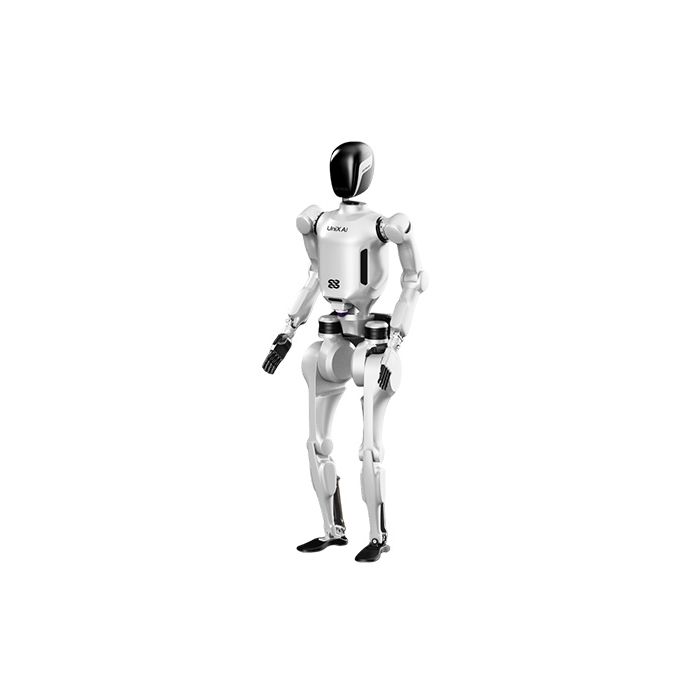
Visitors watching a humanoid robot tend to judge it by its walk. Engineers who have to deploy one judge it by something less visible: how quickly its joints respond, how much computing it carries on board and how open it is to their own code. The Unix AI Martian Bipedal General Purpose Humanoid Robot is built to answer both audiences. It is a two-legged machine of human proportions, with articulated arms, a dexterous hand and a sensor head, and it is designed as a development platform as much as a demonstration piece.
Robots Middle East sells the Martian to universities, research centres, system integrators and corporate innovation teams across the Middle East. We prepare each quotation around your project, arrange delivery to your site and remain your point of contact for support after installation, so that your team can concentrate on the work the robot is meant to do.
Background
Unix AI and its humanoid range
Unix AI develops humanoid robots in more than one form. Alongside the bipedal Martian, the range includes wheeled designs such as the Unix AI Wanda 2.0 Universal Wheeled Humanoid Robot and the Unix AI Panther Next-gen Full-size Wheeled Dual-arm Humanoid Robot. The sources name two generations of the walking model, Martian and Martian 2.0. The figures on this page belong to Martian, and we agree which version your order covers at the time of enquiry.
In-house components and vector control
All core components of the Martian are developed in-house, and the robot uses self-developed high-performance vector control technology to drive its joints. Vector control is a method of regulating electric motors so that torque and position can be commanded precisely and adjusted quickly, which matters greatly on a robot that balances on two legs. The Martian combines perception with large-scale models, placing it within the wider movement towards embodied artificial intelligence, in which a robot learns and acts in the physical world rather than in simulation alone.
Technical Specifications
| Specification | Value |
|---|---|
| Height | 148 cm |
| Weight | 40 kg |
| Max movement speed | 4 m/s |
| Motor max torque | 150 N.m |
| Total payload | 5 kg |
| Arms | 14-DoF |
| Legs | 12-DoF |
| Hand | 11-DoF industrial-grade dexterous hand |
| Computing platform | 40T Computing Power Platform, 32GB Ram |
| Sensors | Depth Camera + RGB*2 + IMU |
| Bus communication | CANFD |
| Battery capacity | 9 Ah |
| Rated voltage | 48 V |
| Developer interfaces | High-/low-level API interfaces for secondary development |
| Software updates | OTA updates |
Specifications are as published by the manufacturer and are confirmed against the datasheet at quotation.
The manufacturer has not published the IP rating, the runtime per charge, the battery charging time, the operating system, the connectivity options, the operating temperature range or the contents of the box; we confirm these with you at quotation.
What makes the Martian different from a wheeled humanoid?
A wheeled humanoid carries its upper body on a rolling base, which gives it stability and simplicity on flat floors. The Martian takes the harder route of walking on two legs, with 12-DoF legs that allow it to squat and bend. Combined with 14-DoF arms, this means the robot can lower itself and pick up objects directly from the floor, a movement that a fixed-height base cannot reproduce in the same way. For buildings designed around people, with low shelves, uneven reach heights and spaces where a human would kneel, a bipedal body is the closer match.
Walking places heavy demands on the drive system. The Martian's motors deliver a maximum torque of 150 N.m, and the joints communicate over a CANFD bus, a fast fieldbus variant suited to the frequent control messages a balancing robot exchanges with its actuators. With a weight of 40 kg and a height of 148 cm, the robot is smaller and lighter than an adult, which keeps it manageable in a laboratory or showroom while remaining large enough to work at human surfaces.
At the end of each arm sits an 11-DoF industrial-grade dexterous hand that delivers human-level flexibility. Where many legged platforms concentrate on locomotion and offer simple grippers, the Martian pairs walking with fine manipulation, which is the combination a general-purpose humanoid requires. Organisations whose work takes place entirely on level floors may still prefer to compare the wheeled models; both forms are presented in our Humanoids category.
What can developers build on the Martian?
The on-board 40T Computing Power Platform with 32GB Ram gives the robot capacity to run perception and control software locally, rather than depending entirely on an external computer. Its sensor set of a depth camera, two RGB cameras and an IMU supplies the inputs that most embodied AI research relies upon: depth for spatial understanding, colour images for recognition and inertial data for balance and orientation.
Crucially for research teams, the Martian offers both high-level and low-level API interfaces for secondary development. High-level interfaces suit application developers who wish to command behaviours and tasks, while low-level access allows control engineers to work closer to the joints, testing their own gait, balance or manipulation algorithms. Support for OTA updates means that the manufacturer's software improvements can be delivered to the robot without returning it, which helps a long-running research programme stay current.
Who is the Unix AI Martian Bipedal General Purpose Humanoid Robot for?
The first group is academic: university departments of robotics, mechatronics and computer science that need a full humanoid body for teaching and research into locomotion, whole-body control and learning from demonstration. The open API structure and on-board computing make the Martian suitable for postgraduate projects that move from simulation to physical testing.
The second group comprises corporate research and innovation centres exploring how humanoid robots could take on tasks in logistics, retail, hospitality or facilities management. For these teams, the Martian provides a platform on which to prototype behaviours before committing to a wider deployment.
The third group includes system integrators and technology showcases, such as innovation hubs and exhibition spaces, where a walking humanoid with dexterous hands communicates technical capability to visitors. Educational institutions seeking a dedicated teaching configuration may also wish to review the Unix AI Wanda EDU Edition Universal Humanoid Robot, and the full set of walking platforms is listed under Bipedal Humanoids.
What is the Unix AI Martian Bipedal General Purpose Humanoid Robot used for?
- Locomotion research – testing gait, balance and recovery algorithms on a physical bipedal body.
- Embodied AI development – connecting perception and large models to real-world action through the robot's APIs.
- Manipulation studies – exploring grasping and fine handling with the dexterous hands.
- University teaching – giving students hands-on experience of a complete humanoid system.
- Pilot projects in service settings – prototyping tasks such as fetching and handling objects in spaces built for people.
- Exhibitions and innovation showcases – demonstrating advanced robotics to visitors, partners and stakeholders.
Pricing and Availability
Robots Middle East supplies the Martian on quotation, so that the configuration, version and supporting services match your project. Delivery, customs clearance and after-sales support are arranged together with your quotation. To begin, please send us a short description of your intended application and timescale; a quotation request for the Unix AI Martian Bipedal General Purpose Humanoid Robot is available on this page.
Frequently Asked Questions
How tall and how heavy is the Martian?
The Martian stands 148 cm tall and weighs 40 kg.
How many degrees of freedom does the robot have?
It has 14-DoF arms and 12-DoF legs, and its hand is an 11-DoF industrial-grade dexterous hand.
Can the Martian pick objects up from the floor?
Yes. Its arms and legs allow it to squat, bend and pick up objects directly from the floor, and it has a total payload of 5 kg.
Can we write our own software for it?
Yes. The robot provides high-level and low-level API interfaces for secondary development and supports OTA updates.
What sensors does the robot use?
The Martian carries a depth camera, two RGB cameras and an IMU.
How long does the battery last?
The battery has a capacity of 9 Ah at a rated voltage of 48 V. Runtime per charge and charging time are among the details listed beneath the specification table.
Where can I buy the Unix AI Martian Bipedal General Purpose Humanoid Robot and what does it cost?
You can buy it from Robots Middle East, which supplies the robot across the Middle East. The cost depends on version and configuration, so please request a quotation through this page.
Summary
The Martian is the kind of humanoid that rewards a second look. Its walk draws attention, but its value to a research or innovation team lies underneath: in-house components, vector-controlled joints on a CANFD bus, an on-board computing platform, a practical sensor set and APIs that open the robot to your own work. It brings legs that can squat and bend together with dexterous hands, in a body sized for human spaces. For organisations in the Middle East ready to move embodied AI from screen to floor, this page is the starting point.