
Unix AI Wanda 2.0 Universal Wheeled Humanoid Robot
In stock
- BRAND:
- UNIXAI
- MODEL:
- WANDA 2.0
- ORIGIN:
- China
- AVAILABILITY:
- SUBJECT TO AVAILABILITY
- SKU:
- Unix-AI-Wanda-2.0
Unix AI Wanda 2.0 Universal Wheeled Humanoid Robot
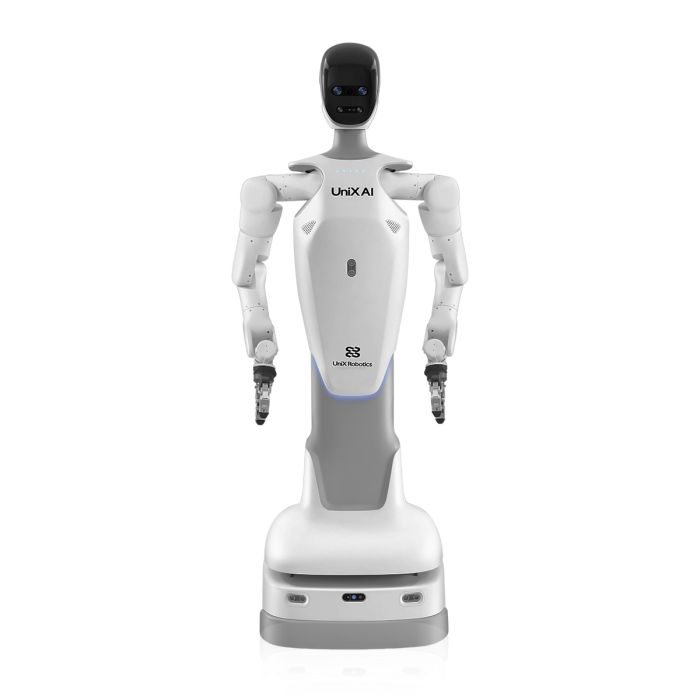
A robot demonstration lasts a few minutes. A hotel shift, a retail day or a university trial lasts many hours, and it is in those hours that a machine either earns its place or becomes an expensive ornament in the lobby. The Unix AI Wanda 2.0 Universal Wheeled Humanoid Robot is designed for the longer version of that story. It pairs a full-size humanoid upper body and bionic arms with a silent wheeled chassis, a high-density battery and an onboard computer that runs perception and manipulation on the robot itself. Grasping, carrying and navigating then become routine work rather than staged moments.
Robots Middle East sells the Wanda 2.0 to businesses, universities and public institutions across the Middle East, and handles the quotation, supply, delivery and after-sales support for each project. Our team can help you judge whether the robot suits your premises and your tasks before you commit. We then remain your point of contact once the robot is in service, from commissioning through to ongoing support.
Background
UniX AI and the Wanda line
UniX AI develops general-purpose humanoid robots for real working environments rather than for the laboratory bench alone. Its catalogue spans wheeled and bipedal platforms. The Wanda series is the company's full-size wheeled family, built around a humanoid torso, arms and head mounted on a mobile base. Wanda 2.0 carries that concept forward as a universal platform. It is not tied to a single task: it is a machine that can be given different jobs as an organisation's needs change. That flexibility matters to buyers who want one robot to serve several departments, or to support research that moves from one manipulation problem to the next.
Bionic arms and imitation learning
The centre of the design is the arm. UniX AI describes Wanda's limb as the world's first mass-produced 8-DoF bionic arm, paired with adaptive intelligent grippers. Each arm follows a "4+1+3" shoulder-elbow-wrist configuration chosen for motion planning. It is built from high-strength, low-density materials. The hardware is matched by software: Wanda uses multimodal semantic keypoints together with an efficient trajectory imitation learning framework. In practical terms, the robot is taught by example. It learns the movement of a task and the points of an object that matter for grasping it, rather than relying solely on hand-coded routines. The robot ships preloaded with popular L4-level applications, so it has working capabilities from the outset.
Technical Specifications
| Specification | Value |
|---|---|
| Product type | Full-size general-purpose humanoid robot |
| Arm | 8-DoF bionic arm, "4+1+3" shoulder-elbow-wrist configuration |
| Dual-arm load capacity | 12 kg |
| Single-arm payload | 6 kg |
| End effector | Biomimetic Two-Finger Gripper |
| Head | 2-DoF; Yaw ±90°, Pitch ±30° |
| Perception system | Head mounted dual RGB & RGBD camera; 6-mic circular array |
| Chassis | Differential drive chassis; hub motor base |
| Navigation and obstacle avoidance | 360° LiDAR, ultrasonic sensor, RGBD camera |
| Minimum passage width | 75 cm |
| Computing power | Up to 275 TOPs |
| Battery life | 8-16h |
| Software | Preloaded L4-level applications |
Specifications are as published by the manufacturer and are confirmed against the datasheet at quotation.
The manufacturer has not published the weight, IP rating, charging time, battery capacity, package contents, operating system, connectivity, operating temperature or noise level; Robots Middle East confirms these details at quotation.
What makes the Wanda 2.0 arm different from a typical service robot?
Many service robots on the market are, in essence, mobile screens or carts. They can greet visitors and deliver items placed on a tray, but they cannot reach out and pick something up. Wanda 2.0 is built the other way round: manipulation comes first. Each 8-DoF arm gives the robot more joint freedom than a simple industrial arm. This allows it to approach an object from different angles, work around obstacles on a shelf or counter, and adapt its posture to the task. The "4+1+3" layout mirrors the human shoulder, elbow and wrist, which is why the arm is described as bionic.
Strength is matched to that dexterity. Wanda 2.0 handles 6 kg in a single arm and 12 kg when both arms work together. That covers a broad range of everyday objects found in hotels, shops, offices and laboratories. At the end of each arm sits a Biomimetic Two-Finger Gripper, and the adaptive grippers adjust to the item in hand rather than demanding a uniform shape. Combined with imitation learning, this lets an operator show the robot a task and build on that demonstration. Tasks do not have to be engineered from scratch.
Perception supports all of this. The head carries dual RGB and RGBD cameras and can turn ±90° in yaw and tilt ±30° in pitch, so the robot can look at what its hands are doing. A 6-mic circular array gives it a way to hear spoken instructions and locate the speaker. Up to 275 TOPs of onboard computing power processes these inputs on the robot itself.
Will Wanda 2.0 work in my building, and for how long?
The two questions most site managers ask are whether the robot will fit and whether it will last the day. On the first, Wanda 2.0 needs a minimum passage width of 75 cm. That figure is worth checking against your doorways, aisles and service corridors during site assessment. The differential drive chassis sits on a hub motor base. It carries a 360° LiDAR, ultrasonic radar and an RGBD camera for obstacle avoidance and precision navigation in complex environments, and it is designed as a silent chassis, which suits guest-facing spaces.
On the second, the high-density battery delivers a battery life of 8-16h. That range covers a single shift in some deployments and a full working day in others. Where your operation falls within it depends on the tasks you assign, and our team will discuss your duty cycle when preparing the quotation.
Who is the Unix AI Wanda 2.0 Universal Wheeled Humanoid Robot for?
The Wanda 2.0 suits organisations that want a humanoid to do physical work rather than simply attract attention. Hotel groups and serviced residences can explore it for fetch-and-carry and guest assistance. Retailers and shopping centres can evaluate it for shelf interaction and customer service. Corporate offices and innovation centres can use it to pilot automation on their own premises. Universities and research institutes form a second major segment. The combination of bionic arms, rich perception, substantial onboard computing and an imitation learning framework makes Wanda 2.0 a capable platform for work on manipulation, embodied AI and human-robot interaction.
Institutions whose priority is teaching may wish to compare the Unix AI Wanda EDU Edition Universal Humanoid Robot, and Robots Middle East can set out the differences between the two at quotation. Buyers considering other wheeled designs from the same maker can also look at the Unix AI Panther Next-gen Full-size Wheeled Dual-arm Humanoid Robot. Those whose research specifically requires walking locomotion should review the Unix AI Martian Bipedal General Purpose Humanoid Robot. The wider range is available in our Wheeled Humanoids and Humanoids categories.
What is the Unix AI Wanda 2.0 Universal Wheeled Humanoid Robot used for?
- Hospitality service: carrying items to guests, assisting at reception and supporting housekeeping routines in hotels.
- Retail assistance: retrieving products, interacting with shelves and guiding customers on the shop floor.
- Embodied AI research: studying manipulation, imitation learning and multimodal perception on a full-size humanoid platform.
- Office and facility support: fetching documents and supplies and handling light deliveries between rooms and floors.
- Household assistance trials: testing domestic tasks such as tidying and object handling in realistic home settings.
- Visitor engagement: welcoming guests at exhibitions, showrooms and innovation centres with spoken interaction and live demonstrations.
Pricing and Availability
Robots Middle East supplies the Wanda 2.0 on a quotation basis, so that the offer reflects your configuration, your site and the support you require. Delivery, customs and support are arranged with the quotation, and our team will confirm any specification you need before you place an order. To begin, share your intended application and location with us, and we will prepare a tailored proposal. A quotation request for the Unix AI Wanda 2.0 Universal Wheeled Humanoid Robot is available on this page.
Frequently Asked Questions
Does the Wanda 2.0 walk on legs?
No. Wanda 2.0 moves on a differential drive chassis with a hub motor base, which gives it stable, quiet travel across flat indoor floors.
How much can the Wanda 2.0 lift?
Each arm carries a single-arm payload of 6 kg, and the dual-arm load capacity is 12 kg when both arms work together.
How long does the battery last?
The high-density battery provides a battery life of 8-16h. Our team can discuss how your intended tasks relate to that range.
How does the robot see and hear?
A head mounted dual RGB and RGBD camera handles vision, and a 6-mic circular array picks up speech. For navigation, the chassis adds a 360° LiDAR and an ultrasonic sensor.
Can the Wanda 2.0 learn new tasks?
Yes. It uses multimodal semantic keypoints and an efficient trajectory imitation learning framework, which allow tasks to be taught by demonstration. It also ships preloaded with popular L4-level applications.
How narrow a doorway can it pass through?
The minimum passage width is 75 cm, so we recommend measuring doorways and aisles along the robot's intended routes during planning.
Where can I buy the Unix AI Wanda 2.0 Universal Wheeled Humanoid Robot and what does it cost?
You can buy it from Robots Middle East, which supplies and supports it across the Middle East. The cost depends on your configuration and project, so please request a quotation and we will prepare an offer for you.
Summary
The difference between a robot that impresses and a robot that works is measured in hours, not minutes. The Wanda 2.0 is built for those hours. It combines 8-DoF bionic arms and adaptive grippers with a perceptive head, up to 275 TOPs of onboard computing and a silent wheeled chassis that navigates complex spaces. Its battery life of 8-16h and an imitation learning framework that lets tasks be taught by example support the same aim of sustained, practical service. For hotels, retailers, offices and research institutions across the Middle East that want a humanoid to carry real workload, Robots Middle East handles the quotation, delivery and support, and this page is the starting point.