
Unix AI Panther Next-Gen Full-Size Wheeled Dual-Arm Humanoid Robot
In stock
- BRAND:
- UNIXAI
- MODEL:
- PANTHER
- ORIGIN:
- China
- Warranty:
- 12 MONTHS
- AVAILABILITY:
- ALLOW 2-4 WEEKS FOR DELIVERY
- SKU:
- Unix-AI-Panther
Unix AI Panther Next-Gen Full-Size Wheeled Dual-Arm Humanoid Robot
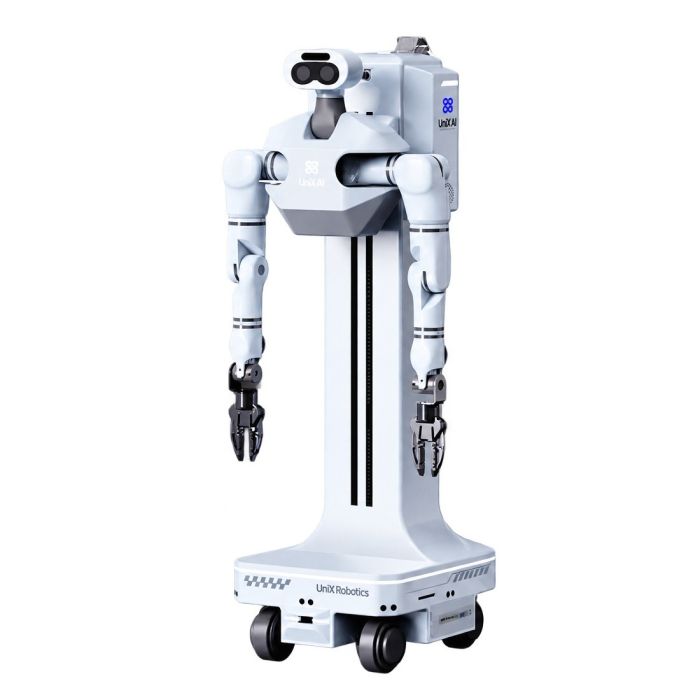
A service robot earns its place over a full working shift rather than in a demonstration. It has to retrieve an item from the floor, pass something across a counter, move between display stands without turning in awkward arcs, and still have charge left when the evening visitors arrive. The Unix AI Panther Next-gen Full-size Wheeled Dual-arm Humanoid Robot is UNIXAI's response to that brief: a human-height upper body with two articulated arms, carried on an omnidirectional wheeled base and supported by enough on-board computing to perceive its surroundings and act on them locally.
Robots Middle East supplies the Panther to businesses, research groups and public institutions across the Middle East. Our team prepares the quotation, coordinates delivery to your site and remains your point of contact for commissioning questions and after-sales support, so that one partner handles the project from the first enquiry through to daily operation.
Background
UNIXAI and its humanoid range
UNIXAI, presented under the UniX AI name, develops a family of humanoid robots that take different approaches to the same goal of general-purpose embodied intelligence. The range includes wheeled platforms such as the Wanda series and the bipedal Martian, which allows a buyer to choose the form of locomotion first and then the level of capability. Within this family, the Panther is the full-size, next-generation wheeled dual-arm model, and it brings together the manufacturer's work on high-DoF arms, power architecture and edge computing in a single chassis.
A wheeled platform with a lifting torso
The Panther's defining design choice is the combination of a wheeled base with a vertically lifting upper body. Rather than balancing on two legs, it travels on a four-wheel steering and four-wheel drive omnidirectional chassis, which allows it to move sideways, rotate on the spot and approach a work surface squarely. Above the chassis, an 80 cm upper-body lift lowers the torso for ground-level reach and raises it again for tasks at counter or shelf height, while giving the head-mounted cameras a wider field of view for navigation and manipulation. The arms are the world's first mass-produced 8-DoF bionic arms, and they end in adaptive intelligent grippers, with compatibility for dexterous hands where a task demands finer handling.
Technical Specifications
| Specification | Value |
|---|---|
| Product type | Next-gen Full-size Wheeled Dual-arm Humanoid Robot |
| Height | 1600-1750mm |
| Degrees of freedom | 34 high-DoF joints |
| Arms | 8-DoF bionic arms with adaptive intelligent grippers |
| Upper-body lift | 80 cm |
| Lifting height | 600-800 mm |
| Single-arm reach | 982mm |
| Dual-arm load capacity | 12kg |
| Repeatability | ±0.5 mm |
| Movement speed | 2m/s |
| Minimum passage width | 65 cm |
| Chassis | Four-wheel steering and four-wheel drive omnidirectional chassis |
| Power platform | Upgraded 48 V platform with a new power architecture |
| Edge computing | Up to 2070 TOPS |
| Battery life | 6-12 h |
| Perception | Head-mounted dual RGB and RGBD camera; top 3D LiDAR (optional) |
| End effectors | Adaptive intelligent grippers; compatible with dexterous hands |
Specifications are as published by the manufacturer and are confirmed against the datasheet at quotation.
The manufacturer has not published the weight, battery capacity, charging time, operating system, IP rating, connectivity, per-arm payload, gripper specifications, footprint dimensions or the contents of the box; each of these is confirmed at quotation.
How does a wheeled humanoid like the Panther compare with a bipedal robot?
Walking humanoids attract attention because they resemble people most closely, and legs remain the right answer for stairs, uneven ground and spaces built around steps. Most commercial interiors, however, are level: shopping centres, hotel lobbies, offices, laboratories and exhibition halls are laid out for trolleys and wheelchairs as much as for pedestrians. In those settings a wheeled base removes the work of balancing, which frees power and computing for the arms and for perception.
The Panther makes the most of that trade. Its omnidirectional chassis lets it position itself precisely beside a counter or shelf, and its 2m/s movement speed allows it to cover a large floor without becoming a slow obstacle. A minimum passage width of 65 cm means it can use the corridors and doorways that people already use. Where a bipedal machine must crouch to reach the floor, the Panther lowers its torso through the 80 cm lift and keeps a stable stance throughout. For buyers whose environment does include steps or rough terrain, the bipedal Unix AI Martian Bipedal General Purpose Humanoid Robot is the alternative within the same family.
What does up to 2070 TOPS of edge computing mean in practice?
A mobile manipulator has to process several streams at once: camera images for object recognition, depth data for grasp planning, optional LiDAR for mapping, and the joint states of 34 high-DoF joints for control. Running that workload on the robot itself, rather than sending it to a remote server, reduces latency and keeps the machine working when a network connection is weak or unavailable. The Panther's edge computing delivers up to 2070 TOPS and is intended for exactly this combination of AI perception and real-time control.
The upgraded 48 V platform and new power architecture support the same aim from the electrical side, giving the motors stronger output and the platform greater mobility and stability. Together with a ±0.5 mm repeatability at the arm, this places the Panther among robots intended for repeated, precise handling rather than for gesture and conversation alone.
Who is the Unix AI Panther for?
The Panther suits organisations that want a humanoid to carry out physical work in spaces designed for people. Retail and hospitality operators can consider it for reception, guidance and item handling in malls, hotels and showrooms, where the omnidirectional base and human height make it approachable and practical. Corporate offices and visitor centres can use it as a front-of-house assistant that also fetches and delivers.
Research institutes and university laboratories working on embodied AI form a second group: the high joint count, dexterous-hand compatibility and substantial on-board computing give researchers a capable platform for manipulation and learning studies. Teaching programmes with more modest requirements may find the Unix AI Wanda EDU Edition Universal Humanoid Robot (Wanda EDU) worth comparing, while buyers reviewing the wider wheeled range can also consult the Unix AI Wanda 2.0 Universal Wheeled Humanoid Robot. The full selection is available in our Wheeled Humanoids category.
System integrators and innovation teams in logistics, light industry and smart-building projects make up a third segment, particularly where a pilot must demonstrate both mobility and two-handed manipulation within an existing site.
What is the Unix AI Panther used for?
- Reception and visitor guidance — greeting guests at a desk and accompanying them through lobbies and corridors.
- Retail and mall service — moving between stands to present products, answer enquiries and retrieve items.
- Ground-level retrieval — lowering the torso to pick up objects from the floor or low shelves.
- Office and facility assistance — carrying documents and supplies between rooms during the working day.
- Embodied AI research — serving as a mobile dual-arm platform for perception, grasping and learning experiments.
- Pilot automation projects — testing two-handed manipulation tasks in existing buildings before wider deployment.
Pricing and Availability
Robots Middle East prepares each Panther quotation for the configuration you require, including options such as the top 3D LiDAR and the choice of end effectors. Delivery, customs clearance and support are arranged together with the quotation, so the full scope of the project is clear from the outset. To begin, please send us your intended application and site details using the quotation request available on this page.
Frequently Asked Questions
Does the Panther walk on legs?
No. The Panther travels on a four-wheel steering and four-wheel drive omnidirectional chassis, which allows it to move in any direction on level floors.
Can the Panther reach objects on the floor?
Yes. Its 80 cm upper-body lift lowers the torso for ground-level reach, and each arm has a single-arm reach of 982mm.
How much can the arms carry?
The Panther has a dual-arm load capacity of 12kg, which suits the handling of everyday objects with both arms.
How long does the Panther operate on a charge?
The Panther's battery life is 6-12 h, which covers a substantial part of a working day.
Which sensors does the Panther use?
It carries a head-mounted dual RGB and RGBD camera, and a top 3D LiDAR is available as an option for mapping and navigation.
Can dexterous hands be fitted?
Yes. The Panther is supplied with adaptive intelligent grippers and is compatible with dexterous hands for more complex tasks in confined settings.
Where can I buy the Unix AI Panther and what does it cost?
You can buy the Panther from Robots Middle East, which supplies it across the Middle East. Pricing is provided by quotation according to your configuration, delivery and support requirements.
Summary
The measure of the Panther is how much of a real working day it can cover. Its omnidirectional wheeled base moves it through ordinary corridors and doorways, its lifting torso takes its two 8-DoF bionic arms from floor level to counter height, and its on-board computing lets it see, decide and act locally. For organisations in the Middle East that want a full-size humanoid to carry out physical tasks in the buildings they already operate, and for researchers who need a capable mobile dual-arm platform, the Panther offers a coherent combination of reach, mobility and intelligence. Robots Middle East quotes, delivers and supports it across the region, and for your project this page is the starting point.