
Genisom L1 EDU RoamerX Pro Quadruped Robot
In stock
- BRAND:
- GENISOM
- MODEL:
- L1 EDU RoamerX Pro
- ORIGIN:
- China
- AVAILABILITY:
- SUBJECT TO AVAILABILITY
- SKU:
- Genisom-L1-EDU-RoamerX-Pro
Genisom L1 EDU RoamerX Pro Quadruped Robot
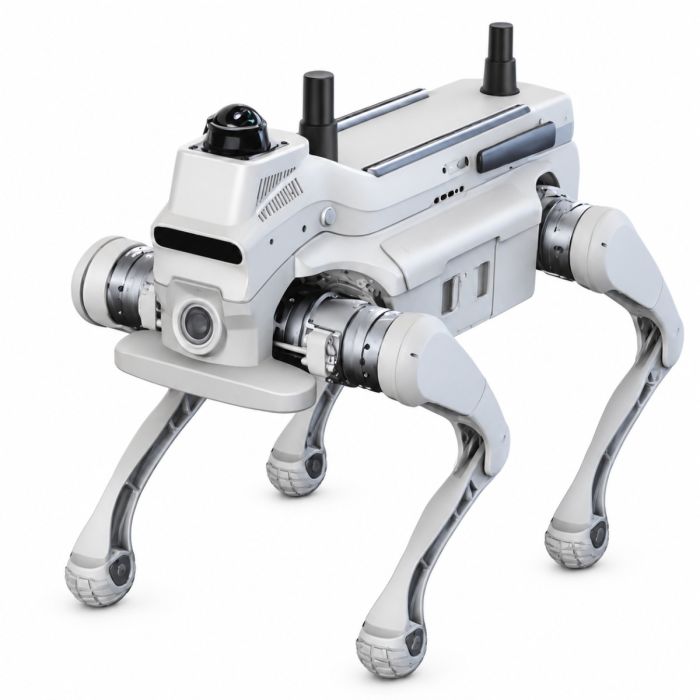
In legged-robotics research, the algorithm is seldom what holds a project back. The delay comes from the months spent mounting a lidar, wiring a depth camera, finding power and space for an onboard computer, and then persuading the whole assembly to walk without shaking itself apart. The Genisom L1 EDU RoamerX Pro Quadruped Robot takes that integration work off the critical path. GENISOM builds sensing, computing, satellite positioning and mobile connectivity into the robot itself, fusing visible light, depth vision and laser point clouds, so that a laboratory can begin its work with perception and autonomy rather than with brackets, adaptors and cable looms.
Robots Middle East supplies the Genisom L1 EDU RoamerX Pro to universities, research institutes and technical teams throughout the Middle East. Robots Middle East prepares each quotation, arranges delivery to your site and remains your point of contact for technical support once the robot is in service, so that procurement, onboarding and after-sales care are handled by a single regional partner.
Background
GENISOM AI and the L1 family
GENISOM AI is a Chinese robotics company founded in 2023. In a short time it has built a family of quadrupeds around the L1 platform, which includes the Genisom L1, the L1 EDU, the wheeled L1-W and the L1 Maker. The standard Genisom L1 establishes the mechanical and software foundation of the family: twelve fully self-developed, high power density joint modules that require no calibration, a built-in AI reinforcement learning algorithm for motion control on complex terrain, and a fully open software SDK with motion, video stream and status interfaces. The wider series is presented on the GENISOM AI GangBeng L1 Series Bionic Quadruped Robot page.
An integrated perception and compute stack
Where the standard L1 is designed to accept expansion modules, the L1 EDU arrives with its research hardware already built in. It carries an NVIDIA Jetson Orin NX providing up to 100 TOPS of computing power, together with a Livox Mid-360 lidar, RealSense depth cameras, a GNSS satellite positioning module and a 5G communication module. The design is highly integrated, enabling the fusion of three forms of perception: visible light, depth vision and laser point cloud. The platform is designed to support simultaneous localisation and mapping (SLAM), 3D reconstruction, autonomous navigation research and open-source development workflows, which places it firmly among research and teaching robots rather than demonstration machines.
Technical Specifications
| Specification | L1 EDU | Genisom L1 (standard platform) |
|---|---|---|
| Onboard compute | NVIDIA Orin NX, up to 100 TOPS | — |
| Built-in sensing and communication | 3D laser radar, depth camera, GNSS satellite positioning module, 5G communication module | — |
| Lidar and depth camera models | Livox Mid-360 lidar, RealSense depth cameras | — |
| Vision and tracking | — | High-definition camera with AI monocular vision perception model for identifying and tracking targets |
| Motion control | — | Built-in AI reinforcement learning algorithm |
| Joint modules | — | 12 fully self-developed high power density joint modules, 48N·m peak torque |
| Continuous walking load | — | 8kg |
| Step climbing | — | 16cm steps, continuous climbing |
| Maximum climbing angle | — | 40° |
| Protection level | — | IP54 |
| Operating temperature | — | 0-40℃ |
| Standing size (L×W×H) | — | ~63 × 36 × 41.5 cm |
| Weight (with battery) | — | ~15 kg |
| Battery capacity | — | 5Ah, 43.2V |
| Maximum speed | — | 3.7 m/s (limit 5 m/s) |
| SDK | — | Motion interface, video stream interface and status interface; full software SDK openness |
| Expansion modules | — | High-performance computing cards, perception modules, positioning modules, 4G modules, long-range image transmission modules |
Specifications are as published by the manufacturer and are confirmed against the datasheet at quotation.
GENISOM has not published the weight, dimensions, battery capacity, runtime, maximum speed or payload of the L1 EDU itself, nor the contents of the box, the operating system or the wireless standards; Robots Middle East confirms each of these with your quotation.
What does the L1 EDU add to the standard Genisom L1?
The difference lies in where the research hardware lives. The standard Genisom L1 is a capable legged base with a high-definition camera and an AI monocular vision model for identifying and tracking targets, and it is designed to be extended: high-performance computing cards, perception modules, positioning modules, 4G modules and long-range image transmission modules are all expansion options. A team starting from the standard robot therefore chooses, sources and integrates those components itself.
The L1 EDU removes that step. Lidar, depth cameras, GNSS, 5G and an Orin NX computer are part of the platform, and they are designed to work together for three-way sensor fusion. For a research group, this means that the first weeks of a project can be spent recording datasets, tuning a SLAM pipeline or testing a navigation stack, rather than designing mounts and debugging power distribution. It also means that results are easier to reproduce between groups, because the sensor arrangement is the manufacturer's, not an improvised one.
The table keeps the two versions apart for that reason. The mechanical figures — torque, load, climbing ability, protection level, size, weight, battery and speed — sit in the standard Genisom L1 column, while the EDU column carries the computing and sensing hardware this version adds.
How has the L1 EDU performed outside the laboratory?
Specification tables say what a robot should do; competitions show what it does under pressure. A University of Manchester team won first place at the IROS 2025 Quadruped Robot Challenge using a GENISOM L1 EDU platform, a result that speaks for the platform's mobility and navigation performance. For a department weighing a purchase, an independent result at a major international robotics conference is a useful reference point: it shows that the integrated sensor and compute stack can carry a competitive autonomy solution in a timed, judged setting, not only in a controlled demonstration.
Who is the Genisom L1 EDU RoamerX Pro for?
The clearest fit is a university research group working on legged autonomy: SLAM, 3D reconstruction, autonomous navigation and multi-sensor fusion. Doctoral and postdoctoral researchers gain a platform on which experiments can be repeated with a consistent sensor set, and supervisors gain a shared resource that several projects can use in turn. Competition teams preparing for quadruped challenges will find the IROS 2025 result relevant to their own planning.
Engineering faculties that teach robotics at advanced undergraduate and master's level are a second audience. The open SDK and support for open-source development workflows allow students to work with real lidar, depth and positioning data on a robot that walks, which is a different experience from simulation alone. Corporate and government research and development teams evaluating legged robots for inspection, mapping or field operations form a third segment, using the platform to prototype autonomy before specifying a deployment system.
If your group would prefer the EDU hardware in a different configuration, the Genisom L1 EDU Quadruped Robot is offered as a separate listing, and Robots Middle East will set out the differences between the two in writing. Teams whose research concerns hybrid wheeled-legged locomotion may wish to compare the Genisom L1-W EDU RoamerX Pro Wheeled Quadruped Robot. Other platforms for academic work are gathered in our Research Robots category.
What is the Genisom L1 EDU RoamerX Pro used for?
- SLAM research — building and testing localisation and mapping algorithms on fused lidar, depth and camera data.
- 3D reconstruction — capturing point clouds of buildings, campuses and outdoor sites for modelling and analysis.
- Autonomous navigation — developing path planning and obstacle avoidance for a legged robot moving through real environments.
- Outdoor positioning trials — combining GNSS satellite positioning with onboard perception for work beyond the laboratory.
- Teaching and open-source development — giving students hands-on access to a legged platform through an open SDK.
- Competition preparation — training teams for quadruped challenges on a platform with a proven international result.
Pricing and Availability
Robots Middle East supplies the Genisom L1 EDU RoamerX Pro on quotation, prepared for your institution and its intended use. Please tell us about your research programme, the number of units you need and any procurement requirements, and we will prepare a proposal for the configuration that suits your work. Delivery, customs clearance and technical support are arranged together with your quotation. To begin, use the quotation request available on this page.
Frequently Asked Questions
What computer does the Genisom L1 EDU RoamerX Pro use?
The L1 EDU is equipped with an NVIDIA Jetson Orin NX, providing up to 100 TOPS of computing power on board the robot.
Which sensors are built in?
The L1 EDU integrates a Livox Mid-360 lidar, RealSense depth cameras, a GNSS satellite positioning module and a 5G communication module, enabling the fusion of visible light, depth vision and laser point cloud perception.
Is the platform suitable for SLAM and navigation research?
Yes. GENISOM designed the L1 EDU to support SLAM, 3D reconstruction, autonomous navigation research and open-source development workflows.
Has the L1 EDU been used in competition?
A University of Manchester team won first place at the IROS 2025 Quadruped Robot Challenge using a GENISOM L1 EDU platform.
How does the L1 family handle difficult terrain?
The standard Genisom L1 uses a built-in AI reinforcement learning algorithm for motion control, climbs 16cm steps continuously and manages a 40° climbing angle. It carries an IP54 protection level and operates from 0-40℃.
Can I develop my own software for the robot?
The L1 platform offers full software SDK openness with motion, video stream and status interfaces, and the EDU version is designed for open-source development workflows.
Where can I buy the Genisom L1 EDU RoamerX Pro and what does it cost?
Robots Middle East supplies the robot across the Middle East on quotation. Request a quotation from this page and we will respond with a proposal covering configuration, delivery, customs and support.
Summary
The Genisom L1 EDU RoamerX Pro is built for teams that would rather spend their time on research than on integration. It pairs the L1 family's self-developed joints, reinforcement learning motion control and open SDK with an onboard Orin NX computer, a Livox Mid-360 lidar, RealSense depth cameras, GNSS and 5G, all designed to work as one perception system. A first place at the IROS 2025 Quadruped Robot Challenge shows what that integration can achieve in skilled hands. For universities and research teams in the region who want their first weeks to produce data rather than wiring diagrams, with Robots Middle East handling quotation, delivery and support, this page is the starting point.