
BWSENSING Cost-Effective Single-Axis CAN Output Inclinometer (BWM415)
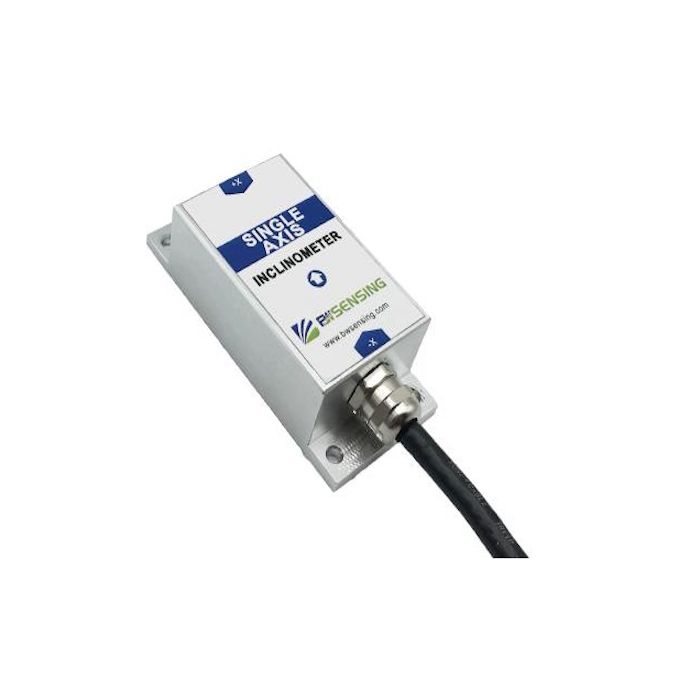
In stock
- BRAND:
- BWSENSING
- PART #:
- BWM415
- ORIGIN:
- China
- AVAILABILITY:
- SUBJECT TO AVAILABILITY
- SKU:
- BWSENSING-BWM415
BWSENSING Cost-Effective Single-Axis CAN Output Inclinometer (BWM415)
An inclinometer datasheet carries two figures that are easily mistaken for one another. Resolution tells you how small a change the sensor can notice; accuracy tells you how close its reading sits to the true angle. On the BWSENSING Cost-Effective Single-Axis CAN Output Inclinometer (BWM415) they are 0.001° and 0.01°. That difference is what a control engineer wants: a sensor that registers slow drift well before it becomes a meaningful error, then reports it as a CAN message that any controller on the bus can read. Sealed to IP67, powered from a 9-36V supply and measuring across a full ±180°, it is an instrument designed for machines rather than laboratories. Its manufacturer names underground trenchless machines as the work it suits best.
Robots Middle East supplies the BWM415 to machine builders, drilling contractors and system integrators across the Middle East. We prepare each quotation, arrange delivery to your site and provide technical support after the sensor arrives. Where your project calls for a different axis count or output protocol, we compare the alternatives in the BWSENSING range with you before you commit to an order.
Background
BWSENSING and its family of inclinometers
BWSENSING builds a broad catalogue of tilt sensors. The range spans single-axis and dual-axis models with several digital output options, including CAN and Modbus, so an engineer can choose the interface that matches the rest of the machine. The BWM415 belongs to the company's cost-effective line. These sensors are intended for series production and fleet deployment, where a project needs dependable angle feedback on many machines and a premium navigation-grade instrument would be excessive. The full selection is on our BWSensing page.
Why a CAN output matters
Controller Area Network was developed for vehicles and has since become the standard nervous system of mobile and heavy machinery. Several devices share one pair of signal wires, and each message carries an identifier, so a controller can listen to many sensors without separate cabling for each. Differential signalling also gives CAN good tolerance of the electrical noise produced by motors, hydraulics and long cable runs. A tilt sensor with native CAN output can therefore join an existing machine network directly, with no analogue conversion stage and no additional gateway between the sensor and the controller.
Technical Specifications
| Specification | Value |
|---|---|
| Axes | Single axis inclination measurement |
| Range | ±180° |
| Resolution | 0.001° |
| Highest accuracy | 0.01° |
| Zero bias | ±0.008 °/℃ (-40~85℃) |
| Output | CAN |
| Output frequency | 5-100Hz adjustable, up to 100Hz |
| Start-up time | <3s |
| Power supply | 9-36V |
| Protection level | IP67 |
| Impact resistance | 2000g,0.5ms,3 times/axis |
| Insulation resistance | ≥100 MΩ |
| MTBF | ≥90000h |
| Dimensions | L90*W40.5*H26(mm) |
| Connector and cable | Metal Joint(Cable 1.5m) |
Specifications are as published by the manufacturer and are confirmed against the datasheet at quotation.
The manufacturer has not published the weight, the frequency response, the contents of the box, the cable wiring colours or the available baud rates; we confirm each of these with you at quotation.
What is the difference between resolution and accuracy on the BWM415?
The two figures answer different questions, and the BWM415 is easier to specify once they are kept apart. A resolution of 0.001° describes the smallest step the sensor can report. It shows how finely the output tracks a change in tilt, which matters when a control loop must react to slow, gradual movement. Accuracy, up to 0.01°, describes how far the reported angle may sit from the real one. It matters when the absolute angle itself is the target, for example when a bore must follow a planned grade.
For most machine applications, both figures count. The fine resolution gives a smooth signal with no visible steps, so a controller can use small corrections instead of abrupt ones. The accuracy figure sets the limit on how far you can rely on the reading as a true measurement. Temperature behaviour is the third part of the picture. The zero bias of ±0.008 °/℃ across -40~85℃ indicates how much the zero point shifts as the housing heats and cools. This is worth considering on equipment that stands in the sun by day and cools at night, and we recommend discussing it during selection.
How does the BWM415 cope with demanding sites?
The specification reads as though written for rough treatment. The housing is rated IP67, the protection level that addresses dust ingress and temporary immersion. The sensor connects through a metal joint with a 1.5m cable instead of an exposed plastic plug. Impact resistance is specified at 2000g, 0.5ms, 3 times per axis, which describes the type of short, sharp shock produced by percussive drilling, a dropped tool or a heavy coupling. The insulation resistance of ≥100 MΩ supports electrical integrity in damp conditions. An MTBF of ≥90000h points to a component designed to be installed and then left in service.
Practical details support the same goal. The 9-36V supply range covers the common machine power rails, so the BWM415 can usually run from the vehicle or rig supply without a dedicated converter. A start-up time of <3s means the angle is available almost as soon as the machine powers up. The adjustable output frequency of 5-100Hz allows an integrator to keep bus traffic light on a busy network or raise the update rate where the control loop needs faster data.
Who is the BWSENSING Cost-Effective Single-Axis CAN Output Inclinometer (BWM415) for?
The clearest match is the trenchless sector. Contractors and equipment builders working on horizontal directional drilling, pipe ramming and similar underground methods need a dependable angle reading from equipment that operators cannot see directly, and the manufacturer names this application specifically. Original equipment manufacturers of mobile and construction machinery are a second natural audience. Their machines often already run a CAN network, and a sensor that joins that network directly simplifies wiring and software integration. System integrators building tilt-monitoring or levelling functions into vehicles, platforms and rigs form a third group, particularly where several sensors must share one bus.
Some projects are better served by a related model. If the application needs pitch and roll together, a dual-axis model such as the BWSENSING Cost-Effective Dual-Axis Inclinometer (BWM427) or the BWSENSING Cost-Effective Dual-Axis Digital Output Inclinometer (BWM426) is the more appropriate starting point. If the control system runs on Modbus rather than CAN, the BWSENSING Cost-Effective Single-Axis Digital Output With Modbus Inclinometer (BWM417) offers single-axis measurement with that protocol. Further options are listed in our Sensors category.
What is the BWSENSING Cost-Effective Single-Axis CAN Output Inclinometer (BWM415) used for?
- Trenchless drilling guidance: reporting the inclination of underground trenchless machines so that crews can hold the planned bore path.
- Drilling rig mast alignment: confirming the angle of a mast or feed beam before and during drilling.
- Machine levelling: feeding a controller the tilt it needs to level a chassis, platform or boom automatically.
- Tilt alarms on mobile equipment: warning operators or interlocks when a vehicle approaches an unsafe angle.
- Attachment angle feedback: tracking the tilt of a working tool or implement on construction machinery.
- Inclination monitoring on structures and installations: reporting slow angular change on equipment connected to a CAN-based monitoring network.
Pricing and Availability
Robots Middle East supplies the BWM415 on quotation, so that each order reflects the quantity, the configuration and the destination you require. Send us a brief outline of the application, the controller and network it will connect to, and the number of units needed, and we will prepare a formal offer. Delivery, customs clearance and technical support are arranged as part of that quotation. To begin, use the quotation request for the BWSENSING Cost-Effective Single-Axis CAN Output Inclinometer (BWM415), available on this page.
Frequently Asked Questions
What angle range does the BWM415 cover?
The BWM415 measures inclination on a single axis across ±180°, with a resolution of 0.001° and a highest accuracy of 0.01°.
Which output does the sensor provide?
The output is CAN, with an adjustable output frequency of 5-100Hz.
Is the BWM415 suitable for wet or dusty sites?
Yes. The sensor is rated IP67 and connects through a metal joint with a 1.5m cable.
What power supply does it need?
The BWM415 runs from a 9-36V supply, which covers the common machine power rails.
How quickly is a reading available after power-up?
The start-up time is <3s.
Can I get a dual-axis or Modbus version?
BWSENSING offers dual-axis models and Modbus-output models within the same cost-effective range, such as the BWM427 and the BWM417. We can advise you on which model suits your system.
Where can I buy the BWSENSING Cost-Effective Single-Axis CAN Output Inclinometer (BWM415) and what does it cost?
You can buy it from Robots Middle East, which supplies it across the Middle East on quotation. Request a quotation on this page and we will reply with a formal offer that covers delivery and support.
Summary
The BWM415 combines two different qualities. It is sensitive enough to register a change of 0.001° and accurate enough to rely on at up to 0.01°. The combination is delivered in an IP67 housing with shock resistance and an MTBF suited to heavy machinery, and it reports through the CAN network that such machinery already uses. For trenchless drilling, levelling and tilt monitoring, the sensor gives the controller both a smooth signal to act on and a reading it can trust. For specifying, comparing or ordering it through Robots Middle East, this page is the starting point.