
BWSENSING Cost-Effective Dual-Axis Digital Output Inclinometer (BWM426)
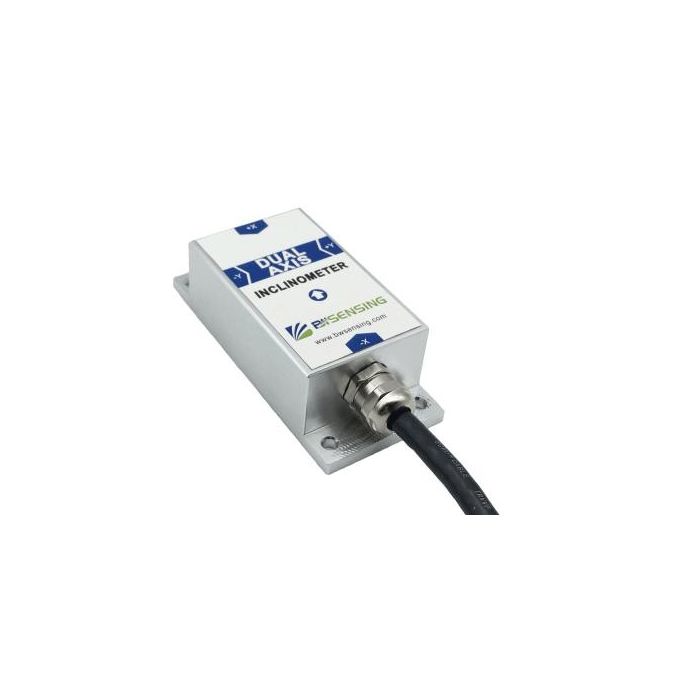
In stock
- BRAND:
- BWSENSING
- PART #:
- BWM426
- ORIGIN:
- China
- AVAILABILITY:
- SUBJECT TO AVAILABILITY
- SKU:
- BWSENSING-BWM426
BWSENSING Cost-Effective Dual-Axis Digital Output Inclinometer (BWM426)
Out on a site where the sun bakes the steel, fine dust finds every seam and the sensor sits in a junction box nobody wants to open twice, the hard part of tilt measurement is often keeping the sensor alive rather than reading the angle. The BWSENSING Cost-Effective Dual-Axis Digital Output Inclinometer (BWM426) takes on both halves of that problem. It measures inclination on two axes with a resolution of 0.001° and reports it digitally over RS232, RS485 or TTL. It does so from an IP67 magnesium-alloy housing rated for operation from -40℃ to +85℃. It is a small, low-cost module, and its appeal lies in pairing that economy with a build intended for real equipment in real weather.
Robots Middle East sells the BWM426 and supplies it to integrators, OEMs, contractors and research teams across the Middle East. Robots Middle East prepares the quotation, arranges delivery to your site and provides technical support after the sensor is installed. That includes help choosing between the published versions and the output interfaces before an order is placed.
Background
BEWIS Sensing Technology and the BWSENSING range
The BWM426 was designed by BEWIS Sensing Technology LLC, whose products are sold under the BWSENSING name. The company's catalogue covers a family of inclinometers that differ by axis count, output type and housing. That breadth matters to a buyer, because the right sensor is usually the one whose interface and range fit the controller already specified, not simply the most capable one. The BWM426 sits in the cost-effective tier of that family, alongside single-axis and alternative-output relatives that you can explore in the BWSensing range.
Positioning: a compact sensor that does not cut corners on protection
Inclinometers of this class measure the angle of a surface relative to gravity. Engineers mount them rigidly to a frame, boom, mast or platform so that any tilt of the structure becomes a tilt of the sensor. The BWM426 is described by its designer as a low cost and small double-axes inclinometer. Its distinctive point is that the low price does not come with a bare circuit board or a fragile plastic case. The shell is anodised magnesium alloy, the protection level is IP67, and the published accuracy reaches 0.01°. For projects that need many measuring points, such as a row of piles, a fleet of machines or a long structure, that combination keeps the cost per point under control without giving up a housing suited to outdoor work.
Technical Specifications
| Specification | Value |
|---|---|
| Measurement axes | Dual axis inclination measurement |
| Measuring range — BWM426 | ±90° |
| Measuring range — BWM426-88 | ± 88° |
| Resolution | 0.001° |
| Highest accuracy | 0.01° |
| Output | RS232/RS485/TTL optional |
| Power supply | 9-35V |
| Operating temperature (BWM426) | -40℃~+85℃ |
| Protection level | IP67 |
| Shell material (BWM426) | Magnesium alloy anodizing |
| Dimensions | L90*W40.5*H26(mm) |
| Installation (BWM426) | Horizontal or vertical (vertical installation requires customisation) |
| Software (BWM426) | Supporting serial debugging software for angle display on a computer |
Specifications are as published by the manufacturer and are confirmed against the datasheet at quotation.
The manufacturer has not published the weight, the cable length or the details of the output protocol; Robots Middle East confirms these at quotation.
What does the BWM426-88 change compared with the BWM426?
The sources name three versions: the BWM426, the BWM426-88 and the BWM426S. The clearest published difference concerns the measuring range. The BWM426 is listed with a range of ±90°. The BWM426-88 is documented with a measuring range of ± 88° and a full-scale accuracy of 0.01°. For most levelling and attitude tasks the difference is academic, because the structure being monitored rarely approaches vertical. It becomes relevant when a design specification quotes a required range explicitly, or when the sensor is expected to operate close to its limits. In that case the version on the purchase order should match the range written into the specification.
The BWM426S is named by the sources, but no figures distinguishing it have been published. If a project document calls for the BWM426S, Robots Middle East will confirm what that version provides against the manufacturer's datasheet before quoting, rather than assuming it matches either of the other two.
How does the BWM426 connect to a control system?
The sensor is offered with an RS232, RS485 or TTL output, chosen at the time of order. Each suits a different situation. RS485 is the usual choice for industrial installations where the sensor sits some distance from the controller or shares a bus with other devices. RS232 suits a direct link to a computer or older equipment. TTL is the natural fit for an embedded board or a microcontroller in a compact machine. Because the interface is fixed when the unit is ordered, it is worth deciding it alongside the controller rather than after the hardware arrives.
Power comes from a wide 9-35V supply, which sits comfortably with the 12V and 24V rails common in vehicles, machinery and control cabinets. For commissioning, the BWM426 is supported by serial debugging software that runs on a computer and displays the measured angle. That lets an installer check orientation and zero before the sensor is handed over to the main control system. The unit installs horizontally as standard. Vertical installation is possible but requires customisation, so it should be mentioned at the enquiry stage.
Who is the BWM426 for?
The first group is machine builders and OEMs who need a tilt input for levelling, safety interlocks or attitude feedback. They are building in volume and want a sensor whose price does not dominate the bill of materials. The second is monitoring contractors and structural engineers who instrument foundations, retaining walls, towers or bridges. For them, an IP67 housing and a wide temperature rating matter as much as resolution. The third is integrators and robotics teams who add inclination to mobile platforms or test rigs and value a TTL or RS232 option that connects straight to a development board. Universities and research laboratories also fit, particularly where the debugging software shortens the path from unboxing to the first readings.
Some buyers will be better served elsewhere in the family. A system that needs only one axis, or that is built around a CAN bus, may suit the BWSENSING Cost-Effective Single-Axis CAN Output Inclinometer (BWM415). Projects whose specification names Modbus explicitly can compare the BWSENSING Cost-Effective Dual-Axis Digital Output With Modbus Inclinometer (BWN427). Another dual-axis option for comparison is the BWSENSING Cost-Effective Digital Dual-Axis Inclinometer (BWM466). The wider choice is gathered in our Sensors category.
What is the BWM426 used for?
- Platform levelling — feeding pitch and roll to the controller of an aerial work platform, outrigger system or mobile machine so that it can level itself or refuse to operate on a slope.
- Structural health monitoring — tracking slow tilt in towers, retaining walls, piles and bridge piers over months of exposure.
- Construction machinery attitude — giving operators and automation systems a digital reading of boom, blade or chassis angle.
- Solar tracker positioning — confirming the actual angle of tracker rows in hot, dusty installations where the housing must stay sealed.
- Robotics and mobile platforms — adding orientation feedback to ground robots, test rigs and inspection vehicles through a TTL or RS232 link.
- Antenna and mast alignment — verifying that dishes, masts and sensor booms stay at their set angle after installation and wind loading.
Pricing and Availability
Robots Middle East supplies the BWM426 on quotation. A quotation lets us confirm the version, the output interface and any customisation, such as vertical mounting, against your application before an order is placed. Delivery, customs clearance and technical support are arranged together with the quotation. To begin, send us your required range, interface and quantity using the quotation request form available on this page.
Frequently Asked Questions
How many axes does the BWM426 measure?
It measures inclination on two axes at the same time, so a single unit reports tilt in both directions of a surface.
What resolution and accuracy does it offer?
The BWM426 has a resolution of 0.001° and a highest accuracy of 0.01°.
Which output interfaces are available?
The output is RS232, RS485 or TTL, selected when the sensor is ordered. Tell Robots Middle East which interface your controller expects and the quotation will reflect it.
Can it be used outdoors in hot climates?
The housing has an IP67 protection level, and the BWM426 is rated for an operating temperature of -40℃~+85℃. Its shell is anodised magnesium alloy.
Can the sensor be mounted vertically?
Yes, but vertical installation requires customisation; horizontal installation is the standard arrangement. Please mention vertical mounting when you request a quotation.
What is the difference between the BWM426 and the BWM426-88?
The BWM426 is listed with a measuring range of ±90°, while the BWM426-88 has a measuring range of ± 88°. The BWM426S is also named, and its details are confirmed at quotation.
Where can I buy the BWSENSING BWM426 and what does it cost?
You can buy the BWM426 from Robots Middle East, which supplies it across the Middle East. Pricing depends on the version, the interface and the quantity, so it is provided in a formal quotation requested through this page.
Summary
Reading an angle is the easy part; keeping a sensor reliable through heat, dust and years on a structure is where cheap tilt sensors often fall short. The BWSENSING BWM426 answers both. It offers dual-axis measurement with 0.001° resolution and a highest accuracy of 0.01°, digital output over RS232, RS485 or TTL, and a wide 9-35V supply. All of this comes in a compact, IP67, anodised magnesium-alloy housing rated from -40℃ to +85℃. Choose the BWM426 or BWM426-88 according to the range your specification requires, and confirm the interface early. For a quotation from Robots Middle East, with delivery and support arranged alongside it, this page is the starting point.