
Deep Robotics LYNX All-Terrain Wheeled Quadruped Robot Dog
In stock
- BRAND:
- DEEP ROBOTICS
- PART #:
- LYNX
- ORIGIN:
- China
- AVAILABILITY:
- ALLOW 2-4 WEEKS FOR DELIVERY
- SKU:
- Deep-Robotics-LYNX
Deep Robotics LYNX All-Terrain Wheeled Quadruped Robot Dog
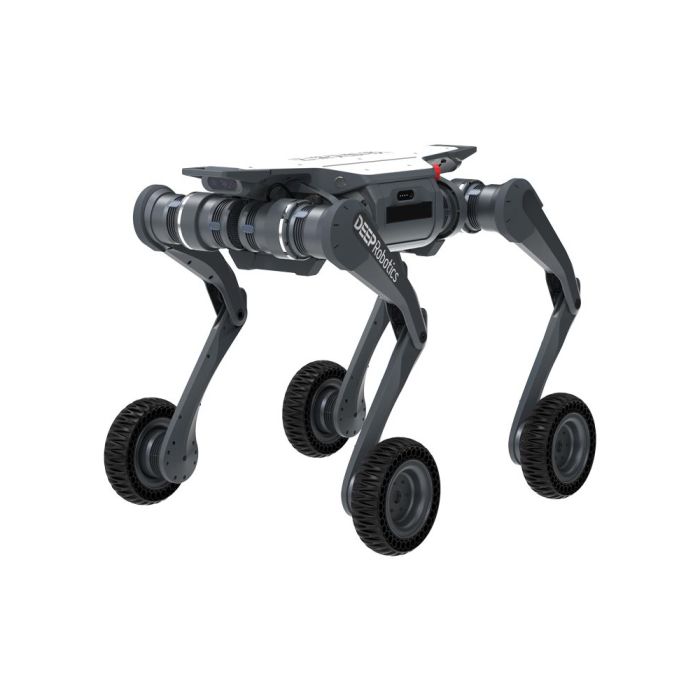
An inspection robot earns its keep in the minutes it is not standing still. It loses them waiting on a flat battery, waiting for someone to lift it onto a ledge, or creeping along a long service corridor at walking pace while the rest of the round waits. The Deep Robotics LYNX All-Terrain Wheeled Quadruped Robot Dog is built to remove those pauses: it rolls quickly where the ground is open, climbs when a platform or a flight of steps interrupts the route, and runs on a battery system that can be exchanged without taking the robot out of service.
Robots Middle East supplies the LYNX to organisations across the Middle East, from utilities and industrial operators to research institutions and security teams. Robots Middle East prepares each quotation, arranges delivery to site and remains the point of contact for support once the robot is in operation, so that buyers in the region deal with a single supplier from first enquiry to deployment.
Background
DEEP Robotics and its embodied intelligence work
DEEP Robotics is a manufacturer of legged robots whose range now spans academic platforms, such as the Lite3, and industrial wheeled quadrupeds. The LYNX carries that experience forward. The manufacturer builds it on the DEEP Robotics AI+ initiative, applying the company's expertise in embodied AI with adaptations tailored to the LYNX's own design. In practical terms, embodied intelligence is the discipline of making a robot's perception and control work together in a physical body, so that the machine responds to the ground beneath it rather than to an idealised model of it.
Wheel-leg motion as the central idea
The defining feature of the LYNX is its wheel-leg motion. DEEP Robotics describes the robot as compact and agile, using this hybrid locomotion to strike a balance between speed and agility. An independent description of the robot puts it in similar terms: a wheeled-leg hybrid design that combines the speed of wheels with the agility of legs. The result is a machine that can treat a smooth surface as a road and an obstacle as something to climb, rather than as the end of the route.
Technical Specifications
| Specification | Value |
|---|---|
| Standing size | 0.8m×0.5m×0.6m |
| Weight | 30kg |
| Payload | 12kg |
| Maximum speed | 5 m/s |
| Platform climbing | Up to 80cm |
| Continuous steps | 22cm |
| Protection rating | IP54 |
| Operating temperature | -10~40°C |
| Camera | 1080P wide-angle lens |
| Battery system | Quick-swap dual batteries, hot-swappable |
Specifications are as published by the manufacturer and are confirmed against the datasheet at quotation.
The manufacturer has not published the battery capacity, the charging time, any LiDAR fitment, the processor, the connectivity ports, the box contents, a maximum slope rating, a dimensional drawing in millimetres or SDK and software compatibility; these are confirmed at quotation.
What does wheel-leg motion change compared with a walking-only robot?
A purely legged quadruped is versatile, but every metre it covers is a sequence of steps, and on long flat stretches that becomes the limiting factor. A purely wheeled platform is quick on paved ground, yet a raised platform or a staircase brings it to a halt. The LYNX addresses both limitations in one body. On open ground it reaches speeds of 5 m/s; when the route changes, it climbs platforms of up to 80cm and navigates continuous 22cm steps.
For an operator, the difference is felt in the planning. Routes no longer need to be designed around the robot's weaknesses, with ramps found for a wheeled unit or extra time allowed for a walking one. A single patrol can include a long access road, a loading dock and a stairwell, and the robot handles each section in the mode best suited to it. The manufacturer also states that the LYNX can tackle a variety of challenging terrains, which is the broader promise behind the hybrid design.
How does the LYNX stay in service through a working shift?
Mobility is only half of uptime. The other half is energy, and here the LYNX uses quick-swap dual batteries in a hot-swappable system, which the manufacturer presents as part of its robust, long-endurance design. A depleted pack can be exchanged while the robot keeps running, so a battery change becomes a short task for the operator rather than a pause for recharging.
Environmental tolerance matters just as much. The IP54 protection rating covers dust and splashing water, and the published operating range of -10~40°C defines the conditions under which the robot is specified to work. Buyers planning outdoor deployments should match that range against their own site conditions and seasonal patterns. The 1080P wide-angle camera, together with the manufacturer's high-performance image and video transmission, gives remote operators a clear view of what the robot sees as it moves.
Who is the Deep Robotics LYNX All-Terrain Wheeled Quadruped Robot Dog for?
The LYNX suits organisations whose sites mix fast, open ground with obstacles that would stop a conventional vehicle. Utility, energy and industrial operators can use it for routine inspection rounds across plant rooms, yards and access roads. Security teams responsible for large perimeters benefit from its speed between checkpoints and its ability to climb when a patrol route rises. Research groups and system integrators can treat it as a mobile base, using its 12kg payload for sensors and equipment of their own choosing. Emergency and public safety organisations evaluating ground robots for reconnaissance will find its climbing ability and camera relevant to that work.
The LYNX name also appears across a wider family. Buyers whose specification calls for a particular series model should compare the Deep Robotics LYNX M20, the Deep Robotics LYNX M20S and the Deep Robotics LYNX S10, each of which has its own page and its own figures; the figures on this page belong to the LYNX alone. The complete range can be viewed in the LYNX Series, and comparable platforms from other angles in the Wheeled Quadrupeds category.
What is the Deep Robotics LYNX All-Terrain Wheeled Quadruped Robot Dog used for?
- Facility inspection rounds: covering long service routes quickly and climbing onto platforms and steps along the way.
- Perimeter and site patrol: moving at speed between checkpoints on large industrial or commercial estates.
- Remote visual monitoring: streaming images and video from the 1080P wide-angle camera to an operator elsewhere on site.
- Sensor and equipment carriage: transporting mission equipment within the published 12kg payload.
- Reconnaissance before personnel enter: giving response teams an early view of areas reached by steps or raised ground.
- Research and demonstration: studying embodied AI and hybrid locomotion, or presenting robotics to visitors and stakeholders.
Pricing and Availability
The LYNX is supplied on quotation, which allows Robots Middle East to confirm the exact specification against the manufacturer's datasheet and to address the points the manufacturer has not yet published. Delivery, customs clearance and after-sales support are arranged together with the quotation. To begin, please share your intended application and site conditions with Robots Middle East, and request a quotation using the form available on this page.
Frequently Asked Questions
How fast can the LYNX move?
The LYNX reaches speeds of 5 m/s. Its wheel-leg motion lets it use that speed on open ground and switch to climbing when an obstacle appears.
What obstacles can the LYNX climb?
It climbs platforms of up to 80cm and navigates continuous 22cm steps. The manufacturer states that it tackles a variety of challenging terrains.
Can the LYNX operate outdoors?
The LYNX carries an IP54 protection rating and is specified for operating temperatures of -10~40°C. Site conditions outside that range should be discussed with Robots Middle East before ordering.
How is the battery changed?
The robot uses quick-swap dual batteries in a hot-swappable system. A pack can be exchanged while the robot remains in service.
How much does the LYNX weigh, and what can it carry?
The LYNX weighs 30kg and has a payload of 12kg. Its standing size is 0.8m×0.5m×0.6m.
Is the LYNX the same robot as the LYNX M20 or the LYNX S10?
No. The M20, M20 Pro, M20S and S10 are separate versions within the LYNX family, each with its own specification. The figures on this page apply to the LYNX only.
Where can I buy the Deep Robotics LYNX All-Terrain Wheeled Quadruped Robot Dog and what does it cost?
Robots Middle East supplies the LYNX across the Middle East on quotation. Pricing depends on the configuration, delivery and support required, and is set out in a quotation prepared for your project.
Summary
The value of a field robot is measured in the time it spends working rather than waiting, and the LYNX is designed around that measure. Wheel-leg motion delivers 5 m/s on open ground and climbs platforms of up to 80cm and continuous 22cm steps, so routes no longer stall at the first obstacle. Hot-swappable dual batteries reduce the charging pause to a quick exchange, while IP54 protection, a 1080P wide-angle camera and a 12kg payload equip it for inspection, patrol and research. Robots Middle East quotes, delivers and supports the LYNX across the region; for any team that wants fewer interruptions on its rounds, this page is the starting point.
Specifications
General
What's included
Related Products
Out of stock