
Deep Robotics LYNX M20 Omni Terrain Industrial Wheeled Quadruped Robot Dog
In stock
- BRAND:
- DEEP ROBOTICS
- MODEL:
- LYNX M20
- ORIGIN:
- China
- AVAILABILITY:
- ALLOW 2-4 WEEKS FOR DELIVERY
- SKU:
- Deep-Robotics-LYNX-M20
Deep Robotics LYNX M20 Omni Terrain Industrial Wheeled Quadruped Robot Dog
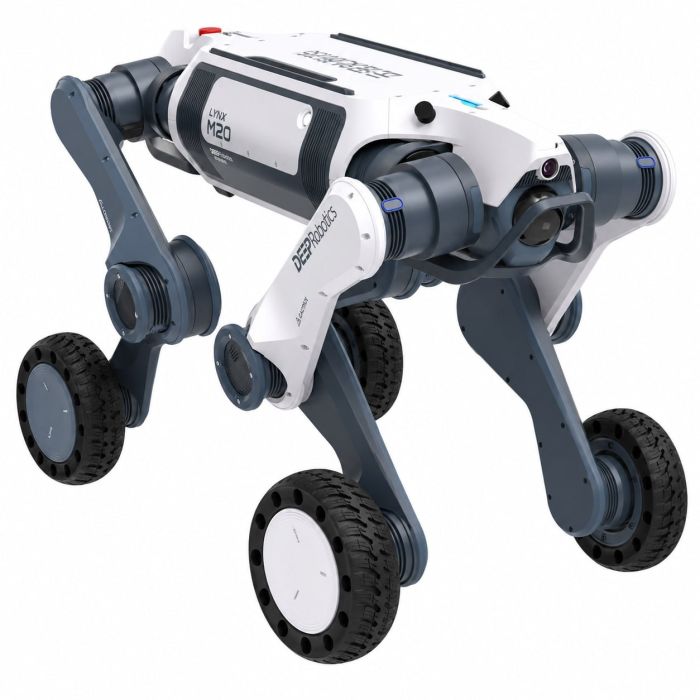
By mid-afternoon in a Gulf summer, the exposed walkways of a processing plant, a substation or a pumping station become hostile ground. Sand drifts against stair treads, fine dust settles into every seam, and the routine inspection round becomes the task that nobody wishes to take on. The Deep Robotics LYNX M20 Omni Terrain Industrial Wheeled Quadruped Robot Dog answers that problem with a different division of labour. It carries IP66 ingress protection and an operating range of -20 °C to +55 °C. It rolls on wheels where the ground is open and rises on articulated legs where steps, kerbs and debris break the route. Instead of asking a technician to walk through the heat, it asks how much of that walk a machine can reasonably take over.
Robots Middle East sells the LYNX M20 and supplies it to industrial, energy, utility, research and public-safety organisations across the Middle East. Our team prepares each quotation, coordinates delivery to your site and remains your point of contact for technical support once the robot is in service. We are also glad to help you compare the M20 with the other members of its series before you commit to a configuration.
Background
Deep Robotics and the LYNX M20 series
Deep Robotics develops legged robots for industrial work, and its LYNX line is devoted to wheeled-legged machines. Robots of this kind can be browsed in our Wheeled Quadrupeds category. The M20 series comprises three versions: the LYNX M20, the LYNX M20 Pro and the LYNX M20S. The series is the world's first wheeled-legged robot built specifically for challenging terrains and hazardous environments during industrial operation. This page covers the LYNX M20 itself, and every figure quoted below belongs to that version.
The M20 is a mid-size platform. Its form balances mobility in narrow spaces, with a clearance of 50 cm, against the payload and endurance that real industrial work demands. The result is a robot small enough for confined routes while still carrying meaningful equipment over a full inspection shift.
Wheels, legs and the switch between them
The defining technology of the M20 is the combination of wheels at the ends of its limbs with hyper-flexible joints. Seamless leg-mode switching, with configurations such as front-elbow/rear-knee, allows the robot to change its posture to suit the obstacle ahead. In practice this means it climbs 25 cm stairs, traverses tunnels and pipelines, and fills the gap between manual labour and heavy machinery. On flat ground the wheels do the work efficiently; when the ground stops cooperating, the legs take over without the operator changing robots.
Technical Specifications
| Specification | Value (LYNX M20) |
|---|---|
| Standing size | 820 × 430 × 570 mm |
| Weight (with battery) | 33 kg |
| Payload capacity | 15 kg |
| Maximum load capacity | 50 kg |
| Unloaded endurance and range | 3 h / 15 km |
| Loaded endurance and range (15 kg) | 2.5 h / 12 km |
| Charging time (single battery) | 1.5 h |
| Maximum speed (lab-tested) | 5 m/s |
| Safe operational speed | 2 m/s |
| Maximum continuous stair height | 25 cm |
| Maximum single-step height | 80 cm |
| Maximum slope | 45° |
| Narrow-space clearance | 50 cm |
| Computing power | Dual octa-core 64-bit industrial processors (16 GB + 128 GB) × 2 |
| LiDAR | Dual 96-line units (360° × 90°, ~860,000 pts/s) |
| Cameras | Dual wide-angle cameras |
| Ingress protection | IP66 |
| Operating temperature | -20 °C to +55 °C |
| Electrical ports | 72 V power input, Gigabit Ethernet |
| Functional features | Omnidirectional obstacle avoidance, point-cloud surround view, front/rear bidirectional lighting, RF image transmission, OTA upgrades |
| Options | Self-charging, modular expansion |
Specifications are as published by the manufacturer and are confirmed against the datasheet at quotation.
Deep Robotics has not published the battery capacity, the battery chemistry, the wheel size, the included accessories, details of the control software, the payload mounting interface or the wireless connectivity standards; we confirm each of these with you at quotation.
How does the LYNX M20 cope with heat, dust and water?
For buyers in this region, environmental protection is usually the first question, and the M20 addresses it directly. Its IP66 rating sits at the level of the ingress-protection scale that covers dust and powerful water jets, which matters on sites where sand is carried by the wind or where equipment is hosed down after a shift. Its operating range of -20 °C to +55 °C covers hot outdoor work at its upper end and refrigerated or high-altitude settings at its lower end.
Protection alone does not make a robot useful in poor conditions; it also has to see. The M20 carries dual 96-line LiDAR units with a 360° × 90° field of view, producing around 860,000 points per second, alongside dual wide-angle cameras. That sensor set supports omnidirectional obstacle avoidance and a point-cloud surround view, so the robot builds a picture of its surroundings even where dust or low light would trouble a camera on its own. Front and rear bidirectional lighting helps in tunnels, plant rooms and night-time rounds, while RF image transmission returns the view to the operator. All of this runs on two industrial-grade computing units, each with dual octa-core 64-bit processors and 16 GB + 128 GB of memory and storage.
Why carry wheels and legs on one robot?
A purely legged robot can tackle most obstacles but spends energy on every step, while a wheeled vehicle covers distance economically yet halts at the first flight of stairs. The M20 is designed so that operators do not have to choose. Without a load it is rated for 3 h of operation and a range of 15 km; carrying a 15 kg payload, those figures become 2.5 h and 12 km. A single battery recharges in 1.5 h.
When the route turns difficult, the legs come into play. The M20 handles continuous stairs of up to 25 cm, single steps of up to 80 cm and slopes of up to 45°. Its lab-tested maximum speed is 5 m/s, with a safe operational speed of 2 m/s for normal work. With a standing size of 820 × 430 × 570 mm and a weight with battery of 33 kg, it remains portable by a single operator between deployments, which simplifies transport from one site to the next.
Who is the LYNX M20 for?
The M20 suits operators of large industrial estates — oil and gas facilities, petrochemical plants, power and water utilities, and logistics hubs — where inspection rounds combine long open stretches with stairs, gantries and confined passages. For these organisations the appeal lies in covering more ground per shift while keeping staff away from exposed or hazardous areas.
Civil defence, fire services and industrial emergency teams form a second group. A robot that can enter a building, climb its stairs and send back imagery and point-cloud data offers a first look before people are committed. Related equipment for this work is gathered in our Emergency Response category.
A third group consists of research institutions and system integrators who need a rugged mobile base. The 72 V power input, Gigabit Ethernet port and optional modular expansion make the M20 a platform on which their own sensors and software can be built. Buyers weighing the wider series should also review the Deep Robotics LYNX M20 Pro Omni Terrain EDU Wheeled Quadruped Robot Dog and the Deep Robotics LYNX M20S Omni Terrain Industrial Wheeled Quadruped Robot Dog; Robots Middle East will set out the differences between the three versions with your quotation.
What is the LYNX M20 used for?
- Routine plant inspection: repeated rounds across yards, walkways and staircases without exposing staff to heat or hazards.
- Tunnel and pipeline inspection: travelling through confined passages where its narrow-space clearance and lighting are an advantage.
- Hazardous-area reconnaissance: entering zones that should be assessed remotely before a person goes in.
- Emergency response support: sending imagery back to incident teams from buildings and sites that are unsafe to enter.
- Equipment carriage: moving tools, sensors or supplies across mixed terrain within its rated payload.
- Survey and mapping: gathering point-cloud data of sites, structures and routes with its dual LiDAR units.
Pricing and Availability
Robots Middle East supplies the LYNX M20 on a quotation basis, so that the configuration, options such as self-charging or modular expansion, and the details of your deployment are agreed before anything is ordered. Delivery, customs clearance and technical support are arranged together with your quotation. To begin, please share your intended application and site, and request a quotation through the enquiry option available on this page.
Frequently Asked Questions
Can the LYNX M20 climb stairs?
Yes. It climbs continuous stairs of up to 25 cm and single steps of up to 80 cm, and it handles slopes of up to 45°.
How long does the LYNX M20 operate on a charge?
Without a load it runs for 3 h over a range of 15 km; carrying 15 kg, it runs for 2.5 h over 12 km. A single battery recharges in 1.5 h.
Is the LYNX M20 suited to hot and dusty sites?
It is rated IP66 and operates between -20 °C and +55 °C. We are happy to discuss the conditions of your particular site when preparing your quotation.
How much can the LYNX M20 carry?
Its payload capacity is 15 kg and its maximum load capacity is 50 kg.
Can the LYNX M20 charge itself?
Self-charging is available as an option. Please mention it in your enquiry so that it is included in your quotation.
How is the robot's software kept up to date?
The M20 supports OTA upgrades, and certain features are enabled through a future OTA update.
Where can I buy the LYNX M20 and what does it cost?
Robots Middle East supplies the LYNX M20 across the Middle East on a quotation basis. Send us your requirements through this page and we will prepare a quotation covering configuration, delivery and support.
Summary
The hardest part of an inspection round is rarely the inspection itself; it is the walk through heat, dust, stairs and confined spaces needed to reach it. The LYNX M20 is designed to take over that walk. It rolls efficiently across open ground, rises on its legs for steps and slopes, and keeps working in dust and water thanks to IP66 protection and a wide operating temperature range. Its dual LiDAR, wide-angle cameras and dual industrial computers give it the awareness to move safely, while its payload, endurance and expansion options let it carry real equipment. For organisations across the Middle East seeking to move routine and hazardous rounds from people to a robust machine, with Robots Middle East handling quotation, delivery and support, this page is the starting point.
Specifications
General
Physical
Performance
Computing
Sensors
Connectivity
Battery + Power
What's included
Downloads
Related Products

Out of stock