
Elephant Robotics Mercury Humanoid Robot A1 (4011300001)
In stock
- BRAND:
- ELEPHANT ROBOTICS
- PART #:
- 4011300001
- ORIGIN:
- China
- AVAILABILITY:
- SUBJECT TO AVAILABILITY
- SKU:
- Elephant-Robotics-4011300001
Elephant Robotics Mercury Humanoid Robot A1 (4011300001)
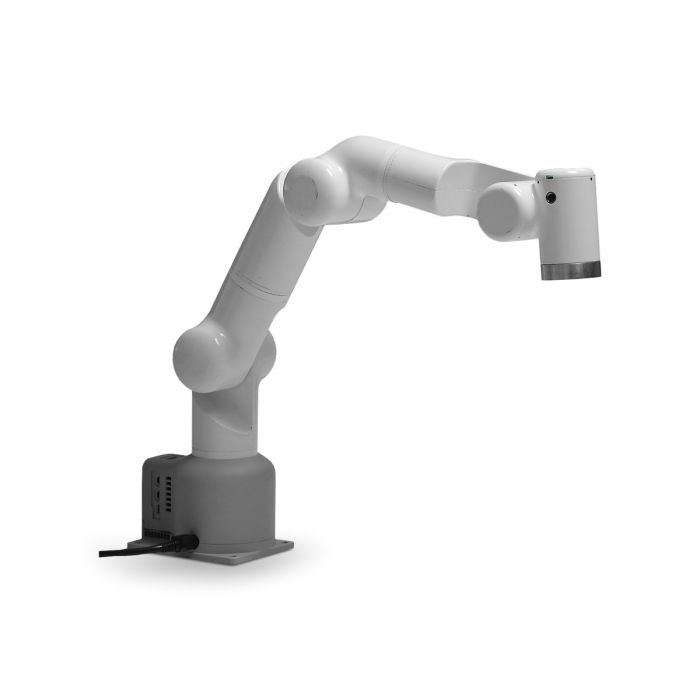
A humanoid robot is usually pictured as a complete body, yet most of the useful work a person does with the world is done by one arm and one hand. The Elephant Robotics Mercury Humanoid Robot A1 (4011300001) starts from that observation. It is the arm of the Mercury family offered as an instrument in its own right, with a 7DOF kinematic chain, harmonic reducers in the joints and an onboard controller that works with ROS. For a laboratory or a classroom, this means that humanoid-style manipulation can be studied, programmed and demonstrated on a bench, without the cost and complexity of a full robot body.
Robots Middle East supplies the Mercury A1 to universities, research institutes, innovation centres and system integrators across the Middle East. Our team prepares your quotation, coordinates delivery to your site and remains your point of contact for technical questions once the arm is in service.
Background
Elephant Robotics and the Mercury series
Elephant Robotics built its reputation on compact, approachable robot arms for education and software development, with the myCobot family the best known of its lines. The Mercury series extends that thinking towards embodied robotics. The sources name three versions: the Mercury A1, the Mercury B1 and the Mercury X1. Across the series, the manufacturer supports the major programming languages and the widely used simulation platforms ROS, Moveit, Gazebo and Mujoco, so that work begun in simulation can move on to hardware within a familiar toolchain. Within that family, the A1 is the single-arm member. It is the version for those who want to concentrate on manipulation itself: reach, orientation, trajectory planning and interaction with objects.
Harmonic drives and the joint module
The engineering of the Mercury A1 is concentrated in its joints. Each uses a harmonic reducer, a gearing principle valued in robotics for its compactness and its low backlash. An electromagnetic friction plate brake holds the joint when required. The manufacturer states that the joint module reaches a maximum output torque of 80Nm, with an encoder resolution of 19bit and a repetitive positioning accuracy of 0.6 arc minutes at the joint. At the tool, the arm offers a repeat positioning accuracy of ±0.05 mm. The structure combines carbon fibre, aluminium alloy and engineering plastics, and Elephant Robotics describes an integrated design in which the controller is part of the arm rather than a separate cabinet. Kinematics self-interference detection is built in to help the arm avoid collisions with itself during motion.
Technical Specifications
| Specification | Value |
|---|---|
| Product size | 98*128*640mm |
| Working voltage | DC24V/9.2A |
| Degrees of freedom | 7DOF |
| Maximum working radius | 450mm |
| Maximum payload | 1KG |
| Repeat positioning accuracy | ±0.05 mm |
| Net weight | 5KG (specifications page); 3.5 kilograms (user manual) |
| Material | Carbon fiber, Aluminum alloy, Engineering plastics |
| Reduction mechanism | Harmonic Reducer |
| Joint brake | Electromagnetic friction plate |
| Main controller CPU | Quad-core ARM Cortex-A72 ARMv8 64Bit [email protected] |
| IO | 24V 6 Input, 6 Output |
| Communication | CAN Bus/WIFI/Network port/Bluetooth/USB serial port |
| Joint module maximum output torque | 80Nm |
| Joint encoder resolution | 19bit |
| Joint repetitive positioning accuracy | 0.6 arc minutes |
| Screens | Two screens on the body; supports M5 ecological applications |
| Development systems | ROS, moveIt |
| Simulation platforms (Mercury series) | ROS, Moveit, Gazebo, Mujoco |
| Programming interface | myPanel, for quick teach programming |
| Safety feature | Kinematics self-interference detection |
Specifications are as published by the manufacturer and are confirmed against the datasheet at quotation. The manufacturer has not published the IP rating, the maximum joint speed, the power consumption, the operating temperature range, the noise level or the package contents; these are confirmed with your quotation.
What does a seventh joint add to a research arm?
An arm that can place its tool at a given position and orientation needs a certain minimum number of joints. Every joint beyond that minimum gives the controller a choice. With 7DOF, the Mercury A1 can hold its end effector still while moving its elbow, which is the same freedom a person uses to reach around an obstacle or to keep a wrist comfortable during a long movement. For researchers, that redundancy is a subject in itself. Null-space control, posture optimisation and obstacle avoidance are all studied on arms of this kind, and a platform that supports ROS and moveIt allows these methods to be tested with established planning tools rather than bespoke code.
Redundancy also matters for the humanoid ambitions of the Mercury series. A human-like arm is expected to move in a human-like way, and that is hard to achieve when every pose of the hand fixes the pose of the whole limb. The combination of the extra joint, harmonic reducers with high-resolution encoders and built-in self-interference detection gives the A1 the conditions for smooth, repeatable and self-aware motion. These are the qualities that make a demonstration convincing and an experiment reproducible. The trade-off is clear in the specification table: this is a precise arm with a modest payload of 1KG, intended for light objects and instrumented end effectors rather than heavy handling.
How is the Mercury A1 programmed and integrated?
The Mercury A1 offers more than one way in, which suits mixed groups of users. At the simplest level, the myPanel interface allows quick teach programming: the operator guides the arm through a task and the arm records it. This is practical for workshops, exhibitions and first lessons. At the other end, the arm supports ROS and moveIt, and the Mercury series works with the simulation platforms Gazebo and Mujoco, so trajectories can be developed and checked virtually before they run on the hardware.
The onboard controller is built on a Quad-core ARM Cortex-A72 ARMv8 64Bit [email protected]. Connectivity covers CAN Bus, WIFI, a network port, Bluetooth and a USB serial port. The 24V IO with 6 inputs and 6 outputs allows the arm to trigger, or respond to, grippers, sensors, conveyors or signal lamps in a small cell. The two screens on the body support M5 ecological applications, which opens the door to status displays, interactive content and expressive behaviour in public-facing installations. Because the arm works with multiple types of end effectors, the same unit can move from a gripping experiment to a display task with a change of tooling.
Who is the Mercury Humanoid Robot A1 for?
The clearest match is the university robotics laboratory. A department teaching kinematics, motion planning or manipulation gains an arm whose redundancy gives students genuine problems to solve, and whose ROS and moveIt support connects coursework to the tools used in research. Postgraduate groups working on embodied intelligence, imitation learning or human-robot interaction will value the repeatability of ±0.05 mm, because learning algorithms depend on consistent hardware behaviour from one trial to the next.
A second group is technical education more broadly: colleges, innovation centres and advanced school programmes that want a platform students can teach by hand through myPanel before moving on to code. A third group is integrators and organisations that build demonstrations for exhibitions, visitor centres and showrooms, where the screens and the integrated design help the arm present itself well.
Not every project stops at one arm. Where the brief calls for a more complete humanoid platform, we recommend comparing the other members of the series, the Elephant Robotics Mercury Humanoid Robot B1 (4011300002) and the Elephant Robotics Mercury X1 Wheeled Humanoid Robot (4011300003). Our team can advise on which version fits your objectives. The wider range is in our Humanoids category.
What is the Mercury Humanoid Robot A1 used for?
- Manipulation research — testing redundancy resolution, motion planning and grasping strategies on a 7DOF arm.
- Embodied AI development — collecting repeatable motion data for learning-based control and imitation studies.
- University teaching — giving robotics courses a hands-on platform that works with ROS and moveIt.
- Simulation-to-hardware workflows — validating trajectories in Gazebo or Mujoco before running them on the arm.
- Functional displays — interactive exhibits that use the body screens and interchangeable end effectors.
- Small automation prototypes — linking the arm to sensors and tooling through its 24V IO and communication ports.
Pricing and Availability
Robots Middle East supplies the Mercury A1 on quotation, so that the offer reflects your configuration, the end effectors you need and your project requirements. Delivery, customs clearance and after-sales support are arranged together with your quotation. To begin, please use the quotation request available on this page.
Frequently Asked Questions
How many degrees of freedom does the Mercury A1 have?
The Mercury A1 has 7DOF. The additional joint allows the arm to adjust its posture while keeping the tool in place.
How precise is the Mercury A1?
The manufacturer states a repeat positioning accuracy of ±0.05 mm for the arm, and 0.6 arc minutes of repetitive positioning accuracy at the joint module.
What are the reach and payload?
The maximum working radius is 450mm and the maximum payload is 1KG, which suits light objects and instrumented end effectors.
Which software does the Mercury A1 support?
It supports ROS and moveIt, and the Mercury series works with simulation platforms including Gazebo and Mujoco. The myPanel interface provides quick teach programming.
How does the arm communicate with other equipment?
It offers CAN Bus, WIFI, a network port, Bluetooth and a USB serial port, as well as 24V IO with 6 inputs and 6 outputs.
Does the Mercury A1 have safety functions?
Yes. It features kinematics self-interference detection to avoid motion collisions, and each joint has an electromagnetic friction plate brake.
Where can I buy the Elephant Robotics Mercury Humanoid Robot A1 (4011300001) and what does it cost?
You can buy it from Robots Middle East, which supplies it across the Middle East. Pricing is provided by quotation, prepared for your configuration and project.
Summary
The Mercury A1 takes the part of a humanoid robot that does most of the work, the arm, and makes it available as a precise, open instrument. Its 7DOF chain, harmonic reducers, high-resolution joint encoders and onboard ARM controller give researchers and educators a platform for studying human-like manipulation without building a whole body around it. Its support for ROS, moveIt and simulation tools keeps it within a recognised workflow, and myPanel keeps it accessible to newcomers. For institutions in the Middle East that want to bring humanoid manipulation onto the bench, this page is the starting point.