
Elephant Robotics Mercury X1 Wheeled Humanoid Robot (4011300003)
In stock
- BRAND:
- ELEPHANT ROBOTICS
- PART #:
- 4011300003
- ORIGIN:
- China
- Warranty:
- 12 MONTHS
- AVAILABILITY:
- ALLOW 4-6 WEEKS FOR DELIVERY
- SKU:
- Elephant-Robotics-4011300003
Elephant Robotics Mercury X1 Wheeled Humanoid Robot (4011300003)
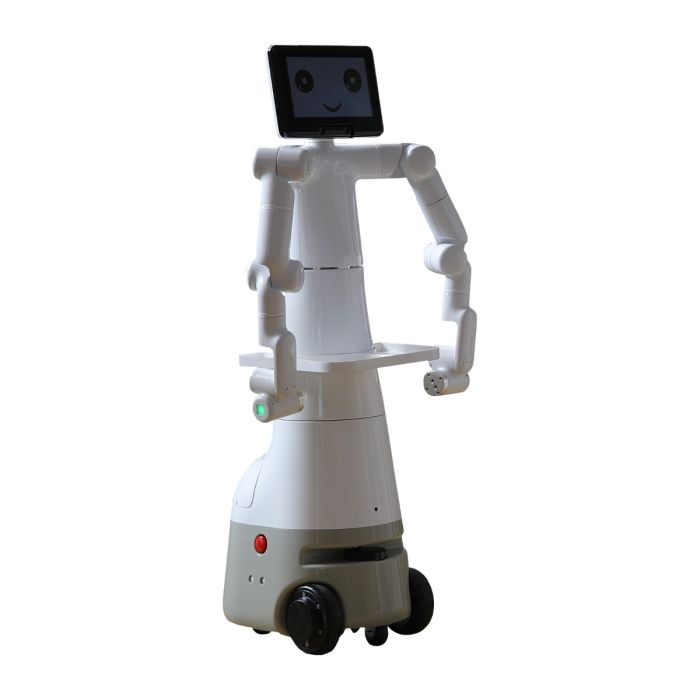
A large language model can describe a dozen ways to clear a cluttered table, yet very few laboratories own a machine that can then cross the room and actually do it. That gap between reasoning and acting is where embodied intelligence research lives, and it is precisely the gap the Elephant Robotics Mercury X1 Wheeled Humanoid Robot (4011300003) sets out to close. Rather than asking researchers to choose between a capable pair of arms and a platform that moves, it joins the two in one 1.18m tall body, with onboard AI compute, navigation sensors and a conversational interface, so that perception, planning and manipulation can be tested together in real rooms instead of in isolation on a bench.
Robots Middle East supplies the Mercury X1 to universities, research institutes, innovation centres, system integrators and enterprises across the Middle East. Our team prepares the quotation, coordinates delivery and customs clearance to your site, and remains your point of contact for technical questions and after-sales support once the robot is in service.
Background
Elephant Robotics and the Mercury series
Elephant Robotics is known to many developers for its compact robot arms and mobile platforms, including the myCobot and myAGV lines, which have made robot programming accessible in classrooms and research groups. The Mercury series extends that philosophy into humanoid form. The series comprises three versions: the Mercury A1, the Mercury B1 dual-arm robot, and the Mercury X1 described on this page. Each addresses a different level of the embodied intelligence problem, and the X1 is the version that brings full mobility to the dual-arm upper body.
A modular body: dual arms on a mobile base
The Mercury X1 is composed of the Mercury B1 dual-arm robot mounted on a high-performance mobile base. This modular construction matters in practice: the upper body brings coordinated two-handed manipulation, while the base brings direct drive motors, a maximum running speed of 1.2m/s, and the ability to handle a 2CM step and a 15° incline. Together they give a total of 19DOF. Control is split sensibly between a Jetson Orin Nano SUPER 8GB main controller delivering 67 TOPS of AI performance and an ESP32 sub controller for the arms, so heavy perception and inference workloads run on the main computer while low-level arm control stays on dedicated hardware.
Technical Specifications
| Specification | Value |
|---|---|
| Product type | Wheeled dual-arm humanoid robot for embodied intelligence applications |
| Composition | Mercury B1 dual-arm robot + high-performance mobile base |
| Degrees of freedom | 19DOF |
| Product height | 1.18m |
| Net weight | 55KG |
| Working voltage | 24V |
| Battery life | 8 hours |
| Maximum payload | 1KG |
| Repeatability | ± 0.05mm |
| Maximum operating speed | 1.2m/s |
| Maximum climbing angle | 15° |
| Maximum climbing height | 2CM |
| Storage space | 15L |
| Main control | Jetson Orin Nano SUPER 8GB |
| AI performance | 67 TOPS |
| Arm sub controller | ESP32 |
| Mobile sensors | LIDAR, Ultrasonic Radar, 2D Vision |
| Screen | 9-inch Touching Screen |
| Microphone | Line array 4 microphones, 5m 180° pickup |
| Communication | WIFI / Network port / Bluetooth / USB serial port |
| IO | 24V 6 Input, 6 Output |
| ROS support | ROS1 and ROS2, with RVIZ simulation environment support |
| Operating systems | Windows, Linux, MAC |
Specifications are as published by the manufacturer and are confirmed against the datasheet at quotation.
The manufacturer has not published the battery capacity, charging time, IP rating, package contents, arm reach, operating temperature, power consumption or chassis dimensions; we confirm these with you at quotation.
How does the Mercury X1 differ from the Mercury B1?
The simplest way to understand the X1 is as the B1 given legs, or rather wheels. The Mercury B1 is the dual-arm upper body; the X1 takes that same upper body and mounts it on a high-performance mobile base. The consequence is a change in what kind of research becomes possible. A stationary dual-arm system is excellent for studying grasping, bimanual coordination and teleoperation at a fixed workstation. Once the arms can travel, the questions broaden to include navigation, mapping, approaching objects from different angles and completing multi-step tasks that span a whole room.
The base contributes more than motion. It carries the LIDAR, ultrasonic radar and 2D vision used for mobile perception, provides 15L of storage space, and supports an 8 hour battery life, which allows long demonstration sessions or extended data-collection runs without being tethered to a power socket. For a team whose work is strictly tabletop, the B1 remains the more focused choice; for a team that needs the robot to move between stations, rooms or exhibition spaces, the X1 is the version built for that.
What can the Mercury X1 run on board?
Embodied intelligence depends on running perception and decision-making close to the hardware, and the X1 is equipped for that. Its Jetson Orin Nano SUPER 8GB main controller delivers 67 TOPS of AI performance, enough headroom for vision models, speech processing and navigation stacks to run locally rather than relying solely on a remote workstation. Interaction is handled through a 9-inch touchscreen and a line array of 4 microphones with 5m 180° pickup, which suits voice-driven tasks and public-facing demonstrations.
On the software side, the robot supports both ROS1 and ROS2 and provides RVIZ simulation environment support, so existing ROS workflows can be carried over and behaviour can be visualised before it is executed. Windows, Linux and MAC are supported for development, while WIFI, a network port, Bluetooth and a USB serial port cover connectivity. The 24V IO with 6 inputs and 6 outputs allows the robot to trigger or respond to external equipment such as sensors, indicators or simple fixtures in a test cell.
Who is the Mercury X1 for?
The primary audience is university departments and research laboratories working on embodied AI, mobile manipulation and human-robot interaction. For these groups the X1 offers a single platform on which perception, language, navigation and manipulation can be studied together, using familiar ROS tooling. Corporate innovation teams and AI developers form a second group: those building service robot concepts, retail or hospitality assistants, or proof-of-concept applications for stakeholders will find the combination of mobility, touchscreen and voice pickup well suited to live demonstration.
Educational institutions and technology centres that run advanced robotics programmes are a third segment, particularly where students need to progress from simulation in RVIZ to work on real hardware. Finally, system integrators exploring humanoid platforms for client pilots can use the X1 to evaluate workflows before committing to larger deployments.
Buyers whose work does not require mobility should consider the Mercury B1, the dual-arm upper body on which the X1 is built. Those comparing the wider field can browse our Wheeled Humanoids and Humanoids categories.
What is the Mercury X1 used for?
- Embodied AI research: connecting vision and language models to physical action in real environments.
- Mobile manipulation studies: combining navigation and dual-arm grasping in multi-step tasks across a room.
- Human-robot interaction: testing voice and touchscreen interfaces with people in shared spaces.
- Robotics education: teaching ROS1 and ROS2 development from RVIZ simulation through to real hardware.
- Service robot prototyping: developing reception, guidance or assistance concepts before commercial roll-out.
- Exhibitions and showcases: presenting interactive AI demonstrations at innovation centres, events and open days.
Pricing and Availability
Pricing for the Mercury X1 is provided by quotation, so that the offer reflects your configuration, software requirements and intended application. Delivery to your site, customs clearance and technical support are arranged together with the quotation. To begin, please use the quotation request available on this page.
Frequently Asked Questions
How many degrees of freedom does the Mercury X1 have?
The Mercury X1 has 19DOF across its dual-arm upper body and mobile base.
What computer controls the Mercury X1?
The main controller is a Jetson Orin Nano SUPER 8GB delivering 67 TOPS of AI performance, with an ESP32 sub controller for the arms.
Does the Mercury X1 support ROS?
Yes. It supports both ROS1 and ROS2 and provides RVIZ simulation environment support.
How long does the battery last?
Battery life is 8 hours, which allows extended sessions away from a power socket.
Can the Mercury X1 handle slopes and small steps?
The mobile base manages a maximum climbing angle of 15° and a maximum climbing height of 2CM, with a maximum operating speed of 1.2m/s.
What sensors does it use for navigation?
The mobile base uses LIDAR, ultrasonic radar and 2D vision for perception and obstacle awareness.
Where can I buy the Mercury X1 and what does it cost?
You can buy the Mercury X1 from Robots Middle East, which supplies it across the Middle East. Pricing is given by quotation, which you can request on this page, together with delivery, customs and support arrangements.
Summary
Embodied intelligence asks machines not only to understand a task but to carry it out where it happens. The Mercury X1 answers that demand by placing the Mercury B1 dual-arm robot on a mobile base, adding 67 TOPS of onboard compute, LIDAR-based navigation, voice pickup and a touchscreen, and opening it all to ROS1 and ROS2 development. For laboratories, educators, innovation teams and integrators who want their AI to leave the screen and act in the room, Robots Middle East supplies, delivers and supports the X1 across the region, and this page is the starting point.