
Linkerbot Linker Hand 06
In stock
- BRAND:
- LINKERBOT
- MODEL:
- LINKER HAND 06
- ORIGIN:
- China
- AVAILABILITY:
- SUBJECT TO AVAILABILITY
- SKU:
- Linkerbot-Linker-Hand-06
Linkerbot Linker Hand 06
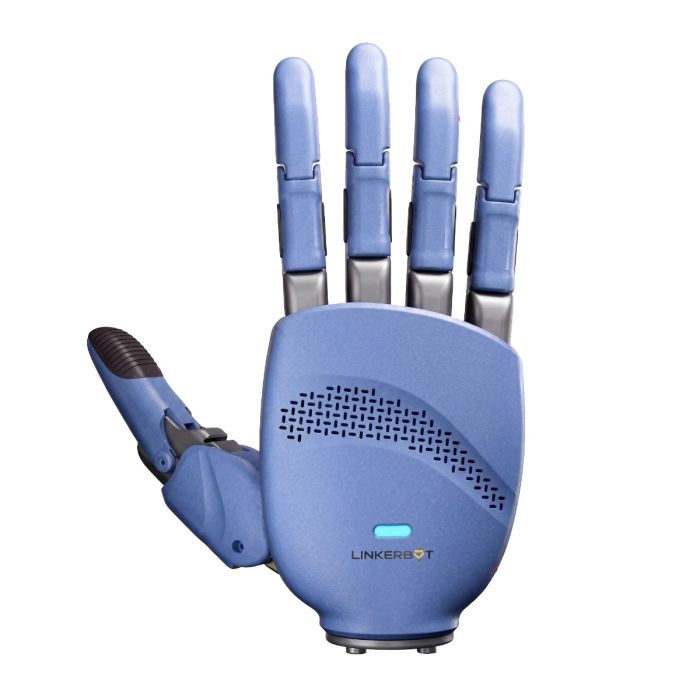
Engineers who build robot hands often say that the fingers are the easy part; it is the thumb that decides whether a hand can hold anything at all. Opposition, the thumb swinging round to meet the fingertips, is what turns a row of curling digits into a grip that can pinch a small component, cradle a bottle or close firmly around a tool handle. The Linkerbot Linker Hand 06 starts from that problem. It pairs a thumb that swings sideways as well as bending with four linkage-driven fingers, in a hand that weighs 360g and is intended to be mounted on a robot arm, a humanoid or a mobile manipulator.
Robots Middle East supplies the Linkerbot Linker Hand 06 to universities, research institutes, system integrators and industrial users throughout the Middle East. Our team prepares each quotation, arranges delivery to your site and remains available for technical support after installation, so that the hand arrives with the interface and hand side your project actually requires.
Background
Linkerbot and its focus on dexterous manipulation
Linkerbot, known in Chinese as 灵心巧手, describes itself as a global leader in dexterous hands, working under the mission of "creating everything". The company concentrates on embodied-intelligence solutions for dexterous manipulation: the hardware and control that allow a robot not merely to move towards an object, but to handle it with something approaching human skill. The Linker Hand 06, which appears in the manufacturer's literature as the Linker Hand O6, is one member of a wider family of hands; the complete line-up is gathered on our Linkerbot brand page.
That focus matters for buyers. A company whose core business is the hand itself tends to treat the end-effector as a platform for research and product development rather than as an accessory to an arm, and the published specification of this model reflects that, with separate figures for thumb and finger speeds, fingertip forces and positioning repeatability.
Six driven joints and five that follow
The Linker Hand 06 has 6 active degrees of freedom and 5 passive degrees of freedom. The active joints are driven directly; passive joints carry no actuator of their own and, in a linkage design, move in step with the joints that drive them. This is how a hand can curl each finger through several knuckles without needing a motor for every joint, keeping mass and control complexity down while preserving a natural closing motion.
Power reaches the fingers through a linkage transmission, that is, rigid mechanical links rather than cables or tendons. Linkage-driven hands are generally valued for their stiffness and for the predictable relationship between actuator position and fingertip position, which is useful when a controller must repeat the same grasp many thousands of times. The thumb has its own side-swing motion in addition to bending, which is what gives the hand its opposing grip.
Technical Specifications
| Specification | Value |
|---|---|
| Degrees of freedom | 6 active + 5 passive |
| Transmission | Linkage transmission |
| Control interface | CAN/CAN FD/RS485/ECAT |
| Weight | 360g |
| Maximum load | 50kg |
| Operating voltage | 24V-48V |
| Repeat positioning accuracy | <±0.20mm |
| Tactile sensor | Optional |
| Maximum thumb fingertip force | 20N |
| Maximum four-finger fingertip force | 25N |
| Maximum five-finger grip force | 70N |
| Four-finger bending angle | 1.61rad (92.59°) |
| Thumb side-swing speed | 1.36rad/s (78.10°/s) |
| Four-finger bending speed | 1.30rad/s (74.75°/s) |
| Thumb bending speed | 0.66rad/s (38°/s) |
Specifications are as published by the manufacturer and are confirmed against the datasheet at quotation.
The manufacturer has not published the static current, the operating temperature, the ingress protection (IP) rating, the resolution of the optional tactile sensor or the dimensions with the wrist flange; these are confirmed at quotation.
What sets the Linker Hand 06 apart from a parallel-jaw gripper?
A parallel-jaw gripper closes two flat surfaces on an object and relies on friction between them. That works well for boxes and machined parts, but it struggles with round, soft or irregular items, and it cannot reposition what it holds. The Linker Hand 06 wraps its fingers around the object instead. Its four fingers bend through 1.61rad (92.59°), and its thumb swings across to oppose them, so the contact is spread over several fingertips and the palm rather than concentrated on two pads.
The force figures show how that grip is distributed. Each of the four fingers can deliver a maximum fingertip force of 25N, the thumb 20N, and all five fingers together a maximum grip force of 70N. For precision work, the repeat positioning accuracy of <±0.20mm means a learned grasp can be reproduced closely from one cycle to the next, which is important both for automation and for collecting consistent training data.
Speed is split between the digits. The fingers bend at 1.30rad/s (74.75°/s) and the thumb swings sideways at 1.36rad/s (78.10°/s), while thumb bending runs at 0.66rad/s (38°/s). In practice, the thumb can move quickly into an opposing position and then close more deliberately, a sequence that suits grasp planning in which the approach and the final squeeze are handled as separate stages.
Weight is the other consideration. Every gram at the end of an arm reduces the payload available for the object itself, and at 360g the hand leaves more of the arm's capacity for useful work than heavier multi-finger designs generally do.
Which version should I choose: CAN or RS-485, left or right?
The Linker Hand 06 is offered as a left-hand and a right-hand version, and with a CAN interface or an RS-485 interface. The hand side follows the application: a single-arm cell can use either, while a bimanual platform or humanoid needs a matched left and right pair. The manufacturer lists the control interface as CAN/CAN FD/RS485/ECAT, so teams planning to use CAN FD or EtherCAT should state this when requesting a quotation.
As a general guide, CAN is widely used on robot arms and humanoid platforms where several joints share one bus, while RS-485 is common in embedded controllers and industrial automation. The operating voltage of 24V-48V covers both of the DC supply levels most often found on robot platforms, which simplifies wiring in many cells.
Who is the Linkerbot Linker Hand 06 for?
The first group is research laboratories working on embodied intelligence, imitation learning and grasp planning. A hand with a known joint layout, published speeds and repeatable positioning gives these teams a stable platform on which to gather data and test control policies. The optional tactile sensor makes the hand relevant to contact-rich research, in which the robot must sense pressure as well as command position.
The second group is humanoid and mobile-manipulation developers, for whom the left and right versions and the low weight are practical advantages. The third is system integrators building pilot automation cells for handling tasks that defeat two-jaw grippers, such as mixed-shape items or tools that must be held as a person holds them. Finally, universities and technical colleges across the region can use the hand in teaching robotics, mechatronics and control.
Buyers who need a different finger count, drive method or configuration can compare the alternatives in our Robot Hands category, and Robots Middle East will advise on which model matches the brief.
What is the Linkerbot Linker Hand 06 used for?
- Embodied-AI research — a repeatable, sensor-ready hand for training and evaluating manipulation policies.
- Humanoid robots — matched left and right hands to give a humanoid platform opposing grasps.
- Teleoperation and data collection — mirroring an operator's hand movements to record demonstrations for learning.
- Pilot handling cells — gripping irregular or rounded items that a parallel-jaw gripper cannot hold securely.
- Tactile and grasp-stability studies — with the optional tactile sensor fitted, investigating how contact forces develop during a grasp.
- Teaching and demonstration — illustrating linkage mechanisms, active and passive joints and bus-based control in the laboratory.
Pricing and Availability
Robots Middle East supplies the Linkerbot Linker Hand 06 on quotation, so that the hand side, the interface and the tactile sensor option can be specified correctly for your project before the order is placed. Delivery, customs clearance and after-sales support are arranged together with your quotation. To begin, please tell us about your robot platform, the controller you intend to use and the objects you plan to handle; the quotation request for the Linkerbot Linker Hand 06 is available on this page.
Frequently Asked Questions
Is the Linker Hand 06 the same product as the Linker Hand O6?
Yes. The manufacturer's literature writes the model as Linker Hand O6, and its versions are named Linker Hand O6 (Left) and Linker Hand O6 (Right).
How many degrees of freedom does the hand have?
It has 6 active degrees of freedom and 5 passive degrees of freedom. The passive joints are moved by the linkage transmission rather than by actuators of their own.
What grip force can it deliver?
The maximum five-finger grip force is 70N. The maximum fingertip force is 25N for each of the four fingers and 20N for the thumb.
Which control interfaces are available?
The control interface is listed as CAN/CAN FD/RS485/ECAT, and the hand is offered in CAN and RS-485 interface versions. Please state your preferred interface when requesting a quotation.
Does the hand include tactile sensing?
The tactile sensor is optional, so the hand can be ordered with or without it to suit your application.
What power supply does it need?
The operating voltage is 24V-48V, which covers the DC supply levels most commonly used on robot platforms.
Where can I buy the Linkerbot Linker Hand 06 and what does it cost?
You can buy it from Robots Middle East, which supplies the hand across the Middle East. The cost depends on the version and options you choose, so we prepare a quotation for your configuration; please request one on this page.
Summary
A robot hand is judged by its thumb, and the Linkerbot Linker Hand 06 is designed around one that swings into opposition and closes against four linkage-driven fingers. Six active and five passive degrees of freedom, a 70N five-finger grip, repeatable positioning and a weight of 360g make it a practical choice for laboratories, humanoid developers and integrators who need a hand that grasps rather than pinches. With left and right versions, a choice of interfaces and an optional tactile sensor, it can be configured to the platform it will serve. For a quotation from Robots Middle East, with delivery and support arranged across the region, this page is the starting point.