
Linkerbot Linker Hand L10 Standard Version
In stock
- BRAND:
- LINKERBOT
- PART #:
- Linker Hand L10
- ORIGIN:
- China
- AVAILABILITY:
- SUBJECT TO AVAILABILITY
- SKU:
- Linkerbot-Linker-Hand-L10
Linkerbot Linker Hand L10 Standard Version
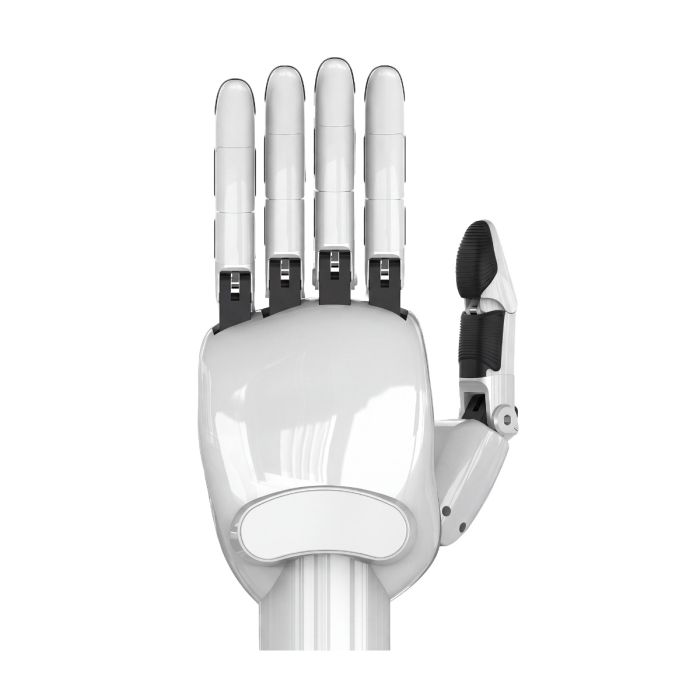
In simulation, a robot hand weighs nothing, draws no current and never has to be fitted to a real wrist. Once a grasping policy leaves the simulator for the laboratory bench, those details become the project itself: how heavy the hand is, what voltage it expects, which bus carries its commands and how reliably its fingers return to the same point. The Linkerbot Linker Hand L10 Standard Version is a ten-degree-of-freedom dexterous hand whose published figures answer each of those questions. That makes it a practical bridge between the hand a team trains in software and the hand it must eventually trust with real objects.
Robots Middle East supplies the Linkerbot Linker Hand L10 Standard Version to universities, research institutes, system integrators and industrial innovation teams across the Middle East. Robots Middle East prepares each quotation, arranges delivery to the customer's site and provides technical support once the hand is in service. A team can therefore move from evaluation to its first physical grasp with a single, accountable point of contact.
Background
Linkerbot and the Linker Hand series
Linkerbot develops a family of dexterous hands under the Linker Hand name, ranging from compact models to industrial grippers and cable-driven designs, all of which can be found in the Linkerbot range. The product manual for the Linker Hand L10B, a variant named alongside the Linker Hand L10 in the manufacturer's documentation, identifies Linkerbot Beijing Technology co., Ltd as the manufacturer. Within this family, the L10 sits as a multi-jointed, five-fingered hand intended to be mounted on a robot arm and controlled as part of a wider manipulation system, rather than operated as a stand-alone device.
Worm gear transmission and layered control
The L10 uses a worm gear transmission. Worm drives are widely used in compact actuators because they achieve a large reduction in a small space, which suits the tight packaging of a hand where every finger needs its own drive. On top of this mechanism, the hand offers position control, speed control and haptic feedback in the form of force control through fingertip sensors, together with online firmware upgrade. For a research team, that combination matters: position and speed control cover scripted and learned motions, while fingertip force feedback allows a grasp to respond to contact rather than simply reaching a commanded pose.
Technical Specifications
| Specification | Value |
|---|---|
| Degrees of freedom | 10 |
| Number of joints | 20 (10 Active + 10 Passive) |
| Transmission | Worm Gear Transmission |
| Control interface | CAN/RS485 |
| Weight | 800g |
| Maximum load | 25kg |
| Operating voltage | DC24V+/-10% |
| Maximum current | 3A |
| Repeat positioning accuracy | < +/-0.2mm |
| Opening/closing time | 1.2s |
| Maximum five-finger grasping force | 80N |
| Maximum thumb fingertip force | 15N |
| Control modes | Position control, speed control, haptic feedback (force control) via fingertip sensors, online firmware upgrade |
| Supported robotic arms | UR, Franka, XArm, RealMan, AgileX |
| Supported simulators | Pybullet, Isaac, MuJoCo |
| In the box | Linker Hand L10 x1; USB-to-CAN Debugging Cable x1; Connector Cable XT30 (2+2) x1; Power Adapter x1; Power Cable x1 |
Specifications are as published by the manufacturer and are confirmed against the datasheet at quotation.
The manufacturer has not published the dimensions, the IP rating, the operating temperature range or the service life of the hand; these are confirmed at quotation.
What do ten active and ten passive joints mean in practice?
The L10 has 20 joints, of which 10 are active and 10 are passive, giving 10 degrees of freedom. In dexterous hand design generally, an active joint is driven directly by an actuator, while a passive joint moves in relation to the driven joints rather than under its own motor. The practical effect is a finger that bends through more than one segment, closer to the way a human finger curls, without the hand having to carry a separate drive for every joint.
For the engineer, this shapes the control problem. Ten independently commanded degrees of freedom are enough to form distinct grasps and to position the thumb against the fingers, yet the number of channels to coordinate remains manageable for teleoperation, scripted motion or a learned policy. Combined with a published repeat positioning accuracy of < +/-0.2mm and an opening/closing time of 1.2s, the hand is described in terms a test plan can use directly: how far it may deviate on return to a pose, and how long a full cycle takes.
Force figures complete the picture. The maximum five-finger grasping force is 80N and the maximum thumb fingertip force is 15N, while the maximum load is 25kg. Together with fingertip force control, these values give a team clear boundaries for planning which objects to attempt and how firmly to hold them.
How does the Linker Hand L10 fit onto an existing robot arm?
Integration starts with the arm. The supported robotic arms are UR, Franka, XArm, RealMan and AgileX, which covers many of the collaborative and research arms already found in laboratories. At 800g, the hand's weight is a known quantity that can be entered into the arm's payload calculation from the outset.
Electrically, the hand runs on DC24V+/-10% with a maximum current of 3A, and it communicates over CAN/RS485. The package includes a USB-to-CAN Debugging Cable, a Connector Cable XT30 (2+2), a Power Adapter and a Power Cable, so a developer can power the hand and talk to it from a workstation before it is ever mounted on an arm. That bench-first approach is useful in practice: firmware can be updated online, control modes can be tested and fingertip feedback can be checked in isolation, which reduces the number of unknowns when the hand finally joins the full system.
On the software side, support for Pybullet, Isaac and MuJoCo allows grasping strategies to be developed and tested in simulation before they are run on hardware, which is precisely where the gap between virtual and physical hands is narrowed.
Who is the Linkerbot Linker Hand L10 Standard Version for?
The first audience is university and institute laboratories working on embodied AI, reinforcement learning and imitation learning. For these groups, simulator support and a bench-testable control interface shorten the path from a trained policy to a physical trial.
The second is teams collecting manipulation data through teleoperation. A hand with position, speed and force control modes and a published repeatability figure gives consistent behaviour across long recording sessions.
The third is system integrators and industrial innovation units building pilot cells on supported arms, where a dexterous hand is being assessed as an alternative to a simple gripper for handling varied parts.
Finally, technical education programmes can use the hand to teach multi-fingered manipulation on hardware that connects to familiar arms and simulators.
Buyers who are still comparing approaches may also wish to review the wider Robot Hands category, including the Linkerbot Linker Hand L20 Pro Version and the Linkerbot Linker Hand L30 Cable Driven Version. Robots Middle East can advise on which hand best matches a particular task once its requirements are known.
What is the Linkerbot Linker Hand L10 Standard Version used for?
- Sim-to-real research: transferring grasping policies developed in Pybullet, Isaac or MuJoCo onto a physical hand.
- Teleoperation data collection: recording human-guided manipulation to build training datasets for learning-based control.
- Force-aware grasping studies: using fingertip force control to investigate how a grasp adapts to contact.
- Humanoid and mobile manipulation development: giving a robot platform an anthropomorphic hand for tasks designed around human tools and objects.
- Pilot automation cells: evaluating dexterous handling of varied parts on UR, Franka, XArm, RealMan or AgileX arms.
- Teaching and training: demonstrating multi-fingered manipulation and CAN/RS485 control in university and technical courses.
Pricing and Availability
Robots Middle East supplies the Linkerbot Linker Hand L10 Standard Version on a quotation basis, so that the configuration, accessories and support match the intended project. Delivery, customs clearance and technical support are all arranged together with the quotation. To begin, please share your target arm, application and timeline, and request your quotation using the form available on this page.
Frequently Asked Questions
How many degrees of freedom does the Linker Hand L10 have?
The hand has 10 degrees of freedom across 20 joints, of which 10 are active and 10 are passive.
Which control interface does the hand use?
The hand is controlled over CAN/RS485. A USB-to-CAN Debugging Cable is included, allowing it to be connected to a computer for setup and testing.
Which robot arms is the hand compatible with?
The supported robotic arms are UR, Franka, XArm, RealMan and AgileX. Robots Middle East can confirm the mounting details for your specific arm at quotation.
Can I develop my application in simulation first?
Yes. The supported simulators are Pybullet, Isaac and MuJoCo, so grasping strategies can be prepared before they run on the physical hand.
How much force can the hand apply?
The maximum five-finger grasping force is 80N and the maximum thumb fingertip force is 15N. The maximum load is 25kg.
What is included in the box?
The package contains the Linker Hand L10, a USB-to-CAN Debugging Cable, a Connector Cable XT30 (2+2), a Power Adapter and a Power Cable.
Where can I buy the Linkerbot Linker Hand L10 Standard Version and what does it cost?
You can buy it from Robots Middle East, which supplies customers across the Middle East. The cost depends on your configuration and project requirements, so please request a quotation through this page.
Summary
A grasp that works in simulation must eventually meet real weight, real current and real contact. The Linkerbot Linker Hand L10 Standard Version brings those realities into view early: its weight, power requirements, control interface, repeatability, timing and force limits are all published, while support for Pybullet, Isaac and MuJoCo keeps the virtual and physical versions of the hand closely aligned. With ten degrees of freedom, a worm gear transmission, fingertip force control and compatibility with widely used research arms, it gives laboratories and integrators a well-defined step from model to hardware. Supplied, delivered and supported by Robots Middle East, it is ready to join your next manipulation project, and this page is the starting point.