
Linkerbot Linker Hand L20 Pro Version
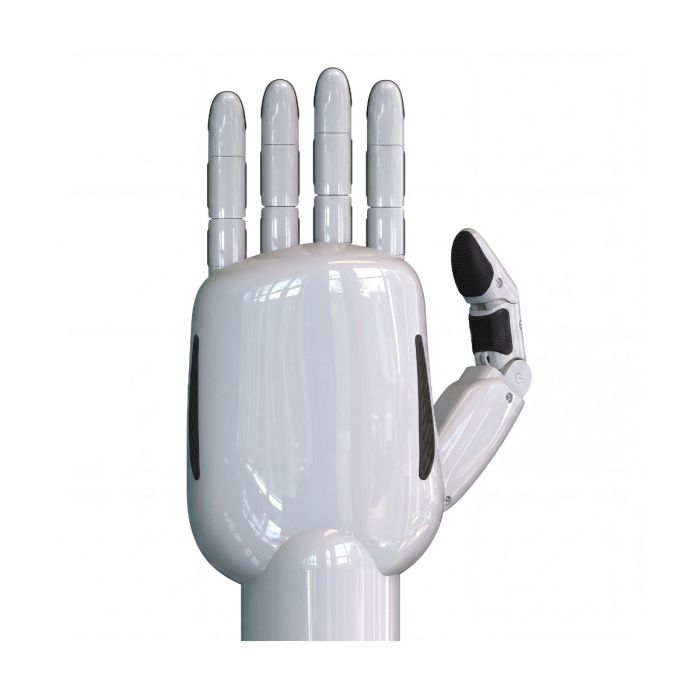
In stock
- BRAND:
- LINKERBOT
- PART #:
- Linker Hand L20
- ORIGIN:
- China
- AVAILABILITY:
- SUBJECT TO AVAILABILITY
- SKU:
- Linkerbot-Linker-Hand-L20
Linkerbot Linker Hand L20 Pro Version
Not every joint in a human hand has a muscle of its own. Several simply follow their neighbours, and that economy is part of what makes a hand capable without making it heavy. The Linkerbot Linker Hand L20 Pro Version applies a similar logic to robotics. Its manufacturer specifies 16 active and 5 passive degrees of freedom, driven by an in-house joint module, in a hand that weighs ≈1200g and is rated for a 20kg maximum load. For engineers deciding how to give a humanoid platform or a robot arm genuine dexterity, the balance between powered joints and following joints is the first thing to understand about this hand.
Robots Middle East supplies the Linkerbot Linker Hand L20 Pro Version to universities, research institutes, system integrators and industrial users across the Middle East. Our team prepares each quotation around the configuration you require, coordinates delivery to your facility and remains your point of contact for technical questions once the hand is in service.
Background
Linkerbot and its origins
Linkerbot, known in Chinese as 灵心巧手, is a robotics company founded in 2023 by Zhou Yong (Alex Zhou). Although young, the company has concentrated on a single, demanding problem: the dexterous robot hand. Its Linker Hand family spans several models and formats, from compact hands intended for research benches to designs aimed at industrial duty. The L20 sits within that family alongside an L20 Lite, while the name Linker Hand L20 Pro Version is the designation used by resellers for the L20 offered here.
This focus matters for buyers. A company that builds hands, rather than complete robots, tends to design its products as end-effectors that must fit onto someone else's arm or humanoid, speak an established communication protocol and accept common power supplies. The L20 reflects that orientation in its choice of interfaces and its voltage range.
Joint modules and a mix of active and passive freedom
The manufacturer states that the L20 is driven by a self-developed joint module rather than an off-the-shelf actuator package. Designing the joint module in-house gives a hand maker control over how force, size and responsiveness are balanced within each finger, which is where a dexterous hand either succeeds or fails.
The second defining choice is the split between 16 active and 5 passive degrees of freedom. Active joints are individually powered and commanded; passive joints move in response to their neighbours or to contact with an object. Combining the two allows a hand to conform naturally around irregular shapes while keeping the number of powered axes, and therefore the control effort and weight, within practical limits.
Technical Specifications
| Specification | Value |
|---|---|
| Degrees of freedom | 16 active + 5 passive |
| Drive | In-house joint module |
| Control interface | CAN/RS485 |
| Weight | ≈1200g |
| Maximum load | 20kg |
| Operating voltage | DC 24V—48V |
| Static current | 0.3A |
| Maximum current | 1.8A |
| Maximum grip force (five fingers) | 100N |
| Maximum thumb fingertip force | 15N |
| Maximum four-finger fingertip force | 20N |
| Four-finger bending angle | 1.22rad(69.9°) |
Specifications are as published by the manufacturer and are confirmed against the datasheet at quotation. The manufacturer has not published an IP rating, an operating temperature range or a list of in-the-box contents; these are confirmed at quotation.
An earlier edition of the L20 product manual, as circulated by resellers, lists a weight of 1100g for the left hand and a piezoresistive tactile array of 6*12, with a capacitive sensor offered as an option.
How do 16 active and 5 passive degrees of freedom work together?
A simple two-jaw gripper has one task: close until it meets resistance. A hand with sixteen powered joints has many more choices, and that is precisely its value. Individual fingers can be positioned independently, the thumb can oppose different fingers, and the hand can switch between a power grasp around a large object and a fingertip pinch on a small one without a tool change.
The five passive degrees of freedom complement this. Rather than requiring every joint to be calculated and commanded, passive joints let parts of the finger settle against the surface of an object. In practice this means the controller decides the intent of the grasp while the mechanics handle part of the fine conformity. For research teams, it also offers an interesting platform for studying how much of dexterity belongs in software and how much can be delegated to structure.
The four-finger bending angle of 1.22rad(69.9°) describes the range through which the fingers curl, which shapes the size of object the hand can wrap around securely. Together with the mix of joints, it defines the working envelope that integrators should model before committing to a cell layout or a grasp library.
Is the Linker Hand L20 Pro Version strong enough for industrial handling?
Dexterous hands are often assumed to be delicate laboratory instruments. The published figures for the L20 argue otherwise. The manufacturer lists a 100N maximum grip force across five fingers and a 20kg maximum load, alongside fingertip forces of 20N for the four fingers and 15N for the thumb. The distinction is useful: whole-hand grip governs how firmly a part is held, while fingertip force governs pinching, pressing and fine manipulation.
Electrical integration points the same way. An operating voltage of DC 24V—48V falls within the range commonly found in industrial automation and mobile robot platforms, and the static current of 0.3A rising to a maximum of 1.8A gives integrators clear numbers for sizing supplies and cabling. CAN and RS485 are both long-established buses in automation, which makes it easier to bring the hand onto an existing controller or robot arm without exotic interface hardware.
What the figures do not settle is environmental suitability. Because no IP rating or operating temperature has been published, buyers planning deployment in dusty, humid or hot settings should raise those conditions with Robots Middle East during quotation.
Who is the Linkerbot Linker Hand L20 Pro Version for?
The first audience is the research laboratory. Universities and institutes working on manipulation, embodied intelligence or human-robot interaction need a hand with enough active joints to reproduce human-like grasps, and the L20 provides that without the bulk of a far heavier system.
The second is the humanoid developer. Teams building full-body or upper-body humanoid robots need end-effectors that combine dexterity with a manageable weight and a standard communication link, which the L20's CAN/RS485 interface and published electrical figures support.
System integrators and industrial automation teams form the third group. Where a production task involves varied parts, re-grasping or handling that a parallel gripper cannot manage, a multi-fingered hand with a 20kg maximum load becomes a realistic option worth evaluating in a pilot cell.
Finally, educators and developers in assistive and care robotics will find the hand relevant, since the manufacturer names education, household assistance and care among its intended fields.
Buyers still comparing formats can review the full Robot Hands category or the wider Linkerbot range. Those interested in a different actuation architecture may wish to compare the Linkerbot Linker Hand L30 Cable Driven Version, and those exploring the family's other entry points can look at the Linkerbot Linker Hand L10 Standard Version. Robots Middle East is glad to help you match the model to the task.
What is the Linkerbot Linker Hand L20 Pro Version used for?
- Education and teaching laboratories: giving students hands-on experience of multi-joint control, kinematics and grasp planning.
- Manipulation research: studying in-hand manipulation, grasp strategies and the interplay of active and passive joints.
- Industrial automation: handling varied or awkward parts in cells where a simple gripper falls short.
- Humanoid robot integration: serving as the end-effector on humanoid and upper-body robot platforms.
- Household assistance: developing robots that open, carry and arrange everyday objects in domestic settings.
- Care and rehabilitation robotics: prototyping assistive systems for elderly care and nursing environments.
Pricing and Availability
Robots Middle East provides the Linkerbot Linker Hand L20 Pro Version on a quotation basis, so that the offer reflects the configuration, quantity and integration support your project requires. Delivery, customs clearance and after-sales support are arranged together with your quotation. To begin, please send us your application details and preferred configuration using the quotation request available on this page.
Frequently Asked Questions
How many degrees of freedom does the Linker Hand L20 Pro Version have?
The manufacturer specifies 16 active degrees of freedom and 5 passive degrees of freedom. The active joints are driven by Linkerbot's in-house joint module.
Which control interfaces does the hand support?
The L20 is controlled over CAN/RS485. Both are well-established buses in automation, which simplifies integration with existing controllers and robot arms.
What power supply does the hand require?
The operating voltage is DC 24V—48V. The manufacturer lists a static current of 0.3A and a maximum current of 1.8A.
How much can the hand grip and hold?
The published maximum load is 20kg and the maximum five-finger grip force is 100N. Fingertip forces are 20N for the four fingers and 15N for the thumb.
Does the hand include tactile sensing?
An earlier edition of the L20 product manual lists a 6*12 piezoresistive tactile array, with a capacitive sensor as an option. The manufacturer's current page does not list tactile sensing, so the sensor configuration of your unit is confirmed in the quotation.
Is an IP rating or operating temperature published?
Neither has been published by the manufacturer. If your application involves demanding environmental conditions, Robots Middle East will confirm suitability during quotation.
Where can I buy the Linkerbot Linker Hand L20 Pro Version and what does it cost?
You can obtain the hand from Robots Middle East, which supplies customers across the Middle East. Pricing depends on configuration and project scope, so please request a quotation and our team will respond with a tailored offer.
Summary
The human hand achieves its versatility partly by not powering every joint, and the Linkerbot Linker Hand L20 Pro Version follows the same principle with 16 active and 5 passive degrees of freedom. Built around an in-house joint module and weighing ≈1200g, it pairs fingertip precision with a 100N grip and a 20kg maximum load, while CAN/RS485 control and a DC 24V—48V supply keep integration grounded in familiar automation practice. Whether your work lies in a research laboratory, a humanoid programme or a production cell, Robots Middle East can help you evaluate the hand against your task, and this page is the starting point.