
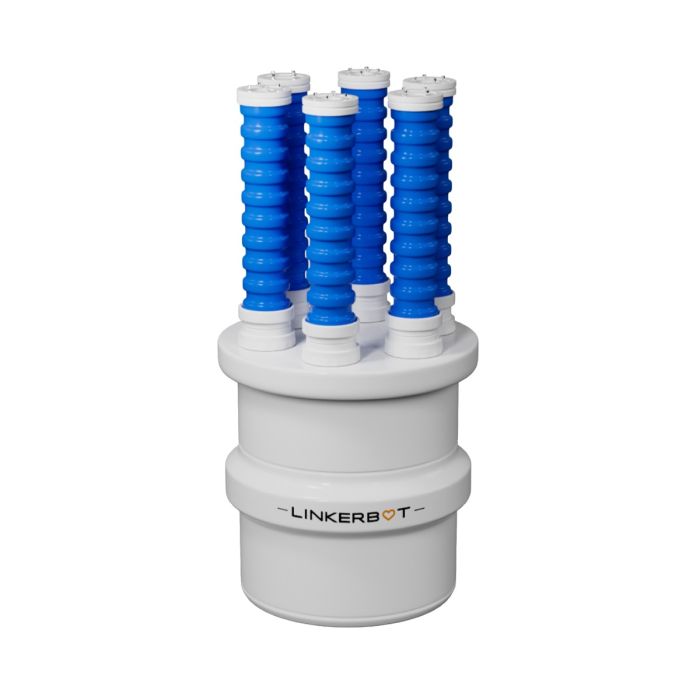
Linkerbot Linker Hand J42 Industrial Grade 6 Finger Claw
In stock
- BRAND:
- LINKERBOT
- PART #:
- Linker Hand J42
- ORIGIN:
- China
- AVAILABILITY:
- SUBJECT TO AVAILABILITY
- SKU:
- Linkerbot-Linker-Hand-J42
Linkerbot Linker Hand J42 Industrial Grade 6 Finger Claw
Inside the human forearm, muscles pull on long tendons, and the fingers move at the far end of those cords. Engineers have borrowed the same idea for decades, and the Linkerbot Linker Hand J42 Industrial Grade 6 Finger Claw takes it in a direction that nature never did: a rope-driven hand with six fingers, built for laboratories and development teams who need to study multi-finger control in far more depth than a simple gripper allows. Its value lies less in any single grasp than in the breadth of finger coordination it lets a team explore.
Robots Middle East sells the Linker Hand J42 to universities, research centres and industrial development teams across the Middle East. Robots Middle East prepares each quotation, arranges delivery into the region and remains the point of contact for technical support once the hand is in service.
Background
Linkerbot Technology and the Linker Hand series
The Linker Hand series is developed by Linkerbot Technology Co., Ltd. in China. The company builds high-degree-of-freedom, high-precision multi-finger robot hands and positions the series for three audiences: education, research and industry. Across the range, Linkerbot offers CAN, RS485 and USB communication and integration with ROS, the Robot Operating System that many laboratories already use to coordinate arms, sensors and planning software. The family spans several models, and buyers can see the wider line-up in the Robot Hands category.
Where the J42 sits in the range
Within that family, the J42 is the industrial multi-finger model with up to 42 degrees of freedom and a six-finger configuration. Linkerbot describes it as suited to research and experiments that require complex multi-finger control. That positioning matters: the J42 is not presented as a general-purpose pick-and-place tool but as an instrument for work in which the coordination of many contact points is itself the subject of study. Its drive method is rope, or cable, actuation, and its communication interface is USB.
Technical Specifications
| Specification | Value |
|---|---|
| Model | Linker Hand J42 |
| Configuration | Six-finger industrial multi-finger hand |
| Drive method | Rope (cable) drive |
| Communication interface | USB |
| Degrees of freedom | 18 to 42 |
| Joint configuration | Active 9 to 42 |
| Operating voltage | DC24V ±10% |
| Repeat positioning accuracy | ±0.20mm |
| Grip force (four fingers) | 5N |
| Grip force resolution | 0.7N |
Specifications are as published by the manufacturer and are confirmed against the datasheet at quotation.
Linkerbot has not published the weight, the dimensions, the maximum payload, the fingertip force per finger, any tactile sensing, the power consumption and current draw, the finger joint ranges and speeds, the contents of the box, the ingress protection rating, the operating temperature or the mounting interface; Robots Middle East confirms these details with each quotation.
What does a rope-driven design mean for the Linker Hand J42?
In a cable-driven hand, the fingers are moved by tensioned ropes rather than by an actuator sitting directly at every joint. The approach mirrors the tendons of the human hand, and in this class of robot hand it is generally chosen to keep the fingers slender and to allow many joints to be controlled within a compact form. For a hand with as many degrees of freedom as the J42, that architecture is a natural fit.
For a research team, the practical consequence is that the J42 should be treated as a precision instrument with its own control characteristics. Tendon-driven mechanisms in general call for attention to cable tension, calibration and the way motion couples between joints, and these are often topics of investigation in their own right. The J42 pairs this architecture with a repeat positioning accuracy of ±0.20mm and a grip force resolution of 0.7N, figures that indicate fine, repeatable control rather than brute strength. Its four-finger grip force of 5N confirms the same picture: this is a hand for dexterity studies and delicate manipulation, not for heavy handling.
How should the 18 to 42 degrees of freedom be read?
Linkerbot specifies the J42 with a range rather than a single number: 18 to 42 degrees of freedom, and an active joint configuration of 9 to 42. The headline figure of 42 therefore describes the upper end of what the model offers, not a fixed count for every unit. Because the configuration supplied affects both the control software and the experiments a team can run, the exact degree-of-freedom and active-joint count for a particular order is agreed with Robots Middle East when the order is specified.
For the buyer, the range is a planning question. A team studying basic multi-finger grasping may have different requirements from one researching in-hand manipulation with many independently actuated joints. Stating the intended experiments at the enquiry stage allows the configuration to be matched to the work, rather than discovered after delivery.
Who is the Linker Hand J42 for?
The J42 is aimed first at research groups. University robotics laboratories, national research centres and corporate innovation units investigating dexterous manipulation, grasp synthesis or learning-based control are the audience Linkerbot names when it describes the hand as suited to experiments needing complex multi-finger control. Across the Gulf and the wider Middle East, such groups increasingly work on embodied AI and humanoid robotics, and a high-degree-of-freedom hand gives them a platform on which to test ideas that simpler grippers cannot express.
Industrial development teams form a second audience. The J42 carries an industrial-grade designation, and engineers exploring whether multi-finger manipulation could replace bespoke tooling on a production line may use it to prototype handling strategies before committing to a final design. Systems integrators building demonstrators for clients are a third group, particularly where the demonstration depends on visible, complex finger motion.
Teams whose tasks need fewer joints, a different finger count or a different drive method may find another model in the series a closer match. The Linker Hand line also includes the Linkerbot Linker Hand L10 Standard Version, the Linkerbot Linker Hand L20 Pro Version and the Linkerbot Linker Hand L30 Cable Driven Version; Robots Middle East can set their specifications side by side with the J42 when a buyer is undecided.
What is the Linker Hand J42 used for?
- Multi-finger control research: studying how many coordinated joints can be commanded together to achieve stable, adaptable grasps.
- In-hand manipulation experiments: exploring how an object can be repositioned within the hand without releasing it.
- Grasp planning and learning: generating and testing grasp strategies for data-driven and reinforcement-learning approaches.
- Embodied AI and humanoid development: providing a dexterous end effector for platforms that learn to act in the physical world.
- Industrial prototyping: trialling multi-finger handling concepts for delicate or irregular parts before a production design is fixed.
- Teaching and training: giving engineering students hands-on experience of tendon-driven mechanisms and high-dimensional control.
Pricing and Availability
Robots Middle East supplies the Linker Hand J42 on a quotation basis, so that the degree-of-freedom configuration and the integration requirements can be agreed before an order is placed. Delivery, customs clearance and technical support are arranged together with the quotation. To begin, please describe your application and the robot or platform the hand will join, using the quotation request available on this page.
Frequently Asked Questions
Who manufactures the Linker Hand J42?
The J42 is made by Linkerbot Technology Co., Ltd., a Chinese company that develops the Linker Hand series of multi-finger robot hands for education, research and industry.
How many fingers does the J42 have?
The J42 has a six-finger configuration, which distinguishes it from five-fingered anthropomorphic designs.
How is the hand actuated?
The J42 uses a rope, or cable, drive, in which tensioned ropes move the finger joints in a manner comparable to tendons.
How does the J42 connect to a control computer?
The J42 communicates over USB. The Linker Hand series as a whole supports CAN, RS485 and USB and works with ROS, and Robots Middle East can advise on software integration for your configuration.
What power supply does it require?
The hand operates on DC24V ±10%.
Can it handle heavy objects?
The four-finger grip force is 5N, so the J42 is best suited to dexterity research and delicate manipulation rather than heavy handling.
Where can I buy the Linkerbot Linker Hand J42 Industrial Grade 6 Finger Claw and what does it cost?
Robots Middle East supplies the J42 across the Middle East on a quotation basis. Please submit your requirements through this page, and the quotation will set out the configuration, delivery and support for your project.
Summary
Like the tendons that carry the forearm's effort to the fingertips, the rope drive of the Linker Hand J42 serves one purpose: putting fine, coordinated control where the work happens. With six fingers, a degree-of-freedom range reaching 42, repeat positioning accuracy of ±0.20mm and a grip force resolution of 0.7N, it is an instrument for teams who want to understand and exploit complex multi-finger control rather than a gripper for routine handling. Robots Middle East matches the configuration to your research or development programme and supports the hand after delivery; for a quotation tailored to your work, this page is the starting point.